A Garden Among Ruins
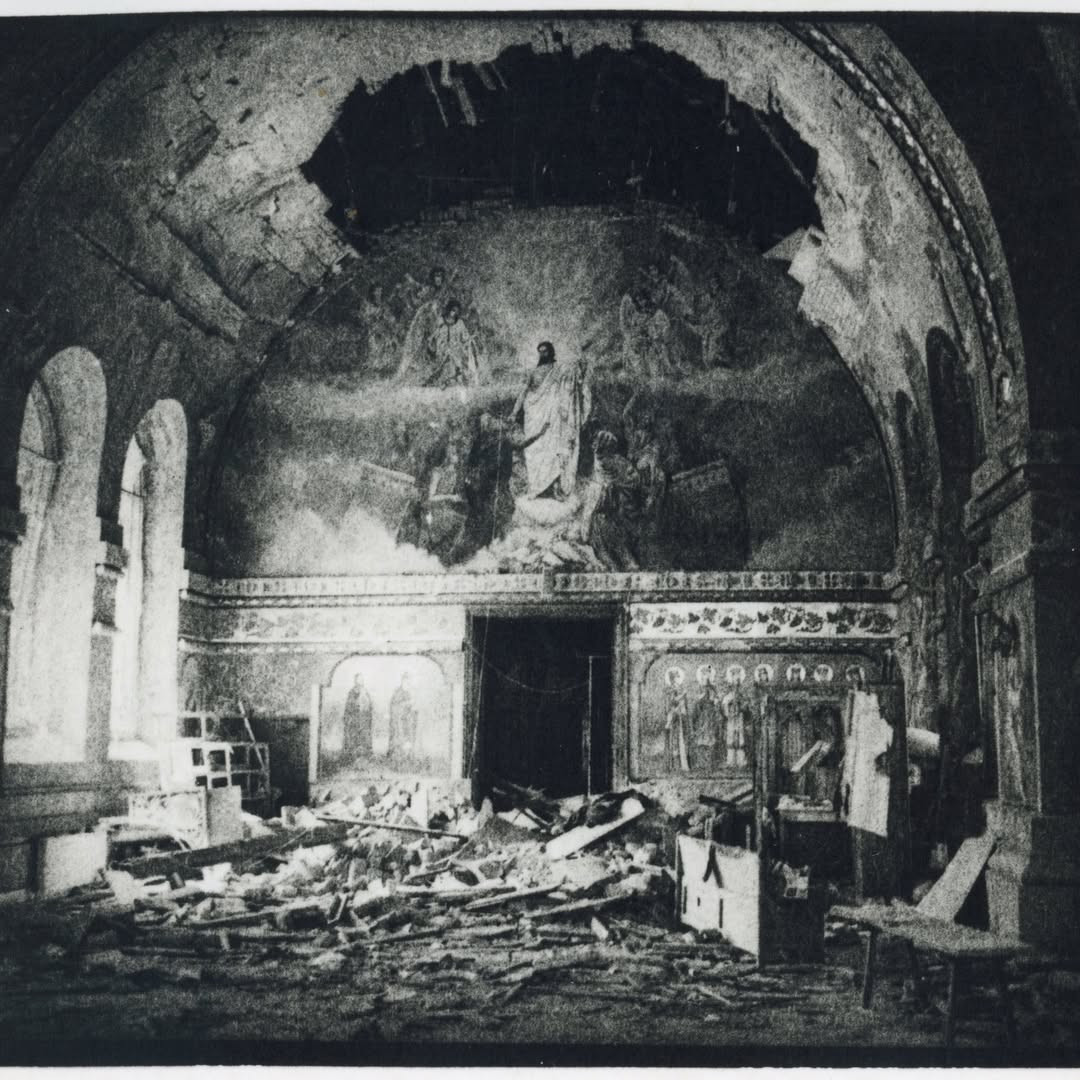
Church of the Nativity of the Most Holy Theotokos in the settlement of Novoekonomichne, Donetsk region. Photo by Kostiantyn and Vlada Liberov, from open sources.
I first encountered ruins not as an object but as a way in which the world lets itself be seen differently. It happened in childhood, during those summer days at a farmstead near Bozha Hora and the small town of Kremenets, when the world did not yet demand definitions or reflection of me. Back then everything revealed itself through presence and a child’s attentiveness. I cannot say that I discovered the ruins. Rather, they discovered me, letting me feel for the first time what would later come to be called the openness of being and of history.
Near the farmstead lay a wooded ravine, deep and narrow, with steep slopes where all sense of direction was lost. Adults would have seen a thicket. But for me it was my first schooling in space: a space that does not submit to the gaze but shapes it. In the dense needles that scratched my face and stole my breath, I came to know what it is to touch the living world directly. I passed through the young pine wood not in order to get anywhere. Movement itself was the event. The branches inscribed me in space, reminding me that movement is always interaction and that the world responds to touch, sometimes not very pleasantly. The touch of the trees became my first experience of the body as inscribed in space rather than merely moving about in it.
A thin stream seeped along the bottom of the ravine, more a pulse of water than water itself. It quietly gave the place its rhythm. I could simply sit and listen to the world holding its silence. This was involvement. The silence made me a participant in the space. I felt that this barely visible flow carried a disclosure. It reminded me that the hidden and the absent are different things. It was here that a space for mystery was taking shape.
On the slopes there were glades, natural rooms enclosed by living walls, like ancient sanctuaries. Their power lay in allowing themselves to remain empty. These were places where childhood felt itself inscribed in the world, especially when you could fit your whole body inside and listen to the earth. Here one could stay silent for hours, and that silence was a way of being.
Beside the ravine, where the slope gave way to the edge of the pine wood, lay my own ruins. The pines grew sparse here, but tall. Their trunks rose in straight lines into a sky that poured down from above, as though someone were parting the air. It was a vertical space: not simply a forest, but a kind of natural clearing, where the world reveals itself through the very possibility of seeing. In this place the sky was always present and almost palpable. Even when the crowns were closed and heavy, a pause remained between the branches, a gap for the light, and that gap came to matter more than the crown itself. The light descended, looking for a place to touch. And every time I came here, I felt it with a body that was becoming part of the space between earth and sky.
Underfoot lay a thick, springy carpet of needles and moss. It swallowed every sound, held the scent of resin, and gave the feeling that the world was preparing to say something but first had to catch its breath. The verticality of the pines only heightened this tension. The trunks were bodies stretching upward toward a luminous air that was more open than anything the eye could see.
This was where the ruins stood. All that remained of the home of a family who, as my father told it, had emigrated to Canada to join distant relatives shortly after I was born. The house was so modest that no one wanted to buy it or take it as a gift. The wood rotted quickly. The clay that coated the house soaked up moisture every night, cracked by day, and over the years turned to sand. Only a few years without an owner, and the dwelling had passed into a state of abandonment.
When I first felt this place to be mine, or when it first let me into its openness, the ruins held only intimations of direction: door openings, each the shadow of a boundary. The pines seemed to hold a space in which the ruins could exist as a sign that the world was in no hurry to fill the emptiness.
When the human form disappears, space opens as a place that holds presence without names. The memory of this place worked as a perceptual interaction. The past showed through as a tension within the present, in the way the surroundings had already been shaped by earlier lives and now directed one’s attention. Significance revealed itself to the degree that one became able to distinguish signs that usually pass unnoticed.
The ruin by the ravine was a point of emergence. The space between the pines, which let in the light, and the space of the ruin, which remained open after the human form had vanished, made up a single event. The clearing here was a concrete experience in which nothing imposed meaning, yet everything kept the possibility of seeing open.
I stood among the pines, beside the half-effaced clay line of a wall, and felt that this vertical space allowed the ruins to be. The light between the crowns disclosed the past as a mode of presence. In this presence I was learning to hear the world as an openness that creates itself anew each time.
The western wall was more like a mound of rotted wood, dust, and fragments of plaster. On this uneven hillock I saw a young dog rose and a few fragile blades of grass growing up through the debris. It was like a premonition of a new landscape that might one day open itself to another child. Perhaps that child will sit beneath this bush and, in a silence of their own, imagine the world the way I once imagined it.
The eastern wall had survived almost intact. In what remained of it, one could still make out the contour of a window and trace the line of the beams where the attic began, the boundary between the living quarters and the dark space for seasonal things. From this wall one could read the height of the house, the number of rooms, and the division of the space inside. The northern and southern walls stood more firmly, though they had lost half their original height. Even that was enough to imagine the door and the south window through which daylight once entered the kitchen, the heart of a poor home, where the days fell into the rhythm of a simple family life.
The room to the left of the entrance, in the southwest corner, was the kitchen. There stood what was left of an iron stove, so old and worn that after the house was abandoned none of the neighbors took it for themselves. It was the largest room. Only a few lacy, almost cobweb-thin scraps of metal recalled the stove, the axis of home life for that family, which had put down roots somewhere in the distant prairies of Canada.
The rough wooden table was gone. Gone too was the bench under the south window, the very one where the owners used to sit in winter, looking out at the steep slope of the ravine. No shelf for dishes, no partition walling off the pantry. The wood had moldered fastest of all, leaving behind only the empty outline of a space.
Nearby lay pieces of board that no one had ever taken. They rotted away slowly, accepting the natural course of things. This was enough for the space to begin revealing itself as a structure that shows itself to anyone who looks attentively.
In this way the ruin revealed itself as a space in which everything superfluous had disappeared and only the essential remained. Light, silence, the verticality of the pines, and the memory of the place held it together. The house showed itself through its boundaries. Here is the threshold. Here is the spot where the door frame met the wall. Here is a slight rise that marks where a bench once stood. Here is a hollow in the earth, the trace of a vessel that did not outlive its owners.
Anyone who came here with an unprejudiced eye would notice that the house itself gives order to one’s attention. It scatters its mysteries through the space: in light entering at a different angle, in a silence that changes depending on where you stand, in pine needles that cover the ground evenly everywhere except a few patches where furniture once stood. One need only stay longer, and the space begins to feel like an event taking place now, at the border between what has vanished and what goes on being.
Everything revealed itself on its own. One room had a different temperature and a different sound of footsteps, and that was enough to sense what it had been for. The threshold between rooms was trodden down differently, and this gave a rhythm to one’s movement. Where a shelf had hung, the acoustics changed: the voice grew quieter, the echo muffled. Even a few splinters under the south window let one sense how light had once entered the house.
The ruins spoke of the way in which the world preserves the presence of the past while letting images go. Imagination receded, giving way to attentiveness. One could stand here for hours and feel the ruin opening a space for attentiveness.
This is how I came to know the place: through the way the space revealed itself, in the scent of resin, in the silence of the pine wood, in the cracks of clay on the walls, in the light passing through a cracked window frame. In this self-disclosure I was slowly learning to see presence, the kind that remains when everything else disappears.
At the time I did not yet know what philosophy was, and could not have imagined that my whole life would later be bound up with that same gesture of attentively reading what reveals itself. I had no idea that from a few surviving details and barely noticeable traces I would learn to reconstruct the form of life this space had once held: a possible one, not necessarily accurate, but plausible. The poetics of ruins and the logic of sacred texts converge here in an incompleteness that leaves enough room for mystery and interpretation.
The ruin was neither the building nor the vanished domestic life, but an open structure of being. Something that needs no explanation, because its truth lies in the way it allows itself to be felt. A ruin is a place where something withdraws so that something else can appear. Ruins leave exactly enough to sustain the movement of thought. That is precisely why we need literature so much: it allows memory to become an event again.
And although at times it seemed to me that I trusted the silence of clay and rotten wood too much, later it became clear that this was where my capacity was born: to think by pushing off from details and to see a direction in them. The questions, however, did not go away. They return again and again. How much objectivity is there in what I saw, and how much of my own nature? Where does the line run between a reading and imagination? Where does interpretation end and the temptation to fill the silence with oneself begin? Back then I did not yet know that this attentiveness would one day become a way of surviving.
The chance to test this came much later, in one late winter of my maturity, when I was forced to walk among ruins I would rather never have seen. From February 2022 on, the cities of my country began turning into ruins. It so happened that I lived beside ruins, walked between them, hid in them from the blasts. To some I went in the hope of finding something intact; to others, almost ritually, to recall what can hold a person in the present.
And so I returned to the childhood question: can anything of substance be read from ruins, from broken spaces, from light falling at a different angle? And each time the answer was the same. Ruins open the possibility of seeing. The rest is done by the one who looks.
I think about the difference between ruins of time and ruins of gesture. In this difference there is a shift that changes the optics itself. Ruins of time are born of the slow passage of years: ancient fortresses, marble columns, ivy-wrapped palaces with peeling paint. They used to seem safe to me, even romantic, like portals to the past where silence has made peace with the end. Now I am surrounded by other ruins: ruins of gesture, a gesture sudden and cruel. This debris came into being in an instant. It has none of time’s gentleness: the edges are sharp, the smell of burning still hangs in the air, and the pain has not had time to dull.
The war has turned a great many of our cities into a landscape of ruins. For some, daily routes now run among burned-out sites and broken buildings. Streets that until recently teemed with life are now covered with shards of concrete and glass. The skeletons of former homes smolder with their windows blown out; further on loom the blackened shells of administrative buildings. Even churches stand split open. Domes caved in, walls laid bare under a cold sky.
Every ruined home is an open world of someone else’s grief. Looking into the shattered rooms, you can see the remains of the everyday: a charred family album, a toy amid the cinders, broken dishes on a table no one will ever sit at again. The ruin of a prefab apartment block breathes the presence of the absent through small things. Photographs, books, children’s drawings that no one is left to gather. In these private ruins personal grief becomes visible, and the walls keep the shadows of those who lived here and the voices that have fallen silent forever.
Sometimes these shadows are felt almost literally. As if a human flash had etched into the walls the outlines of those who are no longer here. The very presence of the people who lived here seems to have left behind fragile silhouettes: shadows without material form, only a thin edging of former life. These testimonies resemble a memory without a name, an imprint that can be lost a second time. There is a difference between a trace and a testimony. A trace is left by someone who passed by and did not know what they were leaving. A testimony remains despite the disappearance of form, as a demand on the one who looks. These shadows on the walls demand something specific: the acknowledgment that each of those people was irreplaceable, that their disappearance is not an abstraction and can never become one. They are addressed to anyone who stops.
In the dark breach in the wall where a corridor used to be, one feels the same hushed pressure of emptiness as in the memories of childhood ruins. The body unconsciously seeks its balance, avoiding the debris, as if it recognized the gesture of a space that now holds something else. Now this gesture carries a different weight, because it holds at once a tragedy, the memory of those we never knew, and shadows that will never become voices.
The ruins of public buildings tell a different story of devastation. The once solid modernist building of the city administration has become a blackened box with its iron ribs torn out, a visible sign of the destruction of the social order. What was a library or a school has become a deserted reminder of cultural progress brought to a halt. The shelves are empty, the books consumed by fire or scattered across the cobblestones among broken brick.
The deepest shock awaits inside a ruined church. Dozens of churches in the east, north, and south of the country now stand open to the sky, sharing the same muteness. But a church is destroyed differently from a house. A house loses its function and leaves a trace of everyday life: a stove, a threshold, a hollow left by a vessel, the frame of a window or a roof. A church loses its direction. Its emptiness is vertical. The surviving icons are silent in their charred frames; the gilding of the dome lies in dusty fragments on the floor. The light that enters through the pierced dome seeks what is no longer there, and lingers on it longer than is possible.
In this openness there is no center demanding interpretation. Absence holds the space in a state of charged significance, not allowing itself to be named. Here nothing speaks on behalf of a higher order, yet it is precisely this silence that holds back the closure of meaning.
Direct rays of sunlight pour through the broken roof into the half-darkness around the altar, where prayers once sounded. The silence beneath the vault, which has now become wind and light, is felt almost as matter. In it every step echoes with emptiness, every breath seems superfluous. The light simply remains.
Despite this despair, a quiet hope appears among the ruins. It arises against all evidence, like a frail sprout in a crack in the concrete. Yet before hope can take shape, ruins always speak of tragedy: of families that vanished, of homes that did not become a shelter, of people who are no longer beside us. Ruins hold the trace of every absence. When war strips being down to its frame, a space for beginning becomes visible. In this open wound of the world, life goes on for as long as we can endure the pain and not turn away from it. Here, hope only keeps the end from being final.
When I think back to my first ruins, I understand this: between them and what I see now there is both likeness and difference, and it is important to hold on to this understanding. The ruins of time invited, because they carried an ancient story within them and demanded nothing but attention. These ruins arise as though a gesture of response were demanded before you have had time to understand the question. The same silence, but with a different weight. And yet the way of seeing has remained unchanged: the attentiveness my first ruins taught me turned out to be the only thing that held.
It was here, at this boundary, that I felt I lacked light. The kind that lets the visible remain unfinished, that leaves a distance between me and what I am looking at, a space where the gaze can come to rest without haste. More and more often I feel my hand searching for support and finding only air. Something in the usual distance between me and the situation has collapsed, and I do not yet know whether this is a loss or the beginning of another way of being.
There are cracks that remain open because they are already filled with what has happened. In these fissures there is another kind of presence: it holds steady between a return to the former wholeness and the final disappearance of that wholeness. For a long time fragility seemed to me a mark of weakness. Over time I came to understand that only what can break remains in relation. The rest turns to stone. When I say, "I lack light," perhaps I am naming the loss of the ability to be near what touches back and allows itself to be felt or seen.
There is a fragility that is obvious, open to view: the fragility of a living body, of stone, of wood, of any other matter. It hurts directly. But beside it there exists another, almost invisible, which has no form and therefore knows no protection. A fragment of brick can be picked up and carried home as proof of what existed. But how do you lift from the ground a gesture of care that never happened? How do you hold on to the ability to hear when it quietly vanishes in a stream of voices? There are losses that do not even leave ruins, and these are the ones that reveal the thinnest edge of fragility, the place where experience vanishes without a trace and never becomes a memory held in things.
War lays this difference bare with cruel precision. In its presence the body ceases to be the unnoticed background of existence and comes to the foreground as condition and limit at once. In peacetime we rarely think about it, as long as it simply carries us through the day, quiet as breathing. But let the earth shudder underfoot, let your hands keep trembling long after the danger has passed, and the body suddenly begins to speak in a language of its own. It finds itself thrown into a situation it did not choose, and this thrownness is felt as the weight of the air, as tension in the muscles, as a fragility living under the skin. Along with this, a quieter rift opens between the one who feels and the one who goes on acting. A person at war often has to move when everything inside longs to stop. The body walks, the hands work, the voice answers, while something deep within has not yet caught up with what has been lived through. In this unsynchronized rhythm lies a particular vulnerability: the relationship to one’s own body, which once seemed self-evident, begins to require a new trust, like the trust that arises after a loss of balance, when one has to learn again how to stand on the ground.
In the same way, relationships between people reveal themselves as fragile. What in peacetime rested on small daily gestures — a shared breakfast, a chance touch, a brief glance of recognition — suddenly loses these supports. Then the fragility of this fabric becomes especially palpable: the vulnerable capacity to be close even when physical closeness is impossible.
True destruction often happens where nothing falls and nothing breaks. It resembles a quiet crumbling of the ground that the body senses and answers with a more careful step. This is how trust disappears, trust that is like a thin film on water: it cannot be seen, yet it is what allows the surface to hold the reflection of the sky. When this film tears, the reflection vanishes, and only then does it become apparent how much light rested on what had seemed to go without saying.
Commonality arises anew each time in small repeated gestures: in the capacity not to render others faceless, in the readiness not to pass by, in the ability to see another as someone, not merely something. When these almost imperceptible acts of reciprocity disappear, "we" still remains in language but gradually loses the density of presence.
Fragility keeps the world open, between the "not-yet" and the "no-longer," in a space where transformation is possible. To respond to it means not to turn away: to see a face as a face, pain as pain, memory as a living presence and not a convenient argument. This requires only attentiveness and a willingness to stay near longer than habit allows. It is in such a space that what returns unbidden reveals itself.
The ruins of a church in winter, the floor covered with snow and the tracks of animals. On the wall, a fresco, half collapsed. The face of the saint had vanished; only a hand remained, stretched out into the void, toward where someone else had once been. It was this incompleteness that held the gaze more strongly than the unbroken compositions in undamaged churches. The hand, reaching toward the absent one, seemed truer than any complete form. It opened a rift in which something did not vanish along with the loss, and this something had no name but demanded attention.
Nearby stood an icon with a charred edge. The dome had partly collapsed, and light came in as an event, not as illumination. Before the altar a damp stain showed dark. The space was deserted, and the silence had taken on density, the kind the body feels before thought does. What changed here was not a thought or a conviction, but a measure. The distance between the one looking and what is being looked at lost its neutrality. The gaze became a reciprocal experience that can be neither proven nor denied without simplification.
Why is something sometimes felt more sharply where form has been destroyed than where it is preserved? An intact form gives the gaze a place, but does not always open a place for encounter. A ruined one offers a gap through which presence enters not by way of an image but by way of its absence. In this rift what surrounds us ceases to be background. The protection that usually keeps a situation at a distance is gone, and it is this, not the event, that changes the mode of dwelling.
We have inherited a world in which the very possibility of such an experience arouses suspicion. A consciousness that has learned to explain works readily with interpretations, but stops short before what will not dissolve into mood or trauma: before the claim that an event could be real and keep its weight beyond any lived experience of the subject. We speak easily of symbols, but grow cautious when experience ceases to be merely an image and begins, as it were, to look back. The line runs between what can be explained and what calls for a response. That is why culture often translates such an encounter into metaphor, which keeps the form but weakens the demand.
I remember an old cup in my grandfather’s house that no one ever meant to mend: chipped, with a crack along the handle. It stood in the same place for years, and when it was gone, I felt something I could not find a word for. It was a kind of deep longing. As if what had vanished were not the object but the pause it held between the people who drank from it. The child in the ravine still knows this, sitting and listening as the place holds its own silence. One has only to slow down, and things begin to speak again, in a way that precedes words.
The time we live in fills silence with unceasing noise out of fear of encounter. Silence brings a question that is hard to prepare for in advance. In it reality steps out of the role of background and approaches as an event that calls for a response.
Silence is a discipline of attention that restores the ability to see, and not merely to designate. To keep silent in such a way that the silence stays open is closer to ethical precision than to inner calm. Silence halts the gesture of appropriation that often hides in the very act of naming, and reminds us that sometimes what matters reveals itself only when we do not let words bring it to a close.
In our history there are places where the word is no longer trusted, because too often it served as a cover. For Ukrainian memory, the names Irpin, Bucha, and Izium already reach beyond geography. In these words war enters life as a boundary after which any explanation changes its tone and weight. In such spaces silent presence sometimes speaks more deeply than any speech, because haste in words widens the distance between experience and whoever tries to designate it. Silence holds pain in its own density, preserving the possibility of standing beside reality without turning it into an argument.
Silence lets us notice that the call rarely comes as a miracle. More often it arises as an almost imperceptible shift in the gaze: the realization that the person beside you is no longer a role or a function, but someone particular, to whom it is impossible to remain indifferent. It may be the sense that the place where you stand keeps someone’s rhythm, like a threshold worn down by a repeated tread that no longer has an owner yet still holds that owner’s weight. Or the understanding that a word gains power precisely when it could have gone unsaid, and when it is able to return to the silence from which it came.
Encounter happens when addressivity arises between two, when the gaze no longer merely registers but recognizes. When the presence of the other reveals itself as irreplaceable. But encounter is never guaranteed: it can only be prepared for, by leaving the space unclosed in advance. Sometimes a single untimely gesture is enough for addressivity to vanish as imperceptibly as a ray of light vanishes when the crowns of the trees close.
Perhaps this is where it becomes clear why a ruin, for all the pain of its space, sometimes seems more honest than an imagined wholeness. It hides nothing and promises nothing beyond what it can bear. A ruin shows a boundary and at the same time leaves room for memory that is living, not frozen: here was a window, here was warmth, here was a hand that opened the door. But what are we to do with that which vanishes formless and does not even leave fragments? There are losses that do not become ruins. There are losses in which the body already knows the answer, but consciousness has not yet formulated the question. Consciousness arrives later and does not always find words for what has already happened.
Sometimes I think about a sprout pushing up through the rubble in a place where no one planted or tended it. It appears without human design, outside any plan for reconstruction. There are things that come regardless of our readiness to receive them. They arise outside the logic of reward or effort, as testimony that something continues on the far side of our explanations and our control. The sprout proves nothing, but it shifts the measure. Within the ending, a gap opens, and continuation shows through it. This continuation comes without promises. It simply reveals itself as presence, and in this emergence there is something no system of causes can contain, though it is felt with complete clarity.
Tending a garden among ruins is a craft that reveals itself only with the passage of time. Here you cannot order a seed to sprout faster, but you can create the conditions for it to grow. Yet today even this gesture feels different. A garden requires trust in duration, and this trust no longer seems self-evident. You put a seed into the ground no longer for the sake of next spring, but rather in spite of everything, knowing that language may betray you again and that hope itself remains fragile. In this gesture the garden ceases to be an image of peace and reveals itself as a risk that promises nothing but attention itself and long labor.
Perhaps this is what a garden among ruins is: not a place, but a practice of dwelling where the outcome is not yet known. And wherever something sprouts, there is always what we did not sow.
Vitalii Shchepanskyi
