The Soviet Colonial Myth of “Friendship of Peoples”
- “Civilizational Gift” for Subalterns
- “Friendship” as Realpolitik
- The Visual Language of "Friendship": slipping while pretending to be liberator
- Magical Socialism
- The Transformation of the Soviet Myth into a Russian Weapon of the 21st Century
- "Friendship of Peoples" as Civilizational Debates
- The role of narrator or who is speaking?
- The Roots of These Ideas or Ideas About the Roots? Why Decolonial Theory Can Help us
- Instead of conclusion
“Civilizational Gift” for Subalterns
Denis Esakov
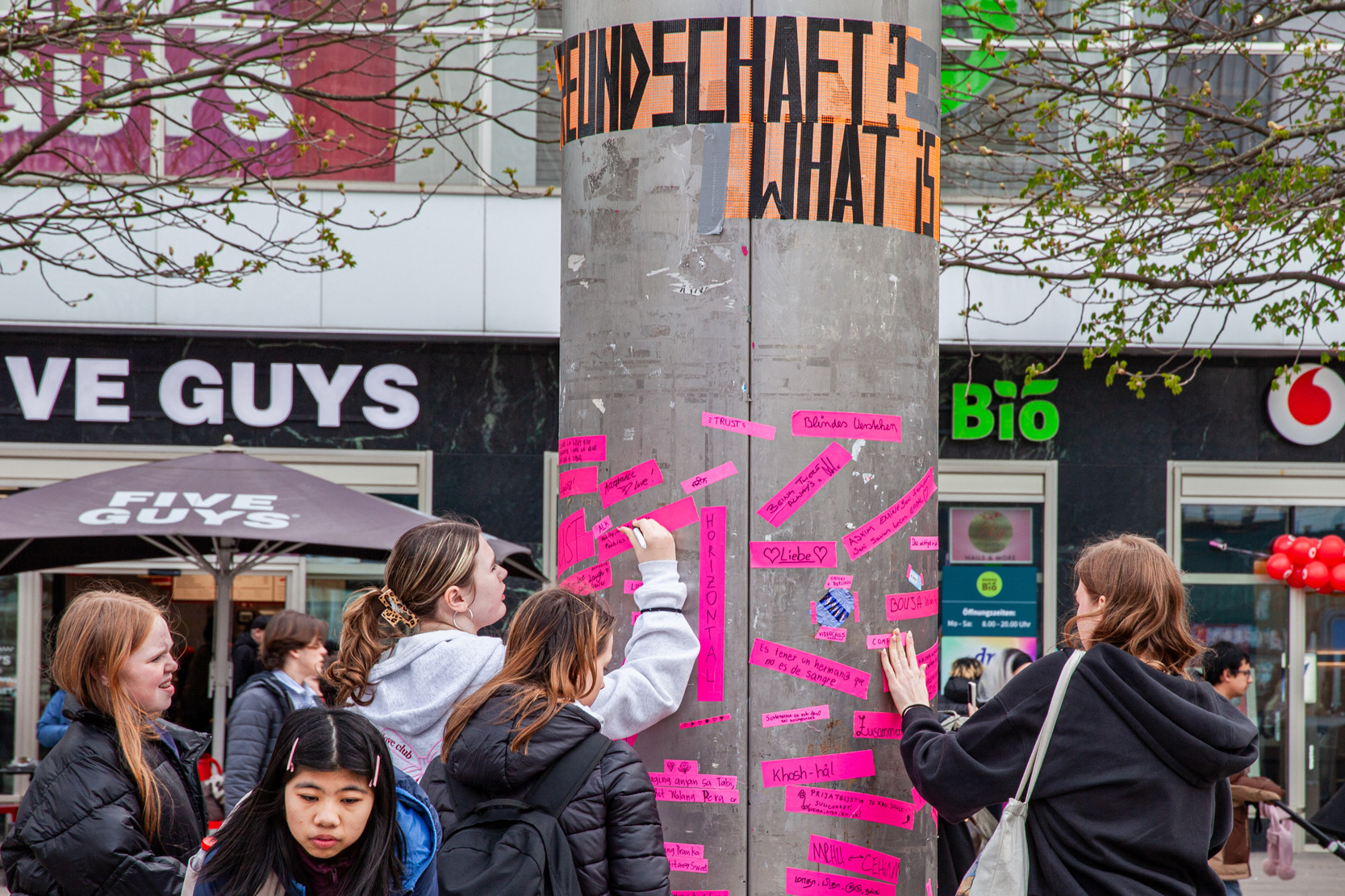
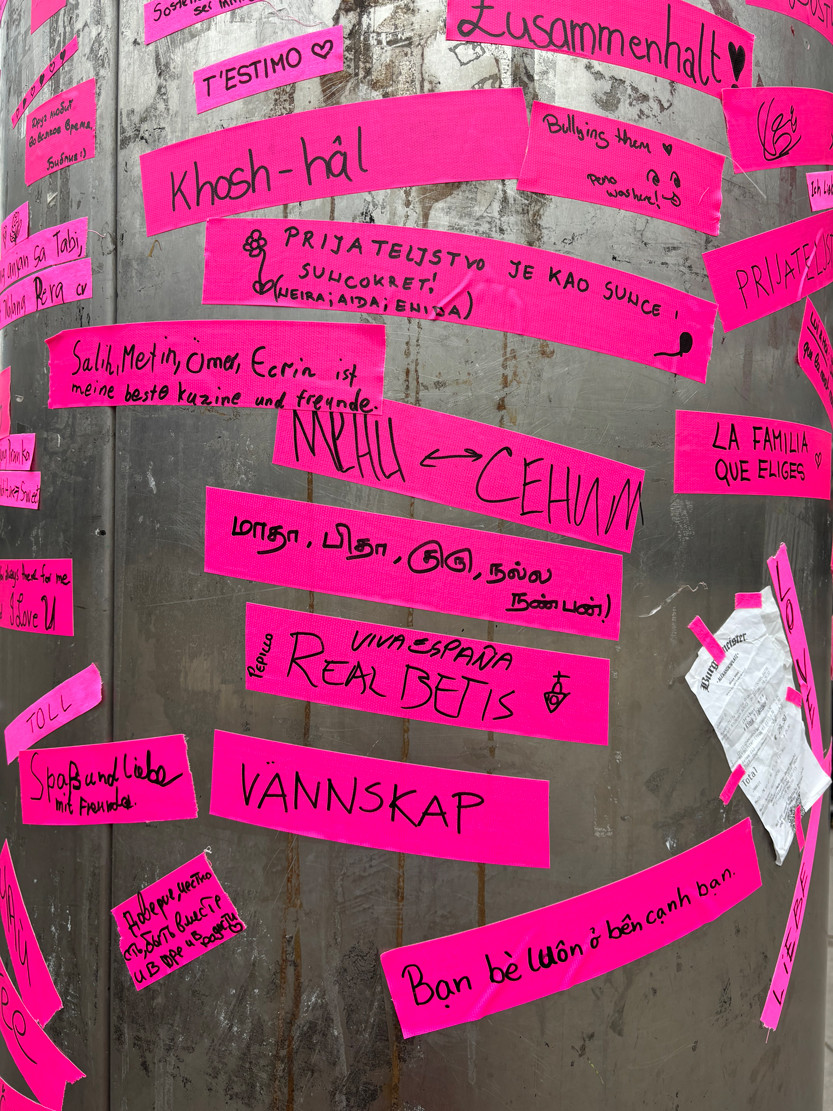
Sometimes narratives of domination and alienation sound friendly. Under the guise of important concepts familiar to many—such as friendship or solidarity—authoritarian political regimes build structures of subjugation and propaganda. This is exactly what happened with the Soviet concept of “Friendship of Peoples.” A very personal feeling familiar to everyone was overlaid with monuments and loyalty parades, sharply polarizing society and distinguishing between “us” and “them.” This space of politically constructed “Friendship” very clearly defined the conditions under which so-called “Friendship” was to take place.
The contradiction between “Friendship” and friendship at times becomes invisible, yet retains its influence for many decades to come, creating space for Ostalgie or Putinverstehers. This dominant propaganda concept still influences communities and the perception of history, overshadowing actual events and social problems. “Friendship” has become a colonial concept that serves as a bridge between very different eras; it has managed to carry over from the Cold War era into our everyday lives today. We propose to examine this myth and reveal its various sides.
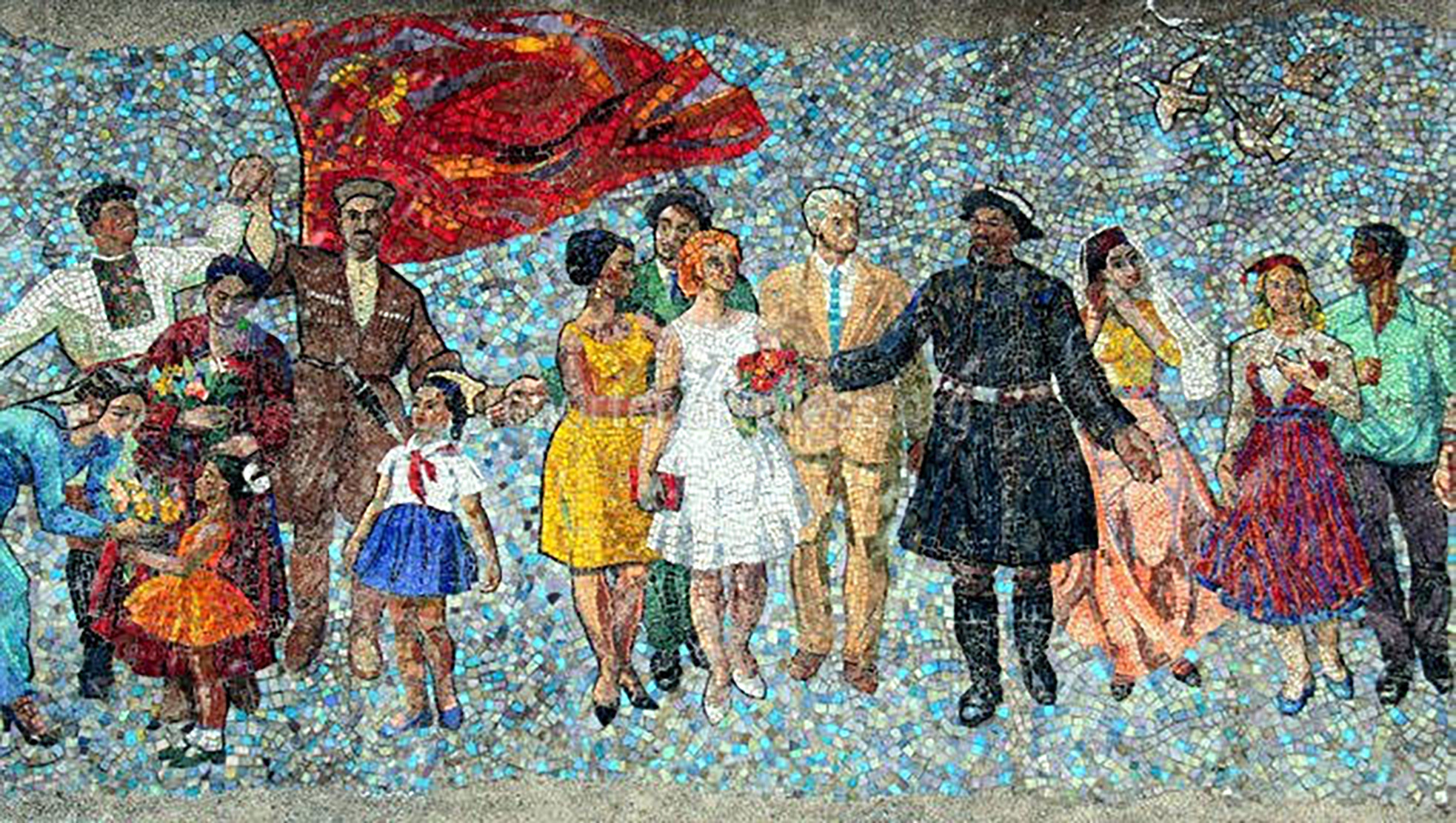
Today, one can find at least two monuments in Berlin dedicated to Soviet “Friendship”—the fountain on Alexanderplatz, the Brunnen der Völkerfreundschaft (1970), and the Deutsch-Sowjetische Freundschaft mosaic column in Marzahn (1985). In other German cities, there are even more of these monuments. Some of them directly depict the conditions of these so-called “Friendly” relations. The Flamme der Freundschaft in Hettstedt (1974) directly commemorates the natural gas extracted from the lands of indigenous peoples in North Asia and delivered to Germany via the Soviet pipeline of the same name, “Druzhba,” (rus. Friendship) as a condition of “Friendship” and the designated “Deal of the Century.”
![The Druzhba [rus. Friendship] pipeline is one of the largest crude oil pipeline networks in the world, stretching over 4,000 to 5,500 kilometers from North Asia to Central and Eastern Europe.](https://fastly.syg.ma/imgproxy/iWdW1dEy8WUDMTjko54D85eHht2T9xvTv9UrlDQlG7A/rs:fit:::0/aHR0cHM6Ly9hc3NldHMuc3lnLm1hL3N0b3JlL2IwMzYxNDRiOTM2M2IzY2NkOWU3OGFjYmMzMTI1ZTdkNTU2YTdmMTc5ZjVlYzcwZGZkZTIyNjgwZjAyMg)
"A similar dynamic can be seen in the inter-imperial relations between West Germany and the Soviet Union in which the two countries developed infrastructures of resourcification across the Soviet-controlled Indigenous lands of the Nenets, Khanty, Mansi, and Selkups in Western Siberia, on the eastern side of the Ural Mountains of the Russian imperial formation."
—Svitlana Matviyenko, Trans-Imperial Energy Necropolitics: Russian Imperial Expansion Through Implication, in: LEAK (2026)
“Friendship” as Realpolitik
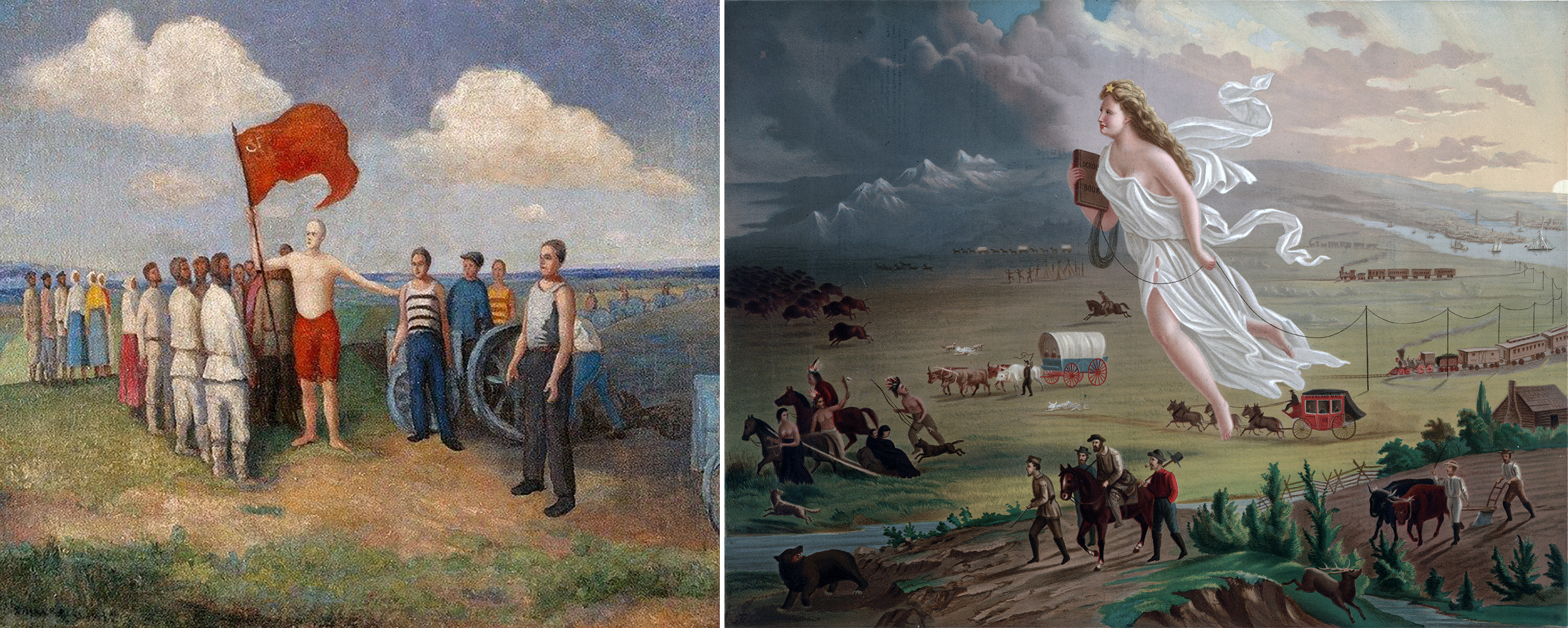
Smychka (1930), by a Kyiv-born in Polish family soviet painter Kazimir Malevich.
American Progress (1872), by a Prussian-born painter John Gast.
John Gast’s painting can be used as a concordance (a comparison of different ways of perception of the same phenomenon) to the concept of “Friendship of Peoples,” stripping away the multi-layered irony and other Socialist Realist strategies for survival and compliance with censorship under Soviet totalitarian and colonial policies. Much like the ideology of “progress” in North America, “Friendship” was an ideological construct of the Soviet Union that underpinned diplomatic relations and public narratives of colonial extractivism, total domination, imperial competitions and epistemicides.
At the very same time when this “Friendly” Soviet ideology emerged—the 1930s—catastrophes orchestrated by Moscow apparatchiks were unfolding in Kyrgyzstan—Кичи Үркүн [Kichi Urkun] (1928–1938), in Kazakhstan—Ашаршылық [Asharshylyq] (1930–1933), in Ukraine—the Голодомор [Holodomor] (1932–1933), multiple mass ethnic deportations and others. These events had colonial objectives of seizing resources and establishing the dominance of Russian rule in the colonized regions.
"Coined in the Stalinist 1930s as the core concept of Soviet nationalities policy, the notion of “Friendship of Peoples” (Druzhba Narodov) signaled the death of socialist internationalism, and its replacement with a Russocentric, ersatz multinationalism in which all Friends were demarcated and separated (each Soviet citizen had their “nationality” marked in their Soviet passport), and one Friend (the Russian Friend) was the most equal of all. All other Friends were ranked in a racialized hierarchy and subject to famine, targeted persecution and killing, deportation and exile, environmental degradation, labor exploitation and resource extractivism, as well as varying forms of cultural reification, exoticization, and infantilization."
—Michał Murawski. Laboratories of Friendship, 2026
The Visual Language of "Friendship": slipping while pretending to be liberator
The monumentalization of the ideology of “Friendship” began in the post-war years, starting in the 1950s, and continued even after the collapse of the USSR. Hundreds of sculptures, mosaics, fountains, stelae, buildings, festivals, and concerts celebrating “Friendship” according to Soviet ideology were erected and held in countless cities around the world.
The visual language employed to depict the ideology of "Friendship" was diverse, but it repeatedly featured techniques that distinguished “Friendship” from ordinary friendship. Although these were very common techniques, there are examples of the monumentalization of “Friendship” that avoided these tropes.
> The central placement of Russian figures in modernist clothing, surrounded by representatives of colonized peoples in ethnic costumes.
> The designation of the date of conquest and the beginning of the colonial history of the conquered peoples; this was marked as the start of the “Friendship” period.
![The “Friendship of the Peoples” Monument in Шэрджэс къалэ (Adyghe) [Cherkessk], featuring dates marking the dominance of the Russian Empire.](https://fastly.syg.ma/imgproxy/ELV663lSpO3EovUBT1WMl8Qf4cvIqARd2h0n-vk_fZ8/rs:fit:::0/aHR0cHM6Ly9hc3NldHMuc3lnLm1hL3N0b3JlLzM0NGEyNzIyYTBlZDRiODM5NmI3ZTEyYzJmMmFhOTAyY2UxNjkzNjkxYzBiMzg5YmY3ZTkzYzdmMzI4OA)
> Demonstrating the superiority of Russian colonial military power.
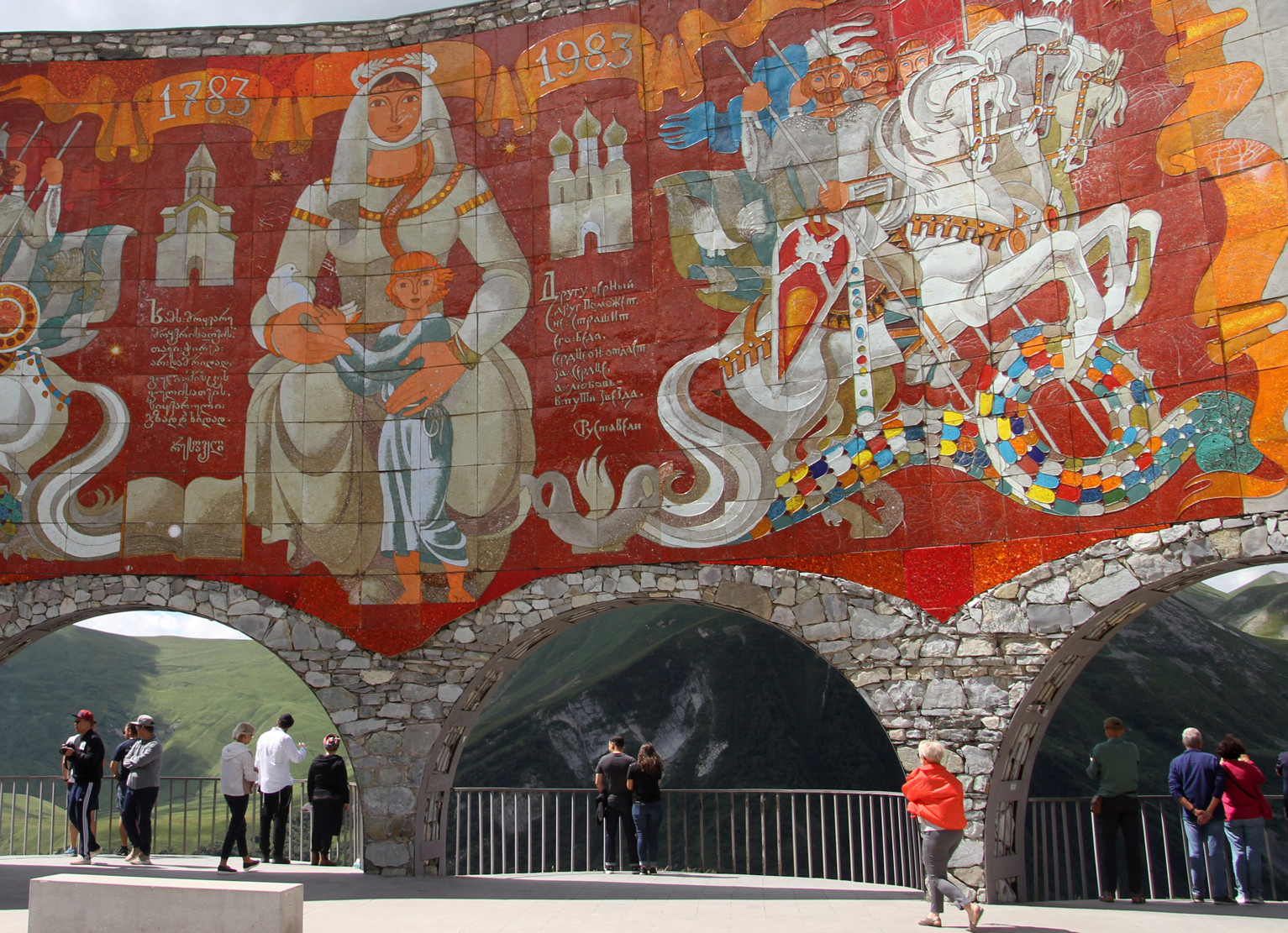
> Visualizing the colonial myth of “voluntarily" accession of colonized peoples into the Russian Empire.
![The Russian-Bashkort "Friendship" Monument (Bashkort: Урыҫ һәм башҡорт халыҡтар Дуҫлығы Монументы) is a monument in the city of Өфө [Ufa], dedicated to the 400th anniversary of the occupation of Bashkortostan by Russian Empire.](https://fastly.syg.ma/imgproxy/s0UjtS2W4dnN7hbp4hXQv4DdThfeIlwC8PKD8sfG1Lo/rs:fit:::0/aHR0cHM6Ly9hc3NldHMuc3lnLm1hL3N0b3JlL2IzNGRjYjYwOTBkYTM3MTlmMGQyNWVjZDg1MjY2MjdkMzg3NmQyNTVlYmVjNWY0MWQzYTJiOTM5NGYxYQ)
> Modernist monumental building facades that distinguish Soviet “civilizational” architecture from the buildings of “bygone eras”.
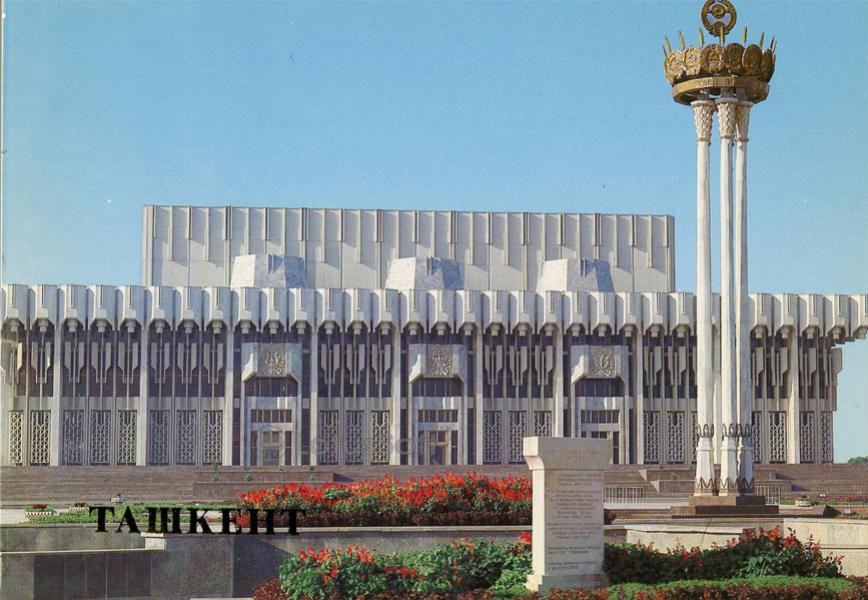
Magical Socialism
“ Imperialism regularized the administration for colonies, to the extent that they became continuous with the agency of sustained exploitation. The Communist revolutions did the same for another sector. ”
—Gayatri Chakravorty Spivak. Who Sings the Nation-State? , 2007
In the 20th century, activists and poets who fought against racial discrimination and colonial structures—such as W. E. B. Du Bois, Aimé Césaire, and others—formulated the idea of the imperial boomerang. The imperial boomerang or colonial boomerang is a concept according to which governments that develop repressive methods to uphold imperialism and maintain control over colonial territories and peoples will ultimately apply those same methods domestically against their own citizens. The violence perpetrated in colonized territories will be reproduced in the colonizers’ homelands, since it was perceived and normalized through science and the media as something “natural” and consistent with ethical norms.
This approach shows that colonial power relations, sustained for hundreds of years, also transform those who benefit from the established order—the colonialists. And the violence they perpetrate sooner or later comes back to haunt them and society around them. This leads to another conclusion: characteristics of colonial power relations—such as racism, xenophobia, extractivism, violence, and others—are social, political, and economic constructs that are passed down from generation to generation and cannot be instantly dismantled by a colonial society merely by expressing goodwill. This, too, is a long, multi-year process of changing—or even replacing—one set of social constructs with another. It may well be a matter of several generations.
The Bolsheviks believed that social constructs could change very quickly. Nomads were forced to become kolkhozniks within bit more than one year (Cameron, 2018). Faithful believers were forced to become atheists the moment a state decree banning churches and religion was announced.
A settler society built on colonial principles also supposed to transform very quickly into a “Brotherhood” based on the concept of “Friendship of Peoples.”
This is what Magical Socialism is. It is this belief in proclaimed decrees and declarations. This, in itself, is a symbol of highly bureaucratized societies, where the formal announcement of an event and its social substance significantly diverge, and priority is given to bureaucratic form.
Belief in this magical transformation of a colonial society into a socialist one through the efforts of a revolution within less than a generation was strong not only in the Moscow Kremlin (which is a medieval fortress with apparatchiks inside) but also among liberation movements in various countries around the world, where the Soviet Union directed its propaganda.
Another aspect of this system’s magical nature is Lenin’s mummy and his tomb, located directly beneath the wall of the ancient Kremlin fortress in the heart of the metropole in the Mausoleum. This is not merely the canonization of an atheist, but also, to this day, a public political stage for demonstrating the power and status of the head of state. The head of state receives official guests and reviews military parades while standing literally at Lenin’s mummy’s tomb, just as Stalin, Khrushchev, and others did before him.
Racism, deeply rooted in Russian colonial society during the Russian Empire, did not disappear the moment the concept of “Friendship of Peoples” was announced (in the 1930s); moreover, society did not change all that quickly during the era of Magical Socialism, and Russian society remains highly xenophobic to this day. To be considered a friend within the circle of “Friendship of Peoples,” one had to learn the Russian language (which, like the Russian nation, was and is dominant), study Russian culture and history in school, and follow the traditions of Russian science.
Put simply, to be a "Friend" in the Soviet Union, it was best to be Russian and follow Russian rule.
In parallel with the resolutions on "Friendship", strategies were implemented to subjugate other peoples to this concept of "Friendship", which manifested in mass ethnic deportations during the 1930s and 1940s. In the USSR, many peoples were subjected to mass multiple ethnic deportations: Koreans, Ingrian Finns, Karachais, Kalmyks, Chechens, Ingush, Balkars, Crimean Tatars, Germans, Meskhetian Turks, and many others. Among them, the Karachais, Kalmyks, Ingush, Chechens, Germans, Balkars, and Crimean Tatars were also robbed of their national autonomy. Hundreds of thousands of people were forcibly uprooted in a short period of time, torn away from their land, ancestors, history, relatives, aspirations, and deported to other regions of the Soviet Union in cattle trains. “Friendship” is enforced by brute force by the authorities in Moscow.
Magical Socialism intertwined the ordinary, real lives of hundreds of thousands of people with impossible things—with things that should never happen: deportations, violence, repression, identity erasure, linguistic domination. This defies the logic of the ordinary person, yet it intrudes into people’s lives, radically and painfully altering them, and for many, ending fatally.
Magical Socialism is the belief that decrees from Moscow can change centuries-old ways of life. It is the belief that the civilization emanating from Moscow must be dominant and erase other forms of knowledge, cultures, and languages.
In everyday life, the people of the Soviet Union were subjected to an incredible, oppressive, magical force that compelled them to change the subject of their conversations, lower their voices to a whisper, and renounce their own families. Undoubtedly, these mechanisms of power can be explained through scientific and philosophical theories, but that realm of immense violence, domination, and virtuoso propaganda—which replaced reality with Soviet textbooks, posters, urbanscapes—was all part of people’s everyday lives, constantly present at their side, and there were no cause-and-effect relationships to explain this magical force. Only under Magical Socialism could posters depicting the “Friendship of Peoples”—featuring proper and happy people—coexist in the same space and time as state terror, ethnic deportations, and the consolidation of colonial structures.
The Transformation of the Soviet Myth into a Russian Weapon of the 21st Century
Marina Solntseva
Soviet narratives cannot be viewed in a vacuum — merely as historical phenomena of their time. The ideology, concepts and wordings that emerged and were popularised at various stages of the Soviet period travel across time and live on in the present as transformed concepts. In the current election campaign in Russia (2026), the United Russia party—Vladimir Putin’s backyard—is using the “Friendship of Peoples” concept for its advertising. It is therefore important to consider ‘Friendship of Peoples’ not only as a Soviet internationalist, romanticised phenomenon in its own form, but also in terms of how these ideas are received within contemporary Russian ideology, political and public discourse or among the neo-imperial thinkers, who sometimes are described as Neo-Eurasianist.
When Russian politicians brag about their alleged anticolonial and internationalist agenda in the sense of “Friendship of Peoples”, at the same time their narratives include military and cultural-heroic narratives. This spectrum of ideas includes the imperial idea with an emphasis on militaristic and historical narratives, as well as the imperial idea with a focus on cultural dominance and orientalism, which are spread among geopolitical debates. While I generally critique the disproportionate attention to the geopolitical debate in the studies of the Russian imperial project, I propose to keep this category as an area of analysis. Notable representatives of this thinking include the members of military-historical community and, for example, General Leonid Ivashov, who also uses the tools of esoteric imperialism in his argumentation:
“In alliance with other closed, primarily financial and political communities, esotericism constitutes a significant shadow force that actively influences global historical processes” (Ivashov 2020, 7-8)
At the same time Ivashov developes Tsymbursky’s idea of “limitrof” understood as an area of so-called liminal buffer territories around Russia, both in public lectures at Moscow State Linguistic University (2010-2015), and in his monographs Geopolitika russkoi tsivilizatsii (“Geopolitics of Russian Civilization”) (2020) and Rossiia ili Moskoviia? Geopoliticheskoe izmerenie istorii Rossii (“Russia or Muscovy? The Geopolitical Dimension of Russia”) (2022) (Ivashov 2020; Ivashov 2022).
Another notable representative of this ideological tradition is Vladimir Medinsky, the current assistant to the President of Russia, historian, as well as a Head of Military Historical Society. His work on the production of myths and historical interpretations includes a series of publications Myths about Russia (Medinsky 2015-ongoing), and recently rewritten history books History of Russia for public schools (Medinsky, Torkunov and Chubarian 2023). Further striking example is the recent publication Denazification of Ukraine by Armen Gasparyan, where the author legitimizes the reasons for the full-scale invasion by the alleged "denazification" (Gasparyan 2018; updated in 2023):
“The essence of denazification lies elsewhere. It involves changing the mindset of members of society, and you will never succeed in doing that on an empty stomach. It is a complete utopia. You can plaster the whole of Ukraine with slogans such as ‘Long live Ukrainian-Russian friendship! ’, ‘Long live Prince Suvorov, Catherine the Great, Joseph Stalin! ’ or anyone else for that matter. Nothing will change as a result. When people have nothing to eat, they do not heed your appeals, even the most impassioned ones that come from the heart.”
"Friendship of Peoples" as Civilizational Debates
The civilizational debates often include the imperial idea centered on notions of civilization, progress, and industrial development, while missionary ideas highlight the imperial idea oriented around the notion of saving the world, destiny, and historical purpose. These ideas can be found, for example, among the representatives of the think tanks Katehon Club, Izborsky Club, as well as in a monograph by the philosopher Alexander Panarin, particularly in Rossiya v tsivilizatsionnom protsesse (“Russia in the process of civilization”) (Panarin 1995). Here we can also remember an idea of “mulipolarity” by Alexander Dugin. Dugin currently heads the traditionalist Tsargrad Institute, and twists the idea of geopolitical multipolarity with the idea that Russia should lead this multipolar world in the Fourth Political Theory, with the focus on being culturally and ethnically Russian (Dugin 2012). It may look like the idea would promote the narrative of peaceful coexistence of different cultural and ethnic groups (similar to the soviet narrative of Friendship of Peoples), however the contemporary neo-imperial idea of Russian project is narrowly twisted with the national debates, manifesting that the historical narratives can be both imperial and national at the same time (Hausteiner 2026).
I also propose to look at imperial ideas of a mixed political spectrum: take, for example, the national bolsheviks. I believe that this category represents an interesting case of political positionality, where the members of the party and the publishers of the newspaper Limonka spread xenophobic and racist views, sometimes including anti-migrant or misogynic ideas with an emphasis on "Russianness" as dominance—a part of broader identity debates. For example, one of the stories in this newspaper featured headlines such as “The Black Mayor with Small Breasts,” comparing the bodies of Condoleezza Rice and Valentina Matvienko, or, in other instances, newspaper columns calling for violence against migrants, referred to as “туземцы,” “аборигены,” or using the kh-word (National Bolshevik Party 2003).
The National Bolshevik Party was founded in 1993 and I believe that the National Bolsheviks are often excluded from studies of imperialism precisely because of their hybrid political identity. However, if we shift our focus away from their place on the political spectrum and instead examine the narrativity of the group’s discourse, we can clearly observe patterns that align with imperial narrative structures. The main representatives of National Bolshevism included Eduard Limonov, Alexander Dugin, Zakhar Prilepin and Yegor Letov.
Their ideological framework was strongly connected to the terms such as "National Bolshevism," the "Russian World" (Russkiy mir), "Eurasianism," "Great Power Chauvinism," and "Russian Nationalism" — all of which underscore the hybridity that fuses both nationalist and imperial ideas.
This group is also particularly interesting because we can trace the narrative trajectories of individual figures. For instance, Eduard Limonov, even while in opposition to the regime, advocated for the return of Crimea to Russia as early as the 1990s — long before the 2014 annexation. Zakhar Prilepin’s positionality is also noteworthy: once considered a protest writer thanks to his novel "Sankya" (2006) — which centered the focus on modern Russian revolutionaries — Prilepin publicly supported the full-scale invasion of Ukraine in 2022, turning his focus from a protest novel into the promotion of Z-ideology (Prilepin 2022). The highly ambivalent figure of Yegor Letov is often seen as a symbol of anti-system resistance, while Alexander Dugin’s views evolved dramatically: from countercultural fringes in the 1990s to a fully mainstream ideological presence by 2026.
The role of narrator or who is speaking?
I would like to draw attention to the role of a narrator (narrator as a single subject or circles of narrators) and the medium, how the imperial ideas are spread, supporting the system of meaning and ideological coding (Barthes 1972). For instance, one can draw a parallel: whereas in early Eurasianism (1920-1930) the main centers of idea production were classical journals and essay writing (primarily a textual corpus), contemporary imperial thought is shaped by a broader landscape of agents involved in the production of ideas. If we would like to analyze the authors of early Eurasianism (1920-1930), we would mostly analyze the essays, newspapers and journaling, because essaying was the main medium of theory production of an emigré community at that time (Laruelle 2008).
However nowadays the actors of production of imperial ideas and the means of the distribution of the ideas are much more diversified: we can find think-tanks and platforms like Katehon, research groups like Russian Institute for Strategic Studies (RISS), different groups of Military-Historical societies, influential Telegram Channels of key personalities and TV channels and shows in case of Malofeev and Medinsky. In addition a Pro-Government NGO "Eurasia" provides a newly updated rhetoric of being Ambassadors of Friendship of Peoples (Solntseva and Shoshanova 2024).
It explains the pluralism among the narrators we observe today. Therefore the choice of the sources should not be reduced only to published books, articles and monographies. Moreover, as already mentioned above, the reception of the imperial ideas can be also found among key public literature personalities or within cinematography, often reproducing colonial narratives (e.g. the film "The Red Poppies of Issyk-Kul" about the establishment of early Soviet power in Kyrgyzstan, filmed in the 70s). This diversity reflects a kind of diagnosis of how political thought is currently being produced. It is also possible to categorize imperial ideas according to the domains in which they are produced—for example, literature, political circles, public debates, school history textbooks, NGOs, informal groups, and discussion circles. In order to provide a detailed analysis of these spheres of imperial idea production, it is necessary to demonstrate the non-monolithic and differentiated nature of this ideological landscape.
Here it is interesting to track, to what extent narratives in literary and academic discourses and texts are politically grounded. Since not only scientific texts and discourses of the (Neo-)Eurasianist programme but also literary texts contain such narratives. In doing so, the logics of knowledge production are questioned, raising issues regarding narrative constructs within imperial ideologies in literature as well as the fictionalization of scientific hypotheses. Including literature texts enables a more complex view of imperial narrativity — showing that despite internal contradictions and even radically oppositional stances, these actors still operate within an imperial narrative framework. This helps moving beyond the assumption that the imperial agenda is only maintained or developed by government-aligned forces. On the contrary, we can observe that support for imperial thinking also exists within oppositional political spaces — thereby adding further layers of complexity to the analysis (Davies 2024).
The Roots of These Ideas or Ideas About the Roots? Why Decolonial Theory Can Help us
I invite the researchers to reflect on analyzing how these ideas speak about the past, rather than the past of these ideas. The critical voices with subaltern positionality (for example, Ukrainian, Central Asian, or indigenous communities from Russia — Buryats, Bashkorts, Tatars and other indigenous communities) help to criticize the imperial narrativity from decolonial positions. These voices and perspectives are very helpful — because they criticize historiography from other positions, often offering alternative historiography or a narrative about another "origin", which is often considered to be more ancient and older than the imperial one. It is important to say that these alternative historiographies help to see the main lines of imperial self-legitimization.
I think this is particularly important for the discussion because focusing solely on the conflict between the West and Russia is problematic — and we desperately need another perspective from decolonial positions. I have observed that when viewed from a Western perspective, Neo-Eurasianism or the Russian imperial program is often framed through narratives of conflict or confrontation—between “Eurasia” and the West (or the “Collective West,” as many Neo-Eurasianist thinkers would phrase it). These narratives are often repetitive, apocalyptic, and framed as ancient or inevitable — as if “it has always been this way.” This framing tends to focus solely on the conflict itself. When we speak of Russian imperiality and focus exclusively on the conflict between the so-called “West” and Russia, we fall into the binary logic of two opposing systems. Of course, we can analyze and recognize patterns in the narrative—how the conflict is depicted as cyclical, inevitable, or eternal (vechnyj), and how such storytelling constructs a kind of historical determinism. However, this focus prevents us from seeing the structure of imperial narrativity from the perspective of those it affects — from the position of the subaltern. By concentrating on the conflict, we only perceive the external face of imperial narrativity—its façade—without taking the necessary step toward deconstructing it as an imperial structure.
Instead of conclusion
This is where decolonial theory becomes helpful: it allows us to adopt a de-imperial positionality and trace how imperial narrativity constructs itself in relation to its subalterns. We can begin to discern differences in narrative structures and historiographies — how the empire constructs itself as a historical narrative or a time-narrative in contrast to alternative historical storytellings.
We can also begin to see which stories imperial narrativity refuses to tell, suppresses, or silences — and we can only trace these silences by placing the imperial narrative in dialogue with alternative ones. Questions we might ask here include: Where does imperial narrativity position its own point of origin, and why? How is that point contextualized if we view it within the framework of an “eternal conflict with the West” versus viewing it from the perspective of the subaltern? However if we look at the Neo-Eurasianist imperial program through a decolonial lens — or from the standpoint of those communities and territories most impacted by it — we gain a more nuanced understanding of how this narrative structure actually operates on the ground. This approach may also offer us useful tools for deconstructing its narrativity. For instance, we can analyze how the myth of the “Friendship of Peoples” functions in practice, or uncover hidden and silenced narratives within this imperial framework.
Resources:
Barthes, Roland (1972) Mythologies. Translated by Annette Lavers. London: Paladin.
Cameron, Sarah (2018) The Hungry Steppe. Famine, Violence, and the Making of Soviet Kazakhstan. Ithaca and London: Cornell University POress.
Davies, Franziska (2024) ‘Anti-Putin does not mean anti-imperial. Why the romanticisation of Russian dissidents is misleading’, Substack, 17 November. Available at: https://efdavies.substack.com/p/anti-putin-does-not-mean-anti-imperial (Accessed: 14 June 2026).
Dugin, Alexander (2012) The Fourth Political Theory. Translated by Mark Sleboda and Michael Millerman. London: Arktos.
Gasparyan, Armen (2023) DeNATSIfikatsiya Ukrainy. St. Petersburg: Piter Poket.
Goll, P., Radynsky, A., Steyerl, H. (2026) LEAK. The Other Side of the Pipeline. Hamburg: adocs.
Hausteiner, Eva Marlene (2026) ‘Russland oder Eurasien? Dissonanzen offizieller Geschichtspolitik’, Jahrbuch Politisches Denken (JPD), 35(1).
Ivashov, Leonid (2020) Geopolitika russkoi tsivilizatsii. Moscow: Argumenty Nedeli Publishing House.
Ivashov, Leonid (2022) Rossiia ili Moskoviia? Geopoliticheskoe izmerenie istorii Rossii. Moscow: Argumenty Nedeli Publishing House.
Laruelle, Marlène (2008) Russian Eurasianism: An Ideology of Empire. Baltimore: Johns Hopkins University Press.
Medinsky, Vladimir; Torkunov, Anatoly; Chubarian, Alexander (2023) Istoriia Rossii. Moscow: Prosveshchenie.
Medinsky, Vladimir (2024) Mify o Rossii — 1. O russkom p’yanstve, leni i zhestokosti. Moscow: Prosveshchenie.
Murawski, Michał (2026) Laboratories of Friendship, Part 1: New Decolonial Culture Buildings Beyond the Russian Neo-Empire. E-Flux.
National Bolshevik Party (2003) Limonka, no. 225 (July), “General Line 21”. Moscow: National Bolshevik Party. Available at: https://archive.org/details/limonka_225_line_21/mode/2up (Accessed: 14 June 2026).
Panarin, Alexander (1995) Rossiya v tsivilizatsionnom protsesse. Moscow: IFRAN.
Panarin, Alexander (1998) Revansh istorii: Rossiiskaia strategicheskaia initsiativa v XXI veke. Moscow: Logos.
Prilepin, Zakhar (2022) “Liberal’ny revansh ochen' dazhe vozmozhen”, interview on Radio Komsomolskaya Pravda, 18 March. Available at: https://zaharprilepin.ru/ru/video/zapisi-vistuplenij/intervju/zahar-prilepin-na-radio-kp-18032022.html (Accessed: 14 June 2026).
Solntseva, Marina and Shoshanova, Saltanat (2024) ‘A Guide to Deconstructing and Resisting the Hijacking of Decolonial Struggles’, Berliner Gazette. Available at: https://berlinergazette.de/de/gegen-die-feindliche-uebernahme-dekolonialer-kaempfe/ (Accessed: 14 June 2026).
Spivak, Gayatri Chakravorty, Butler, Judith (2007) Who Sings the Nation-State?