Re-centering Armenian Art: Post-Soviet Representation at the 1995 Venice Biennale
This article examines how Armenia’s first national pavilion at the 1995 Venice Biennale articulated cultural presence in the aftermath of Soviet collapse. Focusing on Samvel Baghdassarian’s installation Accident/Experience (1993), it argues that process-based and kinetic artistic strategies functioned as practices of repositioning within a newly emerging post-Soviet context. Rather than presenting stable images of identity, these strategies foreground temporality, transformation, and contingency. In doing so, they enabled Armenian artists to enter the international exhibition system while distancing their work from two distinct but overlapping frameworks: on the one hand, Soviet aesthetic paradigms grounded in ideological representation; on the other, visual regimes that reduce artistic production to the expression of national identity.
In 1995, the Republic of Armenia presented itself for the first time as an independent nation at the Biennale.[1] Alongside Russia, it was among the first post-Soviet republics to realize its own national pavilion. This participation took place within a shifting institutional structure. From 1995 onward, the Biennale increasingly accommodated countries without permanent pavilions by assigning alternative exhibition sites across the urban fabric of Venice.[2] Armenia’s pavilion emerged within this expanded framework. Commissioned by the Ministry of Culture of the Republic of Armenia, it was realized by the Center for Contemporary Experimental Art (ACCEA, Yerevan/New York), [3] a transnational institution oriented toward conceptual, installative, and media-based practices with international contemporary art discourse.[4][5]
Such a moment cannot be understood without accounting for the longer historical conditions that shaped Armenian cultural production. For much of the nineteenth and twentieth centuries, Armenian art was structured by imperial interpretative regimes. Within the post-Soviet space, this dynamic is particularly evident: the visibility and interpretation of Armenian art were regulated for decades by Russian, and later Soviet institutional frameworks.
Following the annexation of Eastern Armenia by the Russian Empire in 1828, policies of Russification reshaped administrative structures and everyday life.[6] From the mid-nineteenth century onward, this process intensified in the cultural sphere.[7] Art-historical and archaeological publications increasingly framed Caucasian art as derivative of Byzantine traditions, thereby denying or flattening autonomous developments.[8] This epistemic framework persisted under Soviet rule. Artistic production was centrally organized, and while references to “ethnic” forms and motifs were permitted, they were integrated into a system in which meaning and value were regulated through socialist ideology.[9]
Against this backdrop, the emergence of newly independent republics after 1991 marks not a simple rupture but a reconfiguration of existing hierarchies. The Armenian Pavilion therefore does not only mark a national debut, but exposes the conditions under which cultural visibility is produced in the post-Soviet moment, raising broader questions about how artistic sovereignty can be articulated within exhibition systems structured by persistent epistemic and institutional asymmetries.
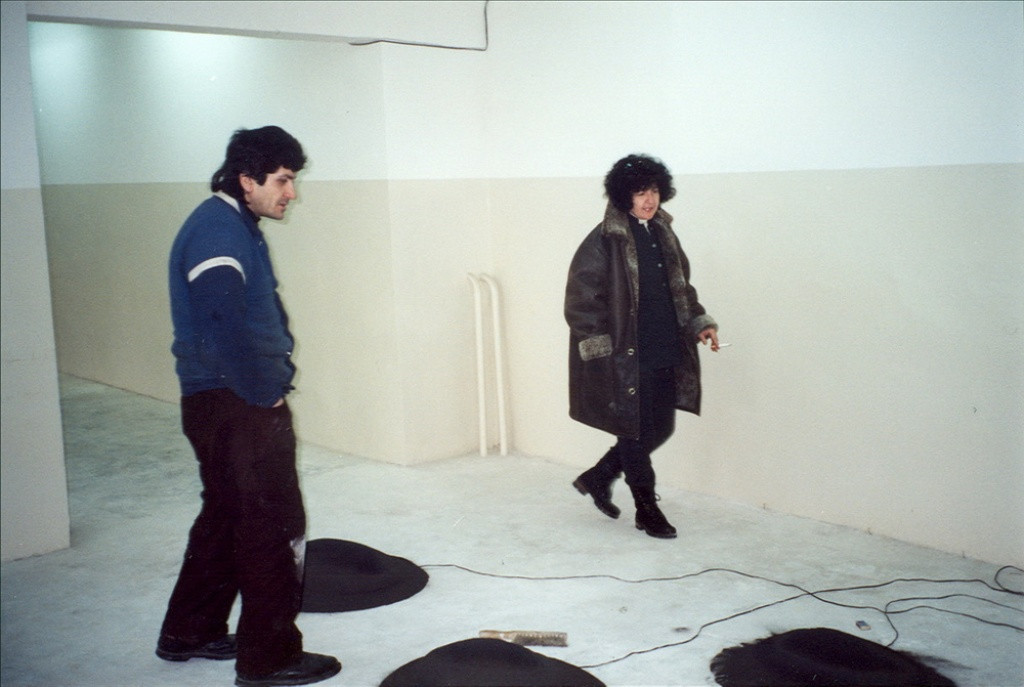
Armenia’s first participation at the Venice Biennale in 1995 can be understood as the result of cultural-political strategies pursued by the Republic of Armenia in the early 1990s. During this period, state cultural policy aimed to generate international visibility through participation in global platforms.[10] In this context, cultural production was mobilized not only to consolidate national identity, but also to contribute to processes of economic stabilization.[11]
These strategies emerged against the background of a profound structural crisis. Following the collapse of the Soviet Union, Armenia faced severe economic constraints, shortages of resources, and political instability, while the first war over Nagorno-Karabakh further intensified these conditions.[12] In the absence of substantial material export goods, culture came to be understood as a resource for external representation and as a form of immaterial export. As early as 1990, the Ministry of Culture established a commission tasked with organizing the export of artistic and cultural artifacts.[13] Ministerial decrees issued between 1992 and 1996 indicate that, for international exhibitions, preference was given to artists whose work conveyed an image of the Armenian nation as modern, forward-looking, and free from ideological burden.[14]
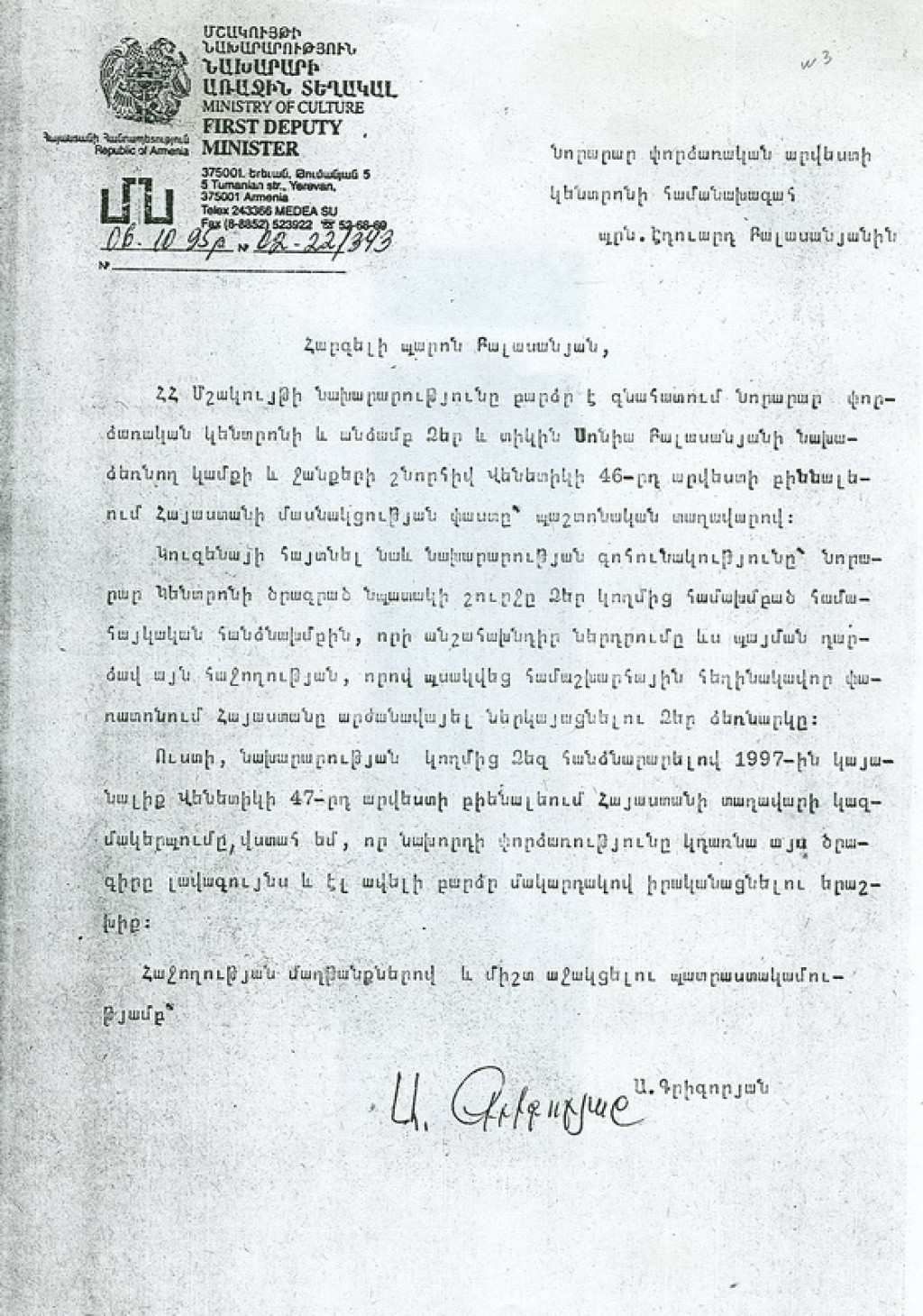
Within this framework, the commissioning of the ACCEA appears as a consistent choice. The institution was associated with modes of presentation that did not primarily address local discourses or rely on extensive theoretical framing. Instead, it operated through formats aligned with an internationally legible exhibition aesthetic, emphasizing conceptual and installative practices. In this sense, the ACCEA corresponded to the cultural-political objective of establishing an image of Armenia that was both contemporary and compatible with international exhibition contexts.
The 1995 Biennale debut was led by Sonia Balassanian, born in Iran and based in New York, who acted as both commissioner and curator. The exhibition presented Garen Andreassian’s Reality, Process, Control (1995) and Samvel Baghdassarian’s Accident/Experience (1993). The curatorial statement framed these contributions as evidence of Armenia’s cultural vitality and emphasized both artists’ familiarity with Western artistic discourse:
“Armenia today has its problems, but one it does not have is a lack of cultural vitality. The work of Garen Andreassian and Samuel Baghdassarian proves this. Both live and work in Armenia, both are installation artists who are well-informed about developments in the West […].”[15]
The curatorial staging thus operated as a form of nation-building. This was not achieved through the use of iconographic national motifs, but through the positioning of Armenia within globally legible codes of contemporary art. The works themselves largely avoided explicit national iconography, a fact that the curatorial statement explicitly underscored. In this way, the pavilion positioned itself against nationally oriented modernist tendencies that had emerged since the 1960s.[16] These tendencies had distinguished themselves from official Socialist Realism precisely through the mobilization of national-cultural emblems and historicizing signs. Socialist Realism, proclaimed in 1934 as the official style of Soviet culture, set the parameters within which artistic production was to operate. The Thaw period (1953–1964), however, introduced a degree of flexibility, allowing nationally oriented modernist approaches in Armenia to be promoted and institutionally consolidated.[17]
In this context, Balassanian stated:
„You will look in vain for specifically national elements in Andreassian’s work, and even in Baghdassarian’s, such elements are subject to extremes of metaphorical displacement, but their work demonstrates that Armenia is not a remote backwater, but a country with a long and splendid artistic tradition that still has something vital to contribute to our emerging ‘world culture’.”[18]
Samvel Baghdassarian (1956–2017) was one of the two artists presented in the first Armenian Pavilion at the Venice Biennale in 1995. At the time of the exhibition, the trained ceramicist lived and worked in Yerevan, where he actively participated in the local art scene. Alongside his artistic practice, Baghdassarian was also engaged in curatorial work. In 1995, he co-curated the exhibition Yerevan–Moscow: The Question of the Ark at the Museum of Modern Art in Yerevan, an exhibition institutionally supported by the ACCEA.[19] This project marked a form of collaboration between Armenian and Russian conceptual artists that was, in this configuration, without precedent. It addressed the attempt to re-establish cultural dialogue between the formerly designated “brotherly nations” in the aftermath of the Soviet Union’s dissolution.[20]
Baghdassarian’s simultaneous activity as artist and curator indicates a close institutional relationship with the ACCEA, situating his practice within its curatorial and organizational framework. At the same time, his exhibition history demonstrates that he was already integrated into transnational circuits of contemporary art in the early 1990s. He participated in group exhibitions in Poland (1991), Great Britain (1992), the United States (1993), Switzerland (1993), Germany (1995), as well as in Russia (1992) and previously within the Soviet Union (1989).[21] Through these participations, his work gained visibility within an international art field largely structured by institutions and contexts associated with what is commonly described as the Global North.[22]
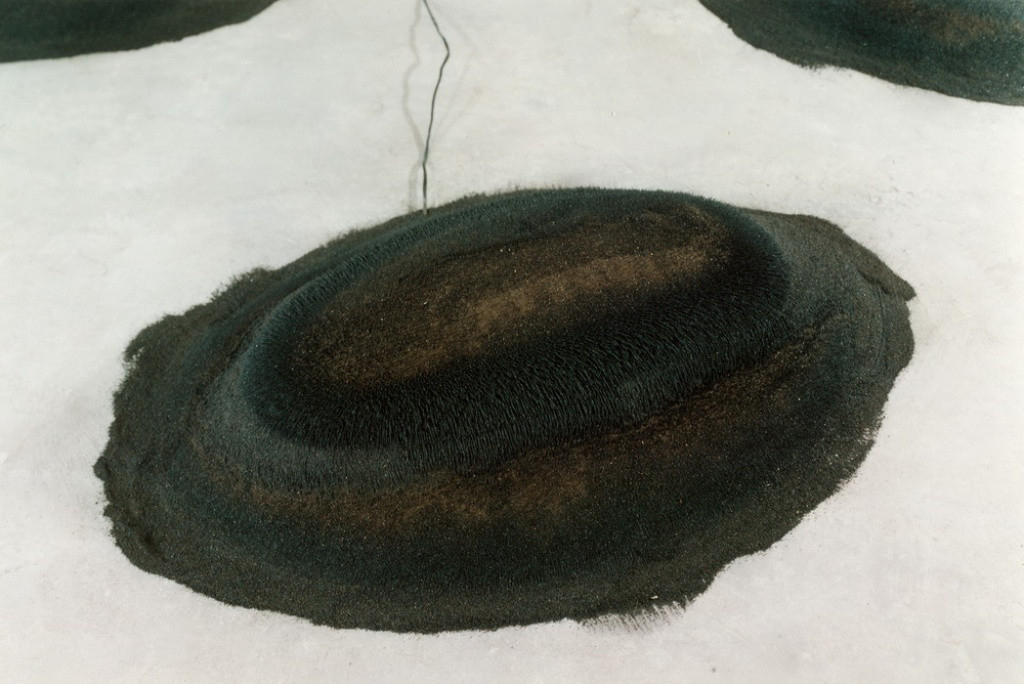
The Armenian Pavilion was presented at the Centro Studi e Documentazione della Cultura Armena (CSDCA) in Venice, a diasporically supported institution operating outside the central Biennale infrastructure and oriented toward making non-dominant cultures visible. Within this framework, Samvel Baghdassarian’s Accident/Experience (1993) consists of an installation composed of multiple elliptically arranged mounds of iron filings in dark brown and green tones, positioned at regular intervals. Programmed magnetic fields set the particles in continuous motion, producing an ongoing transformation of the mounds’ form. Placed directly on the light-colored stone or concrete floor, the installation creates a pronounced contrast between the brightness of the ground and the dense, granular texture of the material.
Accident/Experience engages both aesthetically and conceptually with the language of Western modernism. This reference is explicitly marked within the curatorial framework, as outlined in the previous section, and can also be substantiated through formal analysis of the work itself. In the exhibition catalogue, curator Sonia Balassanian explicitly identifies Marcel Duchamp and Vladimir Tatlin as historical reference points for Baghdassarian’s practice.[23] This framing supports a reading of the work within the discourse of Western modernity.
Both artists are considered central figures in the development of movement-based artistic practices, particularly within the field commonly described as kinetic art. Tatlin’s Monument to the Third International (1919), a large-scale steel construction incorporating rotating elements, has been identified by Frank Popper as an early example of this tendency.[24] Duchamp’s Bicycle Wheel (1913) is likewise received as a paradigmatic work in which movement becomes a constitutive element of artistic practice.[25] Within this curatorial logic, Accident/Experience is thus positioned within a global modernism articulated through the aesthetic codes of kinetic art.
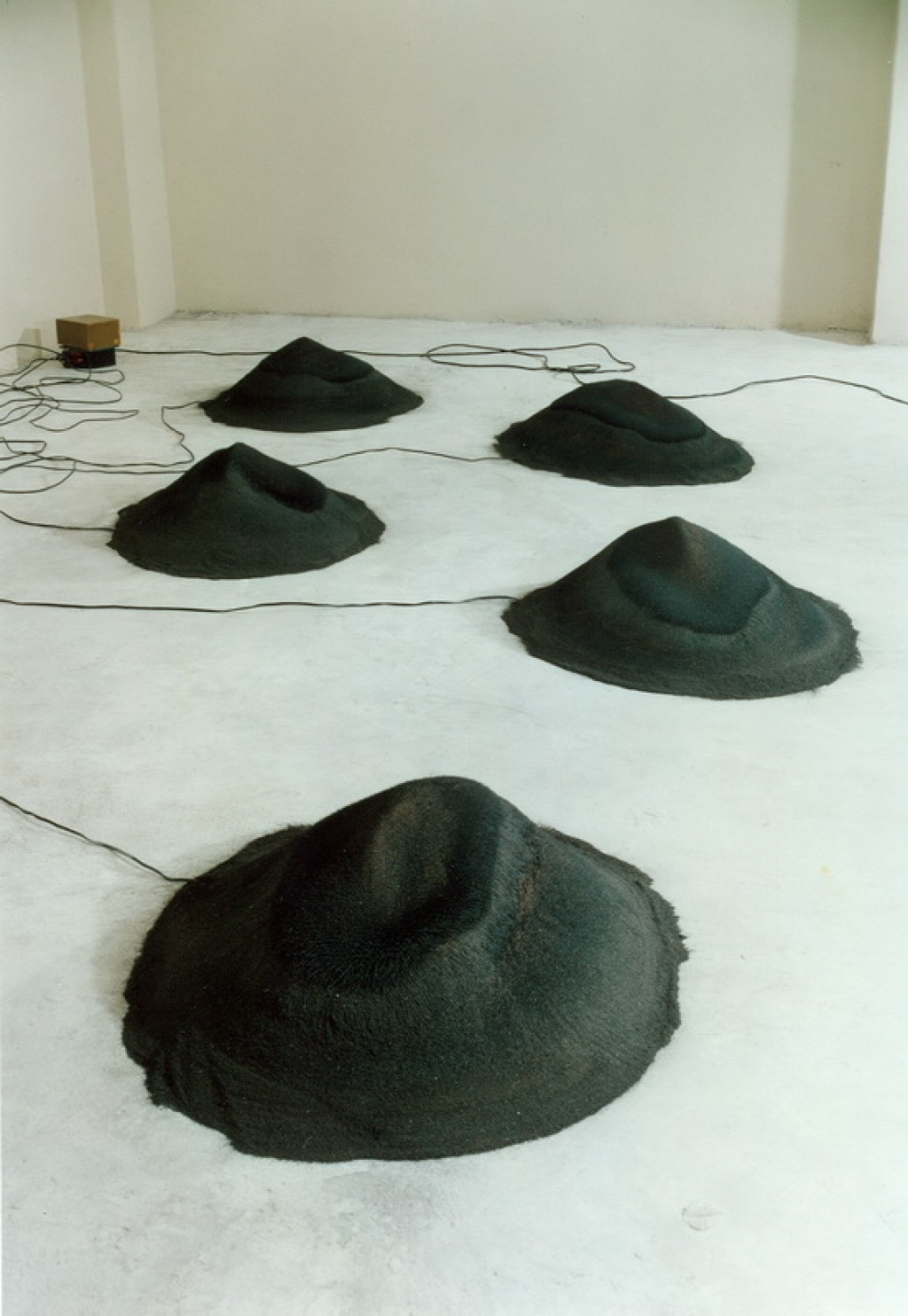
The curatorial reference to movement-based practices of modernism is also reflected in the thematic and formal organization of Accident/Experience. At its core, the work is structured around an aesthetic interest in transformation and process. As Hans-Jürgen Buderer has noted, a defining characteristic of kinetic art lies in the imitation or evocation of natural patterns of movement.[26] Baghdassarian adopts this principle by incorporating real, physically generated motion into the work. The movement is neither mechanical nor motor-driven; rather, it emerges from an invisible magnetic field that continuously reconfigures the iron filings.[27]
The resulting formations—elliptical mounds that expand, contract, and shift—recall dune-like or sedimentary landscapes. Their texture and coloration evoke associations with earth, moss, or mineral surfaces. Through their ongoing transformation, they point to processes commonly associated with geology and meteorology, such as erosion, sedimentation, or the gradual displacement of matter by wind. While elements of the technical infrastructure, including cables and power supply, remain partially visible, movement is not presented as a purely technical phenomenon. Instead, it is translated into a visual vocabulary that abstracts and rearticulates natural dynamics.
The classification of Accident/Experience within the art-historical context of kinetic art can be further specified through a comparison with the West German artist group ZERO.[28] As in Baghdassarian’s installation, the group’s practice aimed to render natural processes perceptible, rather than merely staging representations.[29] In this context, art functions as a medium for the sensorial mediation of natural phenomena, a claim that Accident/Experience formally realizes through the movement and transformation of the iron filings.[30] At the center of ZERO’s practice is the use of new, often industrial materials, which shift the work away from a static objet d’art toward a processual, dynamic experience.[31] By employing iron filings, Baghdassarian likewise works with a material that lies outside classical sculptural value categories, while simultaneously making processes of change visible.
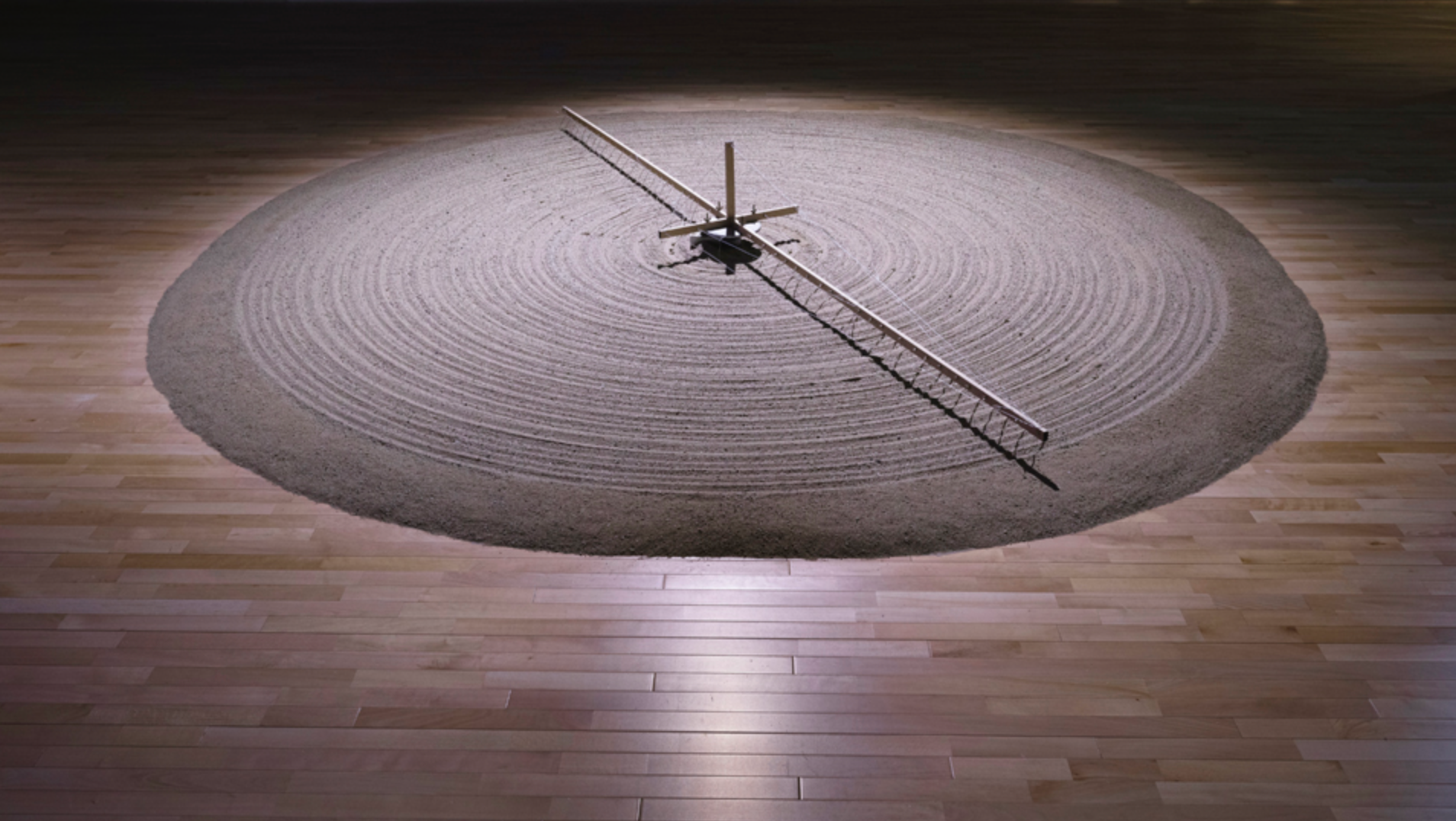
Like ZERO, Baghdassarian also responds to a historical rupture. While the West German group distanced itself, in the wake of the ideological and aesthetic collapse of National Socialism, from charged conceptual oppositions such as representation and abstraction, [32] Accident/Experience must be read against the background of the post-Soviet phase of transformation in Armenia. The disintegration of ideological orders there produced a symbolic vacuum. Within this context, Baghdassarian explicitly situates himself outside ideological discourses. In his artist statement, he writes: “My work’s relationship to nature, national culture and history is largely unconscious.”[33] In doing so, he positions his practice within an open, post-identitarian field.
The detachment from ideological discourses and the turn toward elementary, material-specific processes link Accident/Experience to ZERO and render the work compatible with transnational art discourses of postwar modernism. This compatibility, however, does not imply an uncritical integration into Western discourses. In contrast to the postmodern mainstream of contemporary Western art described by Boris Groys, which is characterized by the appropriation of historical styles, ideological symbols, or commercial visual worlds and their reorganization into new configurations, [34] Baghdassarian’s work eludes this logic. It operates beyond quotation and irony, as it neither relies on the recoding of ethnic or Soviet symbolism nor on subversive reenactments. Instead, it avoids referential overcoding and is oriented toward immediate, physical-sensorial experience. In this sense, both ZERO and Baghdassarian respond to an ideologically overdetermined past through an aesthetic emptying that neither reconstructs nor ironizes, but foregrounds elementary, material processes.
Baghdassarian’s practice must be read against the background of his training within the late Soviet art system. Between 1971 and 1980, he studied at the Yerevan College of Arts and subsequently at the Department of Applied Decorative Arts at the Yerevan Institute of Arts.[35] This education took place within a state-regulated system of art and training that was oriented toward the production of ideologically conform art. Within Soviet art pedagogy, artistic practice was functionalized: it served either the production of propagandistic image programs or the promotion of craft-based traditions.[36] The latter, for example those with an ethnically oriented focus in regions such as the North Caucasus, were reduced to a narrow framework of nationally or ethnically formulated, yet in content socialist-coded, formal and thematic prescriptions.[37] The aesthetic associated with this system aimed at ideological legibility.
By creating a sensorially accessible, processual arrangement, Baghdassarian foregrounds the kinetic moment, and with it change. In the reception of kinetic art, the art object is dematerialized and replaced by a temporally bound event.[38] This transformation alters the relationship between artist, work, and viewer: the work loses its material closure and becomes an effect or event. Accident/Experience thus breaks with the concept of the object embedded in Soviet art, which is oriented toward permanence, ideological unambiguity, and semantic control. Baghdassarian does not articulate a critique on the level of content in the sense of Western postmodern appropriation art, as described by Boris Groys, but instead operates on the level of form: he deconstructs the logic of the stable, ideologically controlled object in favor of an aesthetic of the ephemeral and the processual, thereby undermining central paradigms of his education.
Although materiality plays a subordinate role in kinetic art, since its central concern lies in the dematerialization of the artwork through movement, [39] the choice of material is nevertheless significant in this case. The curatorial statement explicitly attributes importance to the material used, particularly as a residue of physically demanding metalwork.[40] There, iron dust is described as a “modest remnant” of industrial processing, that is, as a substance without its own aesthetic function and, in material-technical terms, assignable to industrial waste. Within the hierarchy of sculptural materials, dust occupies one of the lowest positions and can be classified as an extremely “poor” material;[41] it thus stands outside traditional categories of value.[42]
This choice contrasts with the representational norms favored within the Soviet art system of Socialist Realism, which aimed at monumental, clearly legible, and enduring forms in order to signal ideological permanence and state authority.[43] Accident/Experience withdraws from this canon: the decision to use a fine-grained, form-unstable substance such as iron filings resists stable attribution of meaning and deliberately complicates its reception.[44]
In the first Armenian Pavilion at the Venice Biennale in 1995, a consistent narrative can be reconstructed with regard to Samvel Baghdassarian’s Accident/Experience. The work is framed in the language of Western modernism, as supported by the catalogue’s reference to Duchamp and Tatlin. National symbolism remains absent, while the medium of installation marks an alignment with international, process-oriented practices. The movement sequences induced by magnetic fields and the continuous material transformation can be identified as an engagement with the tradition of kinetic procedures.
At the same time, the work opens up an experiential mode of access that foregrounds process and change, while deliberately withdrawing from iconic representation. The choice of iron filings as a fine-grained, form-unstable material situated outside classical categories of value can be understood as a counter-model to the material-aesthetic norms conveyed within the Soviet system of artistic education, which privileged stability and permanence. In this way, the focus shifts from the enduring object to the temporally bound event.
The work demonstrates compatibility with Western modernist debates, while at the same time avoiding the postmodern logic of appropriation described by Groys and distancing itself from the Soviet object paradigm. From these observations emerges a position of aesthetic autonomy that follows neither the postmodern logic of appropriation nor the Soviet object paradigm. In this sense, Accident/Experience exemplifies how process-based and kinetic strategies operate as a form of post-Soviet repositioning within an international exhibition framework, while suspending both ideological representation and identity-based visual regimes.
[1] La Biennale di Venezia (ed.), 46. Esposizione internazionale d’arte, 1895/1995. Centenario (exh. cat., Venice, La Biennale di Venezia, June 11–October 15, 1995), Venice 1995; La Biennale di Venezia (ed.), BV 97. 47. Esposizione Internazionale d’Arte. Guida alla Biennale di Venezia (exh. cat., Venice, La Biennale di Venezia, June 15–November 9, 1997), Milan 1997; La Biennale di Venezia (ed.), 48. Esposizione internazionale d’arte. Dappertutto = Aperto Over All = Aperto Par Tout = Aperto Über All, vol. 1 (exh. cat., Venice, La Biennale di Venezia, June 12–November 7, 1999), Venice 1999.
[2] Catenacci, Sara: “Beyond the Giardini of the Biennale: Some Considerations on a Supposed Model, ” in: Ricci, Clarissa (ed.): Starting From Venice. Studies on the Biennale, Milan 2010, pp. 78–88, here p. 81.
[3] The Armenian acronym NPAK is also used alongside ACCEA; it derives from the official designation Նորարար Փորձառական Արվեստի Կենտրոն [Norarar P’vordzarakan Arvesti Kentron].
[4] Harutyunyan, Angela: The Political Aesthetics of the Armenian Avant-Garde. The Journey of the ‘Painterly Real’, 1987–2004, Manchester 2017, p. 19.
[5] Angela Harutyunyan emphasizes the central role of diasporic networks—particularly those of Sonia and Edward Balassanian—in introducing and consolidating “contemporary art” in Armenia, distinguishing it from nationally or traditionally defined “fine” art in favor of installative, conceptual, and post-medium practices; in contrast to other post-Soviet contexts shaped by the Soros Foundation, this function in Armenia was largely fulfilled by diasporic networks (Harutyunyan 2017, p. 20; Hock 2023, p. 98f.).
[6] Foletti, Ivan; Khakhanova, Margarita, Armenophobia. Art, Scholarship, and Russian Colonial Policy at the Turn of the Twentieth Century, Brno 2024, p. 11.
[7] Weeks 2004, quoted in Foletti; Khakhanova 2024, p. 64.
[8] ibid.
[9] Tlostanova, Madina: What Does It Mean to Be Post-Soviet? Decolonial Art from the Ruins of the Soviet Empire, Durham/London 2018, p. 40.
[10] Harutyunyan 2017, pp. 114–115.
[11] ibid.
[12] Arevshatyan, Ruben: “The History of the Illusive Island for Contemporary Art, ” in: Katapult Pavillon 2023 (exh. cat. Yerevan, Hay Art Cultural Center, 31.03.–30.04.2023), Yerevan 2023, p. 5.
[13] Karoyan 1993, quoted in Harutyunyan 2017, p. 179.
[14] Harutyunyan 2017, pp. 114–115.
[15] Balassanian, Sonia: [no title], in: The Armenian Pavilion at the XLVI Art Biennale of Venice (exh. cat. Venice, June 16–September 15, 1995), Venice 1995, p. 4.
[16] Armenian national modernism refers to a form of modernism that integrates national iconography and references to tradition into modern visual languages. It emerged in the Soviet context from the 1960s onward as a development of Socialist Realism and continued into the post-Soviet period; its institutionalization is marked by the founding of the Modern Art Museum of Yerevan in 1972 with Moscow’s approval (Harutyunyan 2017, pp. 44–45, 79).
[17] Harutyunyan 2017, pp. 43, 79, 111.
[18] Balassanian 1995, p. 4.
[19] Harutyunyan 2017, p. 148.
[20] ibid.
[21] Balassanian, Edward: [no title], in: The Armenian Pavilion at the XLVIII Art Biennale of Venice (exh. cat. Venice, The Armenian Center for Contemporary Experimental Art, 12.06.–07.11.1999), New York 1999, p. 4.
[22] The global political order until 1989 was shaped by an East–West geopolitical dichotomy (Kempe, Antje; Dmitrieva, Marina: “Introduction. Global or International? Reconsidering Socialist Art Histories, ” in: Hock, Beáta; Kempe, Antje; Dmitrieva, Marina (eds.): Universal — International — Global. Art Historiographies of Socialist Eastern Europe, Vienna/Cologne 2023, pp. 9–34, here p. 11). The Cold War division into First, Second, and Third World was subsequently replaced by the distinction between Global South and Global North (ibid.). In non-European regions of the former Soviet Union, such as the Caucasus, decoloniality is often still articulated in postcolonial terms that implicitly reproduce the distinction between Second and Third World (Tlostanova 2018, p. 34).
[23] Balassanian 1995.
[24] Popper, Frank: Die kinetische Kunst — Licht und Bewegung, Umweltkunst und Aktion, Cologne 1975, p. 170.
[25] Buderer, Hans-Jürgen (ed.): Kinetische Kunst. Konzeptionen von Bewegung und Raum, Worms 1992, p. 7.
[26] Buderer 1992, pp. 7–8.
[27] Buderer 1992, p. 143; Buderer distinguishes between “active” and “passive” behavior of artworks: active in works with hidden motors or drives, passive in works moved by external forces such as air currents, as in mobiles (ibid.).
[28] Ketner II, Joseph D.: Witness to Phenomenon. Group ZERO and the Development of New Media in Postwar European Art, New York 2018, p. 122; Ketner interprets ZERO as a positive new beginning after 1945, oriented not toward destruction but toward the constructive renewal of art, technology, and society.
[29] Ketner 2018, p. 123.
[30] ibid.
[31] Ketner 2018, p. 101.
[32] ibid.
[33] Baghdassarian, Samvel: [no title], in: The Armenian Pavilion at the XLVI Art Biennale of Venice (exh. cat. Venice, The Armenian Center for Contemporary Experimental Art, 16.06.–15.09.1995), Venice 1995, p. 22.
[34] Groys, Boris: Art Power, Cambridge 2008, pp. 166–167.
[35] The Armenian Pavilion at the XLVII Art Biennale of Venice (exh. cat. Venice, The Armenian Center for Contemporary Experimental Art, 09.05.–22.11.1997), New York 1997, p. 20.
[36] Tlostanova 2018, pp. 39–40.
[37] Tlostanova 2018, p. 40.
[38] Popper, Frank: Die kinetische Kunst — Licht und Bewegung, Umweltkunst und Aktion, Cologne 1975, p. 153.
[39] ibid.
[40] Balassanian 1995.
[41] Wagner, Monika: Das Material der Kunst. Eine andere Geschichte der Moderne, Munich 2001, p. 51.
[42] Artists such as Marcel Duchamp, Joseph Beuys, Erwin Wurm, and Ilya Kabakov have also worked with dust as an artistic material (Wagner 2001, p. 51). Kabakov occupies a central position among Soviet and post-Soviet nonconformist artists and provides a relevant reference point for examining the aesthetic meanings of waste in the post-Soviet context (Komaromi, Ann: “Soviet Trash: The Reception of Ilya Kabakov’s Art Beyond the USSR, ” in: Between. Journal of the Italian Association for the Theory and Comparative History of Literature, vol. IX, no. 20, May 2020, pp. 189–222, here p. 189).
[43] Bown, Matthew Cullerne: Art under Stalin, Oxford 1991, pp. 226–227.
[44] Komaromi 2020, pp. 190, 211.