New Tunnels in the Piles of Garbage
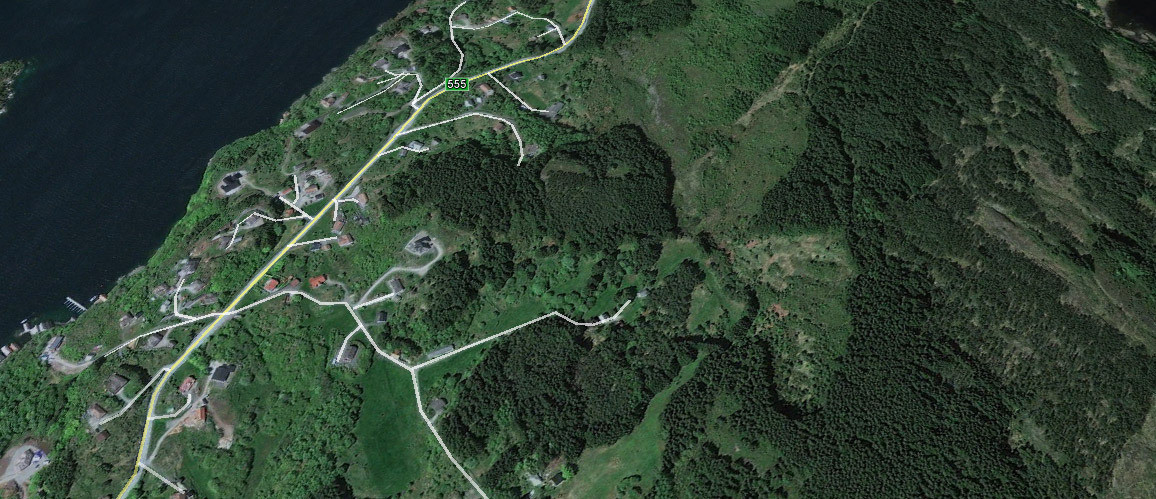
From above, at the scale of the Google satellite image, Norway looks like a pile of moss or mold. If you close up the resolution, the gray-green texture takes on the outlines of mountains and vegetation. Up closer, you can see that the trees and rocks are indeed covered with a thick layer of moss. The mold structure reproduces itself at different scales. The resolution can vary, and regardless of this, you can only see infinitely fragmenting outlines of self-organizing matter.
There are car tunnels inside the mountains. On the way from the airport, we passed one of them. My fellow traveler said that Norway is a "country of tunnels" — there are so many of them. Roads cut through the mountains, cutting off excess rough terrain. They are designed to smooth out the fractals of the fjords; they compensate for the irrational tendency of matter to repeat itself endlessly on different scales.
The fellow traveler served in the Norwegian army as a grenade launcher for 20 years, suffered a professional injury and decided to switch to something creative — he devoted himself to fine art. I didn’t tell him that fine art is widely used in the world war of all against all, along with firearms and other types of weapons, otherwise why would governments spend money on it? I didn’t mention it. The conversation turned to the difficulties of fighting in the Norwegian mountains. Norway cannot be conquered. All tunnels will be sealed, all roads blocked, and only steep mountainsides and forests with partisans will remain — insurmountable obstacles. Unless the conquerors have the fantastic technology of drilling through mountains…
When fighting takes place on the scale of a single city, the walls of houses are not considered as an impassable obstacle. Troops on both sides are trying to smooth out the urban landscape to expose enemy positions. Or at least cut corners, remove the ruins from the way, make a way to where you can surprise the enemy. That’s where the Carl Gustaf grenade launcher might come in handy.
New roads are being built in the city. Paradoxically, they go straight at the same time, bypassing the generally accepted shortest paths, bypassing the usual ones, and into battle. These are paradoxical roads, the construction of which is dictated by military necessity.
The creators of Zvezdny Prospekt also look through the city walls. The pioneers, as they call themselves, laid out a route through the Italian city of Biella in the form of a five-pointed star. They ignored the city roads, their avenue pierces through all the obstacles standing in the way between the peaks of the star — houses, fences, vegetation and other private and public property.
The route was preceded by a thorough collection of building data and conversations with residents. Despite this, many obstacles could not be pierced through, they had to be avoided and the lines did not turn out to be strictly straight. By the curves of these lines, one can judge the specifics of the economic structure of the Biella community, how deeply private property was rooted in the land and in people’s minds, and how difficult it was for the pioneers to filter through the fractals of the human extended phenotype.
For initiator and chief engineer Anastasia Ryabova, Zvezdny Prospekt is a living exploration of the city, an emancipated anarcho-local history, and a critique of urban planning. The collective body of pioneering local historians overcomes obstacles in a disciplined manner in order to draw a star and thus socializes. The best socialization is emancipation. These are the rules of the game. Art does not happen as a result, but in the process of communicating with owners and authorities. In the end, the severely thinned group returns to its starting point.
by urbanfauna.agency