On Evil and Suffering
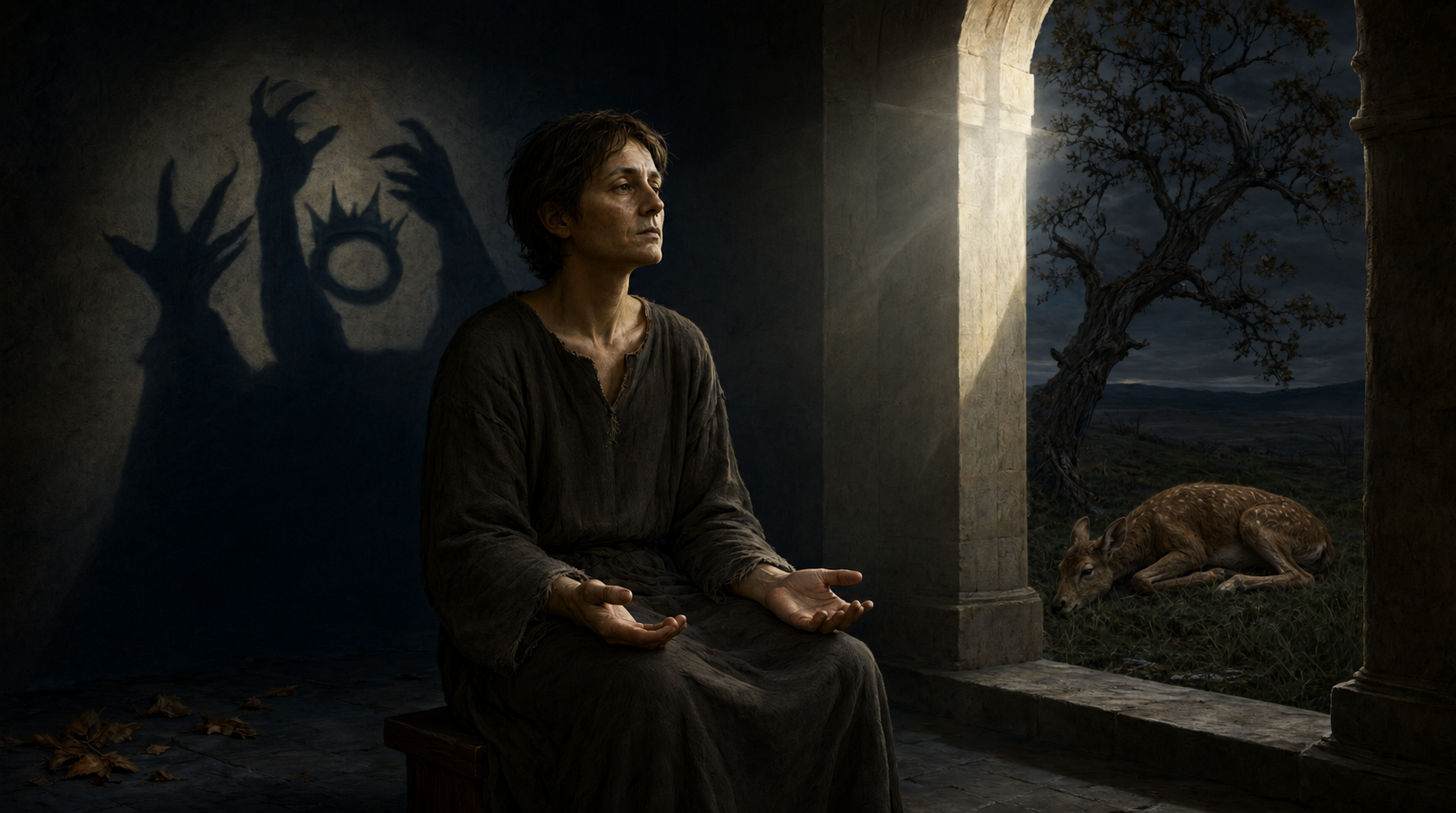
I do not know why the world, whose Source I take to be a good Creator, includes pain, illness, and death. I do not know why the history of life is bound up not only with development and increasing complexity, but also with struggle, loss, and the death of living beings.
I can reflect on this, look for possible explanations, and compare them with one another. But I cannot claim to see the Design from a vantage point at which every individual instance of suffering acquires its final meaning.
Perhaps such a vantage point exists. But I am not standing there.
There is a particular danger in attempts to justify the way the world is ordered. An explanation may be internally coherent, yet achieve that coherence at the expense of the one who suffers. Another’s pain becomes a necessary step in universal development, a condition of a greater good, or an element of a harmony that a human being is not yet able to see.
Perhaps ultimate wholeness really does exist. Perhaps within it there will be a place for what now seems meaningless. But hope for such wholeness does not yet give me the right to claim that I know the purpose of every pain.
One may suppose that the reality of a created world requires stable causes and real consequences. A world in which every painful consequence were canceled by a separate intervention would not be a genuine order, but a stage set continually corrected from outside. Perhaps the Creator creates not the appearance of a world but a reality whose processes have force of their own.
But this supposition explains only the possible value of a stable order. It does not explain the measure of suffering, nor does it answer why the structure of life turned out as it did. Still less does it give us the right to claim that pain is desired by the Creator for its own sake. It therefore cannot be a complete theodicy.
It is especially important not to explain all suffering by human freedom alone.
An animal does not suffer because it has committed a moral wrong. Illness does not decide to cause harm. A natural disaster has no intention. Pain and death existed in the history of life long before the appearance of the human person and moral choice.
Natural suffering cannot be fully accounted for by human selfishness. But it does not follow that the distinction between suffering and moral evil is unimportant.
In the world as it exists, life is bound up with vulnerability to pain, illness, loss, and death. These realities can destroy life, evoke horror, and call into question our capacity to trust its Source. But in themselves they are not yet moral evil.
A discussion of moral evil cannot begin only with the crimes of others. For me, its first honest formula is this: evil enters the world personally through me. It begins where my will ceases to recognize the independent value of another being and reduces that being to a means for my own ends.
I do not create the possibility of pain itself, but I can turn another’s vulnerability into an instrument of evil: deliberately inflict and multiply suffering, appropriate another’s pain, and use another’s weakness to my own advantage. I can justify my own cruelty by what I myself have suffered and turn freedom into a right to control another person.
This does not require committing a crime. Evil can enter an action that remains outwardly good. Help can become a basis for power. Service—a way to assert one’s own importance. Care—a demand for gratitude. A desire for justice—a justification for hatred.
The desire to live, preserve oneself, be recognized, and expand one’s own possibilities is not in itself evil. That force is natural. Without it, a person could not act, create, protect those close to them, or answer for what has been entrusted to them.
The problem lies not in the existence of this force but in its direction.
It can be directed toward another person, toward a common undertaking, toward the continuation of life beyond one’s own interest. But it can close in on itself. Then a person begins to measure everything that happens by the extent to which it confirms that they are important, that they are secure, and that they are right.
Weakness is not in itself evil, but it can become a justification for claiming the right not to see the other. In the same way, service can bring real good and at the same time feed pride: a good outcome does not yet testify to purity of intention.
It is therefore not enough for a person to choose the right action once. Intention can change within the good itself. The more a person does for others, the easier it becomes to take what has been done as proof of one’s own moral superiority.
Then they need not only the result but also confirmation of their own authorship: the benefit must come specifically through them. Another person’s success begins to be perceived as a threat, even when it serves the same end.
Thus evil reveals itself not only in obvious cruelty. It appears in the appropriation of the good, in the will closing in on itself, and in the unnoticed substitution of one’s own importance for the end.
A person can notice this shift, but noticing it does not yet free them from it. I can see my own pride and immediately credit myself for that honesty. I can take pride in my humility, turn the acknowledgment of guilt into a new form of superiority, and even use the desire for correction to restore the image of myself I want—now as someone especially honest, deep, and spiritually experienced.
Inner work therefore cannot be reduced to self-observation and self-discipline.
I can see the direction of my will, stop justifying it, and begin to change my actions. But here the limit of my own efforts becomes visible: I cannot fully correct the will by means of the same movement of will that itself needs correction.
At this boundary of my own capacities, repentance begins for me.
Repentance is not an inventory of wrongs or a way of conveying to the Creator information supposedly unknown to Him. It does not necessarily require spoken words. Sometimes words even get in the way, because they allow a person to remain in control of what is happening: choosing their wording, assessing how sincere they are, and watching themselves from the outside.
Outwardly, this turning can be completely quiet. In the extreme experience I call repentance here, there is no room left within a person for self-justification, for counting on future merit, or even for the question of whether they will be forgiven. They see the direction of their own will and can no longer agree to remain as they are.
This is not yet correction. It is a request for correction.
At that moment freedom appears not as the ability to remake oneself by one’s own power. It remains at a minimal but inalienable point of personal response: to go on defending what one has discovered in oneself or stop defending it; to turn what one has seen into grounds for self-pity or turn to the Creator; to demand confirmation that one is right or ask that what one can no longer honestly call right be changed.
In turning to the Creator, a person neither produces nor completes their own correction. They freely open themselves to the Creator’s action, but that openness does not free them from further participation in inner work.
I do not know how this action takes place, and I do not think it can be described as an inner mechanism. Sometimes a person experiences a clarity in which familiar contradictions temporarily recede and the right direction becomes evident before any reasoning.
But such a state cannot be appropriated. It cannot be turned into merit, summoned at will, or used as proof of one’s own chosenness.
It can go away.
And perhaps its departure is no less important than its arrival. While clarity fills a person, the right action can seem almost natural. Inner work begins in earnest when ordinary life returns and the chosen direction has to be maintained without a special feeling, without inner uplift, and without confidence that one is right.
Inner work does not consist in holding on to a state once experienced, but in a readiness to notice deviation again. To acknowledge the harm one has caused without demanding immediate forgiveness. To return to another what belongs to them. To put right what can still be put right. Not to use the impossibility of complete restitution as a reason to do nothing.
Repentance does not cancel consequences. A change of intention does not bring the dead back, erase a wound inflicted, or oblige the person who was harmed to restore the former relationship. It changes a person’s direction, but it does not rewrite the past.
Inner work therefore does not end with a sense of closeness to the Creator. It continues in actions performed after that sense has gone.
Inner work does not require us to stop seeing the suffering of the world. Trust acquired at the price of indifference to another’s pain would be another form of self-deception. The correction of one person does not explain illness, death, or the suffering of living beings, and it does not resolve the problem of theodicy. It only prevents the unresolved nature of theodicy from being used to justify one’s own participation in evil.
I cannot explain why a good Creator permits the full measure of natural suffering. But neither can I take that suffering as proof that the Creator does not exist or is indifferent.
For me, trust arises not from a complete picture of the world but from an inner sense of the Creator’s presence as the Source of being and goodness. This is not scientific proof, nor knowledge that I have the right to impose on another. From this trust arises my personal hope.
In my Christian understanding, this hope is rooted in Christ. I understand that connection not as a formula that makes every pain intelligible, but as the conviction that the Creator does not remain an external observer of human suffering and that death does not have the final word.
Victory over death does not yet explain every death. But it does not allow death to be taken as the final meaning of the created world.
I do not know how the history of Creation will be completed or what its ultimate wholeness precisely means. I can only hope that the world as it now exists is not the final measure of the Design, and that the pain a person has endured does not exhaust that person’s fate.
This is hope, not a solution.
It does not forbid a person to question, argue, and refuse premature reconciliation. Perhaps honest disagreement is closer to faith than an explanation offered only to defend the Creator from a human question.
The Creator does not need our rhetorical defense. But the one who suffers needs their pain not to be used as an argument.
I therefore cannot end by saying that everything that happens is necessary and right. I do not know that.
I can indicate only a direction.
A person does not have to explain the whole world in order to stop multiplying evil. But after seeing another’s pain, they can no longer honestly pretend that the question of how the world is ordered has been settled.
Inner work takes place in the tension between responsibility for what lies within a person’s power and a question to which they have no final answer.
It begins with a readiness to see one’s own participation in evil, continues with a freely made request for correction, and is confirmed by actions that demand neither recognition nor reward.
It does not destroy the question of suffering.
It does not allow us to hide behind it.