INNER ECOLOGY
Abstract: This essay introduces a concept of inner ecology as a means of understanding the relation between human animal and nature. The inner intensity is reflected as of the same importance as exterior one, and related to the concept of biopolitics turning to necropolitics in a war-state of the world, that is explained as anti-ecological.
We can no longer sit idly by as others steal our mouths, our anuses, our genitals, our nerves, our guts, our arteries, in order to fashion parts and work in an ignoble mechanism of production which links capital, exploitation, and the family. We can no longer allow others to turn our mucous membranes, our skin, all our sensitive areas into occupied territory—territory controlled and regimented by others, to which we are forbidden access (To Have Done with the Massacre of the Body, Félix Guattari) [1].
1 — Living is living in the living
Reading various essays on body politics, be it a homo-sexual or a female or a body without organs, rarely do I see an understanding of what a body is. Or, rather, I read between the lines that: a) body belongs to human (belongs to humanity as a concept, belongs to the global exchanges, economics, culture, science, knowledge, consciousness); b) my body belongs to me (not a father, not a mother, not a family, not a medical institution, because I want to have power and control over reality and over myself); c) my body belongs to societal practices (to a state, an emperor, a king, a master, a jail, a school, service, a job, an institution); d) body belongs to nature (to life, death, birth, diseases, functions); e) a body is a beast-part of a human (uncontrollable mechanism, that lives and desires on its own as an animal, not understanding death, life, sex and the relations between them). Barely among these I meet a statement that a body belongs to someone else except the human world, that it’s built not by outside, but inside, and this inside is a world to those who never see the exterior and only know and dwell in the interiors of the body. I mean various things — from bacteria, temporal structures, cells, mitochondria to the microbiome that outnumbers human cells ten to one, to viruses woven into the genome itself. For them, a human body is not a part of nature, it is nature, their habitat.
But what is nature? Or how much of nature is nature? Two rocks and two trees — is it nature? Ten rocks and ten trees? A pile of rocks and a pile of trees? An incomprehensible number of rocks and trees? Or maybe a historical number of iterations of rocks and trees? As dark ecologist Timothy Morton puts it in his essay Ecology without Nature, nature is a hyperobject, relying on The Heap paradox. A hyperobject that gave birth to another hyper-object that is ecology. The quality of both is their vastness, invisibility, their ability to hide from precision and their openness to interpretation.
“Nature is nowhere given to me in my phenomenal experience. I see rabbits, I see thunderstorms, I hear the mewing of cats. But I fail to see or otherwise sense Nature. Perhaps then Nature is the totality of a certain set of things. I go about constructing this set: birds, fish, mammals… Yet by definition the set always excludes something. Let us add nonliving forms such as iron deposits and chalk hills, which are made of lifeforms — as are most of the top levels of Earth’s crust. This set excludes what lies below the crust and, say, the electromagnetic shield around Earth that protects it from solar rays, and so enables life to evolve. So let us now include nonlife in our set” (Ecology without Nature, Timothy Morton, p. 63) [2].
One can’t calculate nature, that’s why it was seen as an infinite source of wellness, it’s a bottomless pit of appearance and disappearance, a source of restoration, re-vitalization and regeneration, a source of birth and birth and a new birth. Nowadays, nature is considered a finite resource, when some species, biomes, soils, and waters had disappeared. When there is a change to the infinite and generous power of nature. But is regeneration itself considered finite? If there will be less living substance, less structures to make other structures, it might become so.
“Conflating its historical necessity with ‘natural necessity’, capital cannot recognize the true meaning of ‘natural necessity’, which consists of the elementary requirements of production confined by the universal metabolism of nature. It instead behaves as if even these absolute natural limits are transcendable — some might be actually transcendable with the aid of science and technology but obviously not all — and aims to subjugate them for the sake of its further valorization, leading to the ‘degradation and ultimate destruction of nature’ (Mészáros 1986: 183). Since capital cannot recognize absolute limits, a ‘conscious recognition of the existing barriers’ as the condition of the universal development of the individual is a revolutionary act” (Marx’s Theory of Metabolism in the Age of Global Ecological Crisis, p.18) [3].
The restoration of flesh has a price. It’s a simple price — another flesh. There is no infinite source of powers in nature, there is a finite amount of living material that can be consumed and converted into another living thing. And as the species, water, soil and air can become scarce, revitalization, birth, regeneration can become so. It can be lost as heat according to the entropy in the 3rd rule of thermodynamics 4. And it’s beautifully imagined in the game Scorn (2022).
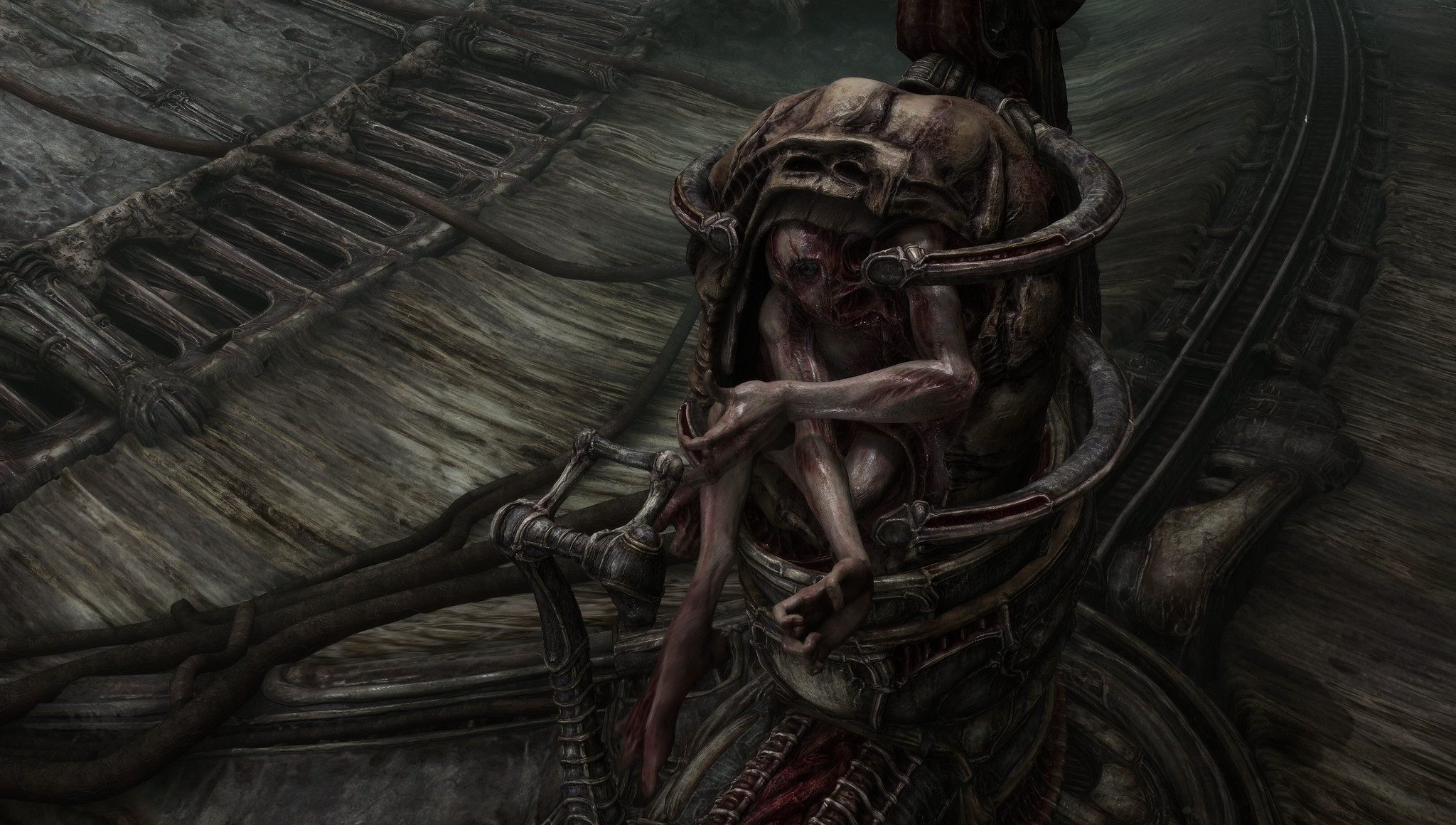
Image 1. Scorn (2022), moldman cripple processing, stitched panoramic screenshot [5].
In the realm of Scorn, flesh is made into a disposable and recycled tool to be used to produce the next flesh out of itself. This flesh has no mouth, no penis, no anuses, no guts, no nose, no breasts and no vaginas. Just as Félix Guattari described it, capitalistic production robbed it all. This creature is born to start the next living mechanism and be dragged inside this mechanism for it to start working and produce the next creature to start the next cycle. Flesh is working power, and a resource, Scorn offers a very brutal depiction of this truth.
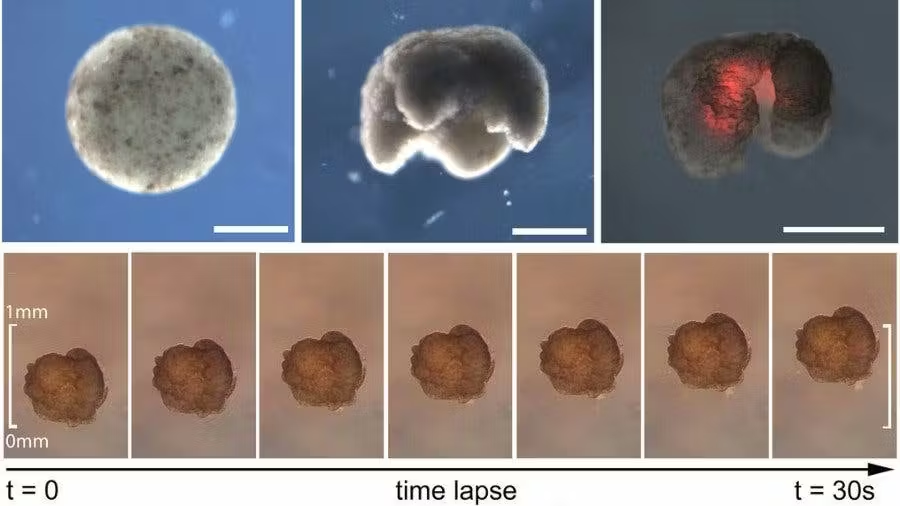
Image 2. Xenobots, AI-designed bio-robots made from Xenopus laevis frog heart muscle and skin tissue made by Sam Kriegman and Douglas Blackiston.
Flesh can be made into a part of a machinery as the flesh is a machinery itself. Or, rather, it could be made. But a living machinery fails to live without its complexity. And its complexity is closely tied with the concept of inner ecology.
2 — Inner ecology
What is inner ecology? I would like to describe it from the point of view of popular ecology. Ecology is a caring attitude towards the living, the Earth and its status quo. Ecology also is recognition of the negative impact of human acceleration and technocracy on Nature and its cycles. Ecology is also a reflection on the borders of the power of living and its recreation. Ecology is activism, practice, theory, politics, ideology, science and lifestyle. Ecology is a guilty person trying to save something driven by the Loss Aversion effect. But also, its inability to accept the loss, inability to accept not the end of nature, but the end of humans. Inability to resign on a human path to strive, build life based on Classicism concepts of prosperity, meaning, reason and goal. It’s inability to give up these concepts, turned into an attempt to understand what life is by itself, with no humans and its dreads.
“Hyperobjects are directly responsible for what I call the end of the world, rendering both denialism and apocalyptic environmentalism obsolete. Hyperobjects have already ushered in a new human phase of hypocrisy, weakness, and lameness: these terms have a very specific resonance in this study, and I shall explore them in depth. Hypocrisy results from the conditions of the impossibility of a metalanguage (and as I shall explain, we are now freshly aware of these conditions because of the ecological emergency); weakness from the gap between phenomenon and thing, which the hyperobject makes disturbingly visible; and lameness from the fact that all entities are fragile (as a condition of possibility for their existence), and hyperobjects make this fragility conspicuous” (Hyperobjects, Timothy Morton, p.2) [6].
Ecology is not about nature. It’s about humans. It’s a deeply egocentric concept and it’s tied to the health and life of humanity as a part of nature. This is why being anti-ecological is a death-wish, or anti-human, or just morbid. And as ecology is hyperobject, it’s easy to say that the problems it states just don’t exist.
“A White House spokesperson said that Trump was “unleashing American energy like never before — ending the Green New Scam, cutting harmful regulations, reopening offshore drilling, and approving the first LNG (liquified natural gas) project since Joe Biden’s disastrous ban last year” (Trump has launched more attacks on the environment in 100 days than his entire first term, The Guardian, Oliver Milman, 1st May 2025) [7].
But when we consider a body, it’s not an abstract, or hyper-object. It’s a present and very close, very knowledgeable object, and its ecological problems are simply detectable, as micro-plastic in brain cells, they are diseases and malfunctions. Because someone inside the body is unable to do its work. Or there is no one to do it. But body is not one, body is not a whole, it’s not even parts. The body is a colony, it’s constructed of other bodies that strive to live, it’s a biome, it’s inner nature. And if we are accepting the existence of exterior ecology as the assembly of species and living creatures, we should acknowledge the ones that live inside us.
We are — our sense of presence, wholeness, rationality, our sense of us is simply false. “I” is an illusion of cognition, a basis of the decision-making center of the body. “I” is a surface level of it, a distant ruler, a nonchalant empress in a high tower, looking at her belongings — her lands, her isles, full of the houses of the peasants that work not for her, but for themselves. The ruler doesn’t ask how they live and what they need, she guesses, she doesn’t ask permission, she uses and demands. Consciousness is a colonizing entity, and from time-to-time the body (as a colony of the living inside the body) asks for one thing, and the “I” chooses another. I bet you have experienced it dozens of times.
Have you ever been so tired after a working day full of tasks, that you barely could stay awake? You obviously needed to sleep, yet you made yourself prepare for the next day. You went to the shower, you checked your mail, or you finished a task, because it was the deadline. More to it, tomorrow you should have woken up very early, and it stressed you even more. You were afraid to oversleep, you were afraid of waking up tired, you were afraid of being too nervous and not being able to fall asleep at all. You completed your tasks late and your hands became cold and numb, your eyes were strained, your brain barely functioned. Then you felt unfamiliar pain in your arm, but there was no wound. It was almost like a sting, but a feeling that something got broken inside. It was very mild, very small and unreachable, strangely phantom. And you understood, that this arm all these hours lived a completely different life from yours. It had nothing to do with your deadlines, tiredness, confusion, or stress. It lived as an arm, a colony of bacteria in your palm, at the crook of your elbows, the bacteria that became parts of your cells, the ones that became a part of your genes. They all are different ones; they are not you. And not only an arm. Even more of you is not you. Among hundreds of them, you are a little part of the object “you” consider “yourself”. You are an object of multy-existence, and this multiexistence is absolutely unaware of being the whole.
This is what inner ecology refers to.
I find it unfair that this aspect of the body is neglected, even if I agree with feminist or queer or post-colonial understanding of the body. And there are a few concepts of the body in philosophy. It’s a lesbian body by Monik Vittig, it’s a cyborg by Donna Haraway, its body without organs by Deleuze and Guattari and many more.
“Desiring-machines make us an organism; but at the very heart of this production, within the very production of this production, the body suffers from being organized in this way, from not having some other sort of organization, or no organization at all. "An incomprehensible, absolutely rigid stasis" in the very midst of process, as a third stage: "No mouth. No tongue. No teeth. No larynx. No esophagus. No belly. No anus." The automata stop dead and set free the unorganized mass they once served to articulate. The full body without organs is the unproductive, the sterile, the unengendered, the unconsumable” (Anti-Oedipus, Gilles Deleuze and Felix Guattari, p. 8) [8].
I want not a conceptual, but a living body present in philosophical writing. I want it to be what it is, not a constructed metaphor made to support sociological and psychological or left- or right — ideas. I want theory to look at praxis. What body actually is? How body lives? To answer this question, we need to take a look at some biological concepts. A concept that emphasizes the interrelation between the inside and outside is symbiogenesis 9. It highlights bacteria’s role in evolution and genetics in symbiogenesis theory by Lynn Margulis. Contrary to the image of the clean, closed and unbreachable body, it depicts a body that is open to other bodies, a body that co-exists, that is built from multiple bodies. For example, it emphasizes the role of bacteria in evolution. Cells are structures that evolved from bacteria, and it has bacteria’s organs.
Mitochondria were a bacterium, when they merged with other bacteria that had a digestion system, that could move or had chlorophyll, or other special organs. These cells created different species — plants, mammals, insects and other kingdoms. And the coexistence of bacteria, their ability to make symbiosis, to collaborate is an antagonistic vision of evolution to the Neo-Darwinism theory, which considers evolution a competition-driven, all-against-all war [10]. Neo-Darwinism also highlights auto-processes as for example mutation-theory. Contrary to it, symbiosis proposes that organisms are connected and inter-dependent. This theory serves to a better understanding of ecology, outside or inside, and strengthens the relation between these two.
Because just as nature, a body can be polluted, abused and mis-used. And the most important form of body abuse is reproductive labor.
3 — Necropolitics
Reproductive labor is one of the shadiest labors of all time. It was clothed with so many veils. It is soaked with guilt, shame, and dread. It’s sacred, but also precious and priceless. Strange enough, it gives a mother no honorary labels. A female body is constantly abused. Female organs are a resource. Be it chicken eggs, cow milk, or the flesh of a female body and her children. Femininity is doomed by the rules of life — cycles of making one substance into another — living in dead and dead in living.
"The wolf also shall dwell with the lamb, and the leopard shall lie down with the kid; and the calf and the young lion and the fatling together; and a little child shall lead them. And the cow and the bear shall feed; their young ones shall lie down together: and the lion shall eat straw like the ox. And the sucking child shall play on the hole of the asp, and the weaned child shall put his hand on the cockatrice' den. They shall not hurt nor destroy in all my holy mountain: for the earth shall be full of the knowledge of the LORD, as the waters cover the sea" (Bible, Isa. 11:6–9, TNKJV) [11].
An example of a chewing and puking death machine is the government in a state of war.
It abuses the abused birth cycles even more. I have been watchfully tracking Russian pro-life propaganda after the Russia-Ukrainian war started. Interestingly enough, biopolitics, which were in a stasis, woke up and intensified to the point of becoming aggressive [12].
As the pile of corpses grew up, the more absurd, misogynistic and inhuman proclamations from officials became. And a naked truth appeared — a state wants to devour lives; it raises soldiers to continue the war. Men who make decisions about it and women who support it should immediately resign. Yes, they slowly criminalize abortions, decriminalize domestic abuse, and encourage under-age girls to become mothers.
Biopolitics is the ugliest among the economics and businesses. Biopolitics is necropolitics.
Only a mother should decide if she wants to start a war. Only a mother can understand the value of her children. A mother gave life and she should decide, if it should be taken. This way, with mother’s love and a pity to her children, every war should end. Because I believe there will be no wars. Because a mother knows the price of life.
Yet, she only has an opportunity to be nudged by the pro-life posters, that give false impression of government support for her motherhood, her child and her family, giving false impression of what a child is. Giving a simplified image of parenthood as raising an eternal newborn, Puella Aeterna or Puer Aeternus. It’s not a person; it’s a vessel of the concepts of childhood — cleanness, innocence, goodness, pureness — the religious misconceptions, that were transferred to modern times through the education system. This system evolved in the 19th century as a discipline of no sexual behavior as Michel Foucault shows in his The History of Sexuality. The concept of childhood is deeply rooted in suppressing the human animal body, it’s a practice of denying inner ecology. As for it’s not repressing the obedient, but most disobedient processes of it, processes that are happening on its own, processes of the inside. It abuses the nature of the body. It cheers when it obediently perishes. It would love it if it would never grow and mature.
“The space for classes, the shape of the tables, the planning of the recreation lessons, the distribution of the dormitories (with or without partitions, with or with out curtains), the rules for monitoring bedtime and sleep periods-all this referred, in the most prolix manner, to the sexuality of children. What one might call the internal discourse of the institution-the one it employed to address itself, and which circulated among those who made it function-was largely based on the assumption that this sexuality existed, that it was precocious, active, and ever present. But this was not all: the sex of the schoolboy became in the course of the eighteenth century-and quite apart from that of adolescents in general-a public problem” (The History of Sexuality, Michel Foucault, p.28) [13].
What the mother doesn’t know from this brochure is that as time comes, her newborn will be forced to transform into a killer, a soldier, and suddenly there is no care, no tenderness, no sympathy, no pro-life statements. This child is suddenly disposable, because the concept of a newborn is no longer connected to him or her. Because suddenly we have one concept and another layering over the same body seamlessly and surprisingly smooth, signifying and re signifying things without shame. How can it be that in pro-life brochures a mother is fed with not even half-truths? And how can it be that parents fall into believing them, and then become surprised that someone else, a different one is living inside their house, the one they invited into their home themselves to then deny the human nature of being different, trying to make them homogenous to themselves? How can it be that parents don’t understand that their child is not a making, but appearing, not a chosen, but a stranger?
These questions are a part of inner ecology, because the reproductive system of the human body (which is nature) is a place where politics, economics, ecology, self and others meet. It’s a place where authority lays its invisible powers. Its violence made before violence. It’s a place where all wars start, and a body is indeed made with violence.
If we want to deeply acknowledge ecology, we need to consider inner ecology. We need to start understanding where the world begins. We need to acknowledge the means of the powers of reproduction, its rules and its limits. We need to see reproduction as a finite resource that is neglected and abused by the religious, scientific, philosophical, political, sociological concepts. We need to include reproduction in the structures of knowledge to understand them, we do not need to shade it with so many veils, but to unveil it and look at what it is in all conditions, human or not.
_______________________________________________________________________
[1] Félix Guattari, To Have Done with the Massacre of the Body
[2] Theory on demand #8, Timothy Morton, Ecology without Nature, p.63
[3] Marx’s theory of metabolism in the age of global ecological crisis
[4] Third law of thermodynamics, Wikipedia
[5] SCORN, moldman cripple processing, stitched panoramic screenshot
[6] Hyperobjects, Timothy Morton, p.2
[7] Trump has launched more attacks on the environment in 100 days than his entire first term, The Guardian, Oliver Milman, 1st May 2025
[8] Anti-Oedipus, Gilles Deleuze and Felix Guattari, p. 8
[9] Symbiogenesis. Wikipedia
[10] Endosymbiosis and its implications for evolutionary theory, Maureen A. O’Malley, April 16, 2015, PNAS
[11] Bible, The New King James Version, Isaiah 11:6-9
[12] Frankfurter Allgemeine Zeitung: Они бьют и ругают их, ЭХО
[13] The History of Sexuality, Michel Foucault, p.28
Images
Image 1. Scorn (2022), moldman cripple processing, stitched panoramic screenshot.
Image 2. Xenobots, AI-designed bio-robots made from Xenopus laevis frog heart muscle and skin tissue made by Sam Kriegman and Douglas Blackiston.
_______________________________________________________________________
Music
Swamp Electro (For Young Ladies) by soft blade