Artistic specificity of alien space in the A. A. Bogdanov “Red Star”
A.A. Bogdanov (Malinovsky), a prominent representative of leftist philosophy, science fiction writer and theorist of proletarian culture, has been the subject of interest of many researchers. Social utopia of A.A. Bogdanov’s “Red Star” first published in 1908, is usually considered significant as a work popularizing the author’s philosophical views and anticipating many technical achievements of our time.
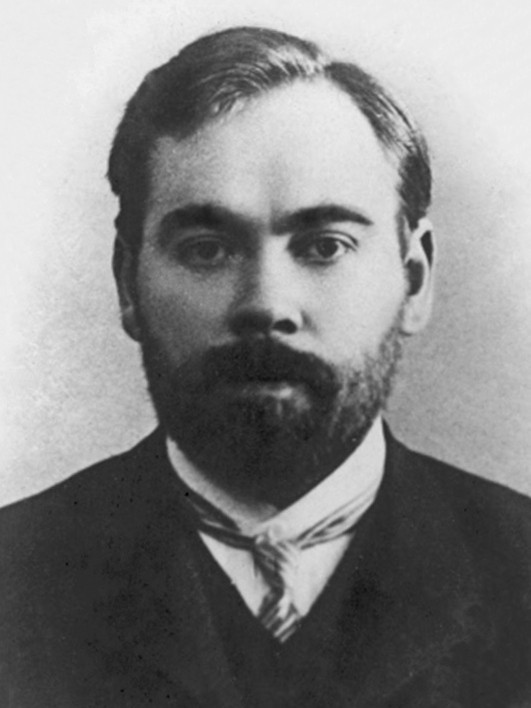
A.A. Bogdanov, one of the founders of the RSDLP and an active participant in the first Russian revolution, in 1911 withdrew from party work in order to create and develop his own philosophical concept, reflected in his monumental work “Tectology” where he tried to introduce a theory of “universal organizational science." According to Bogdanov, in the future, science, ideology and production will become a single whole, thus helping to unite humanity and reject any group and class differences.
Researchers have paid attention both to the connection of “Red Star” with the philosophical ideas of A.A. Bogdanov and its influence on the principles of “Russian cosmism”. According to I.E. Vasiliev, N.V. Kovtun and E.N. Proskurina, “In the world of literary utopia, A. Bogdanov … turns out to be the successor of the philosophy of N. Fedorov, when utopia begins to be regarded not as a speculative project, but as a real matter that requires immediate implementation.” [3, 130].
Subsequently, Bogdanov himself outlined his futuristic credo interpreting the ideas of N.F. Fedorov, who compared the Earth to an interplanetary ship.
“Someday, the Earth will become the center of life for all the planets of our system — it will populate them with its emigrants.” [2, 429]. In the novel “Red Star" the Earth has not yet reached this stage of development, noticeably lagging behind the humanoid inhabitants of Mars.
At the beginning of the twentieth century, several Russian literary utopias were published, starting with the novel by N.N. Shelonsky “In the world of the future” (1892), where scientists exploring the newly discovered polar continent fall into a lethargic sleep. After a thousand years, they find themselves in a utopian future, where most of humanity has abandoned cities and weapons.
In the novel by K.S. Merezhkovsky ``Earthly Paradise, or a Dream on a Winter Night (A Tale-Utopia of the XXVII century)” (1903), the protagonist of the story is transported eight hundred years ahead and met by the same utopian beautiful humanity. A translation of H.G. Wells' “The Time Machine'' had already been published in Russia in 1900, but the descriptions of the future of humankind in the aforementioned Russian utopias are not of a tragic nature, which is the case with Wells' dystopia.
However, already in 1906, N.D. Fedorov published “Evening in 2217”. In this story, echoing Yevgeny Zamyatin’s later classical Russian dystopia “We” the technical achievements of humankind fade because the lack of humanism and the strict regulation of personal and social life, but, as it has been already mentioned, the narrative of these works takes place on Earth.
The first Russian novels describing interplanetary travel and meeting with other civilizations were “In the Ocean of Stars' ' by A.G. Lyakide (1892) and “On another planet” by P.P. Infantiev (1901). Both novels describe either real (“In the ocean of stars'') or virtual (“On another planet”) space travel and meeting with an advanced civilization, which, using the words of the A.G. Lyakide, “was ahead of us, unfortunately, on the path of progress!”. [5, 49]. A similar progress is described in the work of P.P. Infantiev, also a member of the Social Democratic Party. “On Another Planet” like the later “Red Star '' was also saturated with socialist ideas. The book was published in a version significantly curtailed by the censors.
The similarity between the novels of Infantiev and Bogdanov has already been noticed. In particular, A.Y. Morozova writes that “Both Infantiev’s story and Bogdanov’s novel are written in the first person. The reader sees everything through the eyes of the protagonist. The descriptions of his experiences are the product of his self-esteem and self-reflection.” [6, 40].
The novels of Infantiev and Bogdanov unite the left sympathies of his earthly heroes and a detailed description of the technical innovations they encountered on Mars. However, the Martian landscape receives a sparse treatment in the novels, especially in “Red Star”, where the author pays special attention to scientific and socio-philosophical aspects of Martian society.
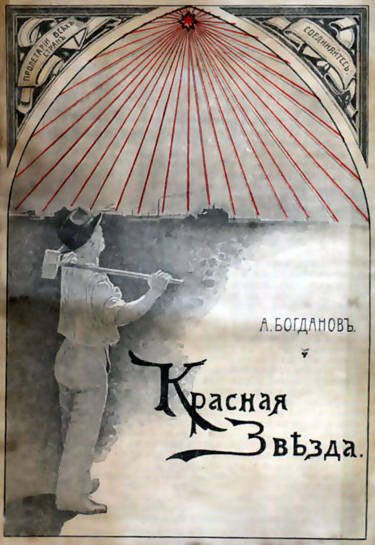
A.A. Bogdanov’s protagonist explains her reluctance to go into details about the Martian landscape in the following way.
“I cannot waste time and space in describing the peculiar forms of plants and animals on Mars, or its atmosphere, clean and transparent, relatively sparse, but rich in oxygen, or its sky, deep and dark, greenish in color, with a thinner sun and tiny moons, with two bright evening or morning stars — Venus and Earth. All this was strange and alien then but beautiful and dear to me now. In the colors of memories, it is not so closely connected with the tasks of my narration. People and their relationships are what matters most to me. In all that fabulous setting they were the most fantastic and most mysterious. [1, 32].
However, the specifics of the description of the Martian space in the “Red Star” has its own characteristics, both uniting the work of A.A. Bogdanov with science fiction texts preceding it and contrasting with it.
Let us analyze the feature of the landscape mentioned in almost all works where the plot unfolds on Mars, namely the explanation of the epithet “red” applied to the planet.
Table 1
Interpretation of the epithet “red” in the science fiction novels contemporary to “Red Star.”
Red Star Unveiling a Parallel On Another Planet Across the Zodiac
The first thing that struck me in the nature of Mars and what is most difficult for me
I had to get used to it — this is the red color of plants …
“This is the color of our socialist banner, ” I said, “I should get comfortable with your socialist nature. “[1, 128].
It is not literally red, by the way; that which makes it appear so at this distance is its atmosphere —its “sky, ”—which is of a soft roseate color, instead of being blue like ours. It is as beautiful as a blush. [9, 5]
… it soon became clear to me why the planet Mars seems like a red star to us from Earth. It turned out that the mainland of Mars in general is a desert with barren soil of a bright red color. Stones, sand, clay — all this on Mars has a bright red color …
[4, 463]
The lower slopes were entirely clothed with yellow or reddish foliage. [8, 67]
In the early American feminist utopia “Unveiling the Parallel” (1893) by Alice Jones and Ella Merchant, the red color associated with Mars is interpreted in a “feminine” way, taking on a pink hue “like a blush in beauty.” The planet is losing its masculine qualities, turning, according to the novel, into a matriarchal society.
In the novel “Across the Zodiac” (1880) by the American author Percy Greg, considered the first attempt at the “sword and planet” fantasy-adventure genre, the author prefers to explain the origin of the red color by natural causes, just as P.P. Infantiev.
However, Bogdanov interprets the Martian landscape as proof of the socialist nature of the planet’s inhabitants. When the Martian offers the protagonist the special glasses to help him get used to the situation, he refuses. The choice of the socialist way of life, although accompanied by temporary inconveniences, in the future brings satisfaction from the achieved higher goal. At the same time, Bogdanov, through his heroes, hints at the coming socialist revolution on Earth.
“If so, then we must admit that there is socialism in the terrestrial flora, but in a hidden form, ” Manny noted. “The leaves of terrestrial plants also have a red tint, masked by a stronger green. It is enough to put on glasses that completely absorb green rays and let red rays through, and your forests and fields will become red like ours. [1, 128].
Thus, the means of technical progress become instrumental for achieving the goal of the transition to the socialist social system. The Martian landscape in the “Red Star” performs not so much an artistic as an ideological function.
In the future, only in “Aelita” by A.N. Tolstoy (1923) does the description of the deserted Mars reflect the negative emotions of the longing and saddened protagonist without carrying an ideological burden.
In the works of A. and B. Strugatsky, “Night on Mars” (1960) and “Interns” (1962), the lifeless Martian landscape, inhabited by primitive aggressive creatures, contrasts with the complex technical means used by earthlings to master it.
Soviet science fiction, following the confident position of Bogdanov, expressed in “Tectology”, inhabits the planets of the solar system with earthlings who have reached the level of development that engineer Lanny, the protagonist of Red Star, could only dream of.
Bibliography
1. Bogdanov, A. A. Red Star: (Utopia) / A. Bogdanov. — St. Petersburg, 1908. 156 p.
2. Bogdanov, A. A. Tectology: General organizational science Parts 1 and 2 re-edited. Z. I. Grzhebin, 1922. 526 p.
3. Vasiliev I. E., Kovtun N. V., Proskurina E. N. The project of the reorganization of the world and Russian prose of the early twentieth century (Bogdanov and Platonov) // Siberian Journal of Philology. 2013. No. 2. URL: https://cyberleninka.ru/article/n/proekt-pereustroystva-mira-i-russkaya-proza-nachala-hh-veka-bogdanov-i-platonov (Date of access: 13.11.2021).
4. Infantiev P.P. On another planet. You can help the living: Collection of fiction. Compiled by L.Y.Shuvalov. — M.: Young Guard, 1990, 480 p. pp. 407-480.
5. Lyakide A.G. In the ocean of stars: Astron. odyssey / A.G. Lyakide. — St. Petersburg, 1892. 271 p.
6. Morozova, A. Y. Journey to Mars and Martian society through the eyes of an earthling in the works of P. P. Infantiev and A. A. Bogdanov / A. Yu. Morozov // Russia XXI. — 2021. — No. 3. — P. 36-59.
7. Chadaeva, Olga & Bakala, Pavel. (2020). Bolshevik’s Flight to Mars: “Red Star '' by A. Bogdanov from a Natural-Scientific Perspective; Rossica Olomucensia. Časopis pro ruskou a slovanskou filologii). LIX. 5.
8. Greg, Percy. ACROSS THE ZODIAC: THE STORY OF A WRECKED RECORD. London: Trubner & Co., 1880. 288 c.
9 UNVEILING A PARALLEL. a romance By Two Women of The West. COPYRIGHT 1893, BY ARENA PUBLISHING COMPANY. 158 p.