THE RED OCTOPUS
while we float in streams of data
and materialized
disinformation, not treating
it
as a sphere for personal intervention —
nearby
once again
war begins.
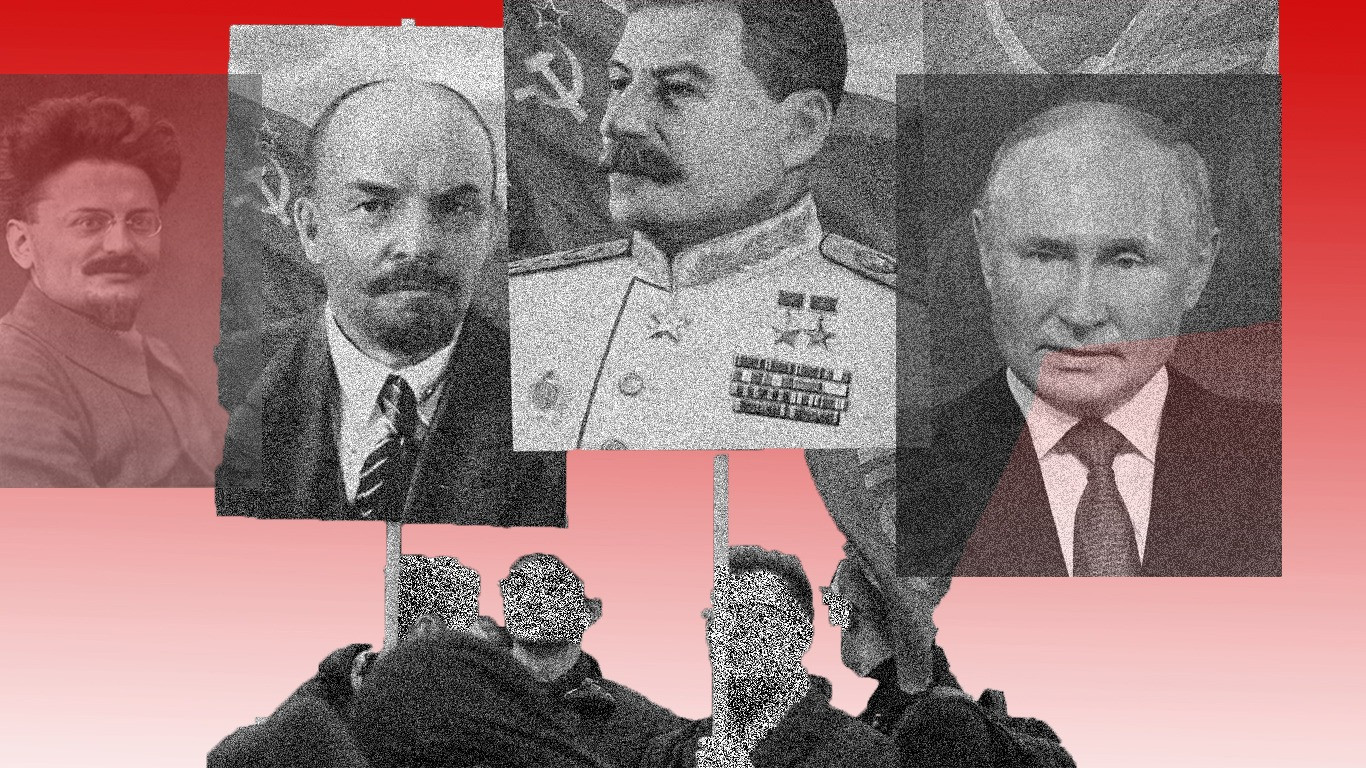
This text is written from the standpoint of anarchist critique and offers a view of the existing left parties and movements from the RF (russian federation) as ideological enablers and beneficiaries of contemporary russia’s colonial wars. Clearly, the left are not the only ones serving these ends, yet they often turn out to be active conduits of russian imperialism and revanchism, ideologically harking back to the USSR project and to nostalgia for the communist regime. At the same time, they most often manage to sidestep any critique of russian imperialism and of the pervasive dictatorial nature of Bolshevik politics. This text continues the investigation into the agency of the russian left inside and beyond russia, whereas their colonial imagination was the subject of an earlier piece.
Although this text does not treat all representatives of the left as enablers of Putins regime or as victims of russian political technologists, it clarifies the latter’s interest in leftist
movements. Also examined here is the dangerous tactical proximity between the strategies used by Kremlin’s and many on the left when it comes to the questions of the territorial/colonial policies of RF, . Taking into account the long history of the Soviet Communist Party’s influence on world military and revolutionary events, close attention is paid here to the followers of Soviet ideologies — especially regarding their presence within the orbit of the former Soviet republics. Unreflected imperialist perspectives of the left are a hospitable and nourishing medium for the political theatre of contemporary Russia.
The ideas described, with examples of organizations and their public representatives, are still rather deeply rooted and widespread among the Russian left, and the circles of loyalty of newer and older organizations inevitably overlap.
How communist, leftist movements justify the seizure of territories and the destabilization of power in the EECCNA region (Eastern Europe, Caucasus, and Central and North Asia) by the contemporary, putinist russia.
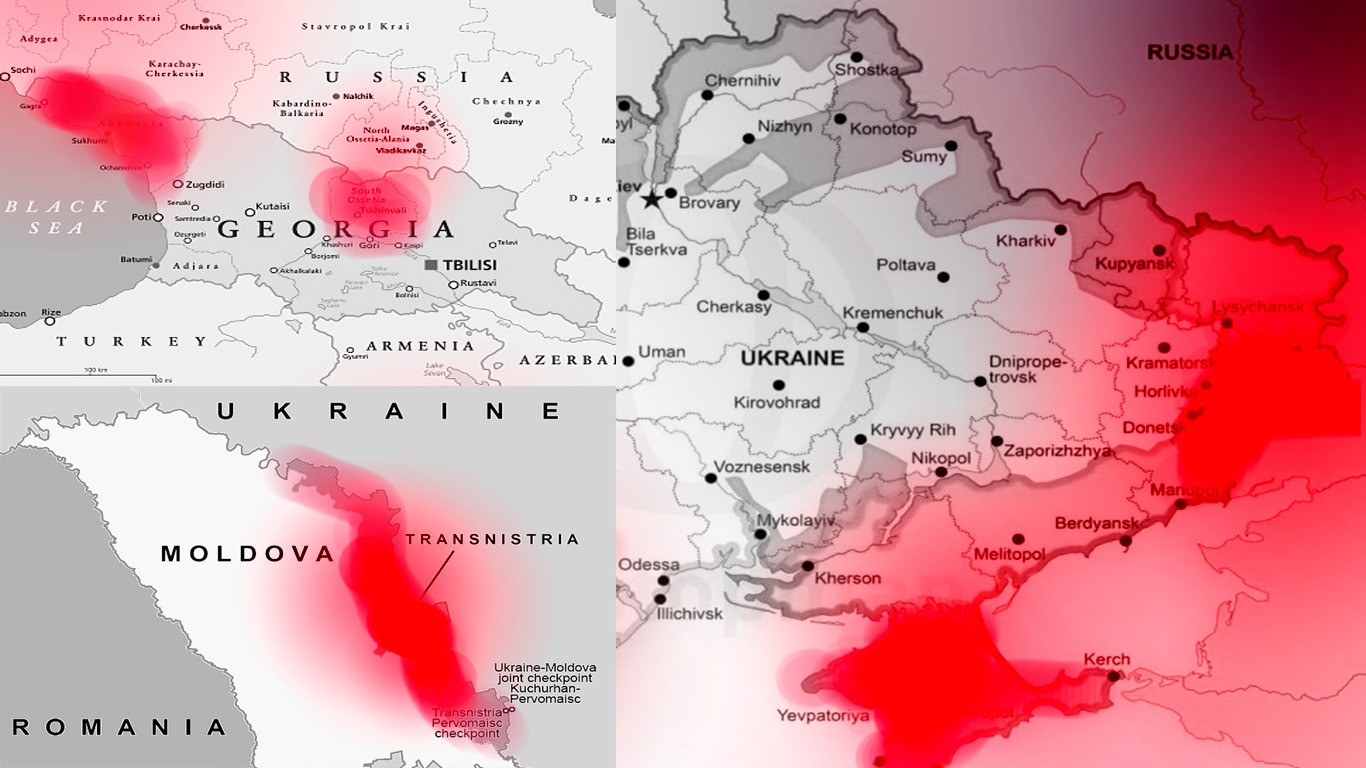
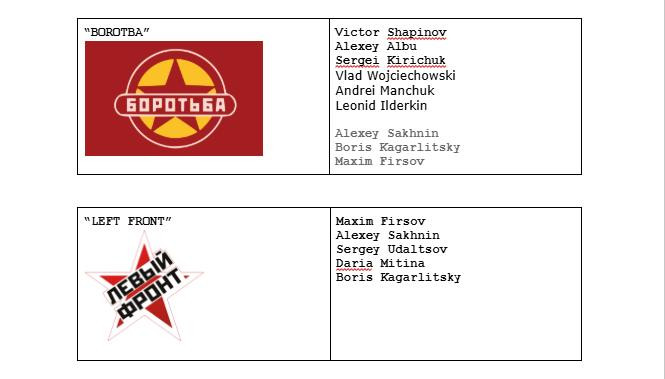
After the collapse of the Soviet Union, russia has used a recurring tactic of waging proxy wars in сountries that won their independence. The maps reveal a systematically repeated operation: a “problem” region appears within a territory demanding “political and cultural autonomy and a revision of borders.” From russia’s perspective this is called a “civil war” or “separatist sentiment.” Next, under the pretext of peacekeeping missions of justice, russia sends in troops and builds “observation posts” that are in fact military bases. The pretext for intervention is either protecting the rights of the russian-speaking population, or stabilizing political unrest. If one looks closely at events in Moldova and Ukraine, one can see that the political work that destabilized the territorial integrity of these countries was prepared in advance. Russian political technologists together with “pocket” left-wing parties and organizations made specifically for these tasks (“Borotba,” “New Crimea,” “Union of Left Forces, “Antifa-Moldova,” “Left Front”), developed and implanted Kremlin’s agenda there. Visible presence of their supporters at street rallies was inflated, the electorate was bought off, and their presence was strengthened in media oriented toward information wars and disinformation. The conduits into the regions for these organizations were heir organizations of the CPSU (Communist Party of the Soviet Union).
Validation of the russian presence within the contours of the former USSR is carried out through leftist parties and communist slogans.
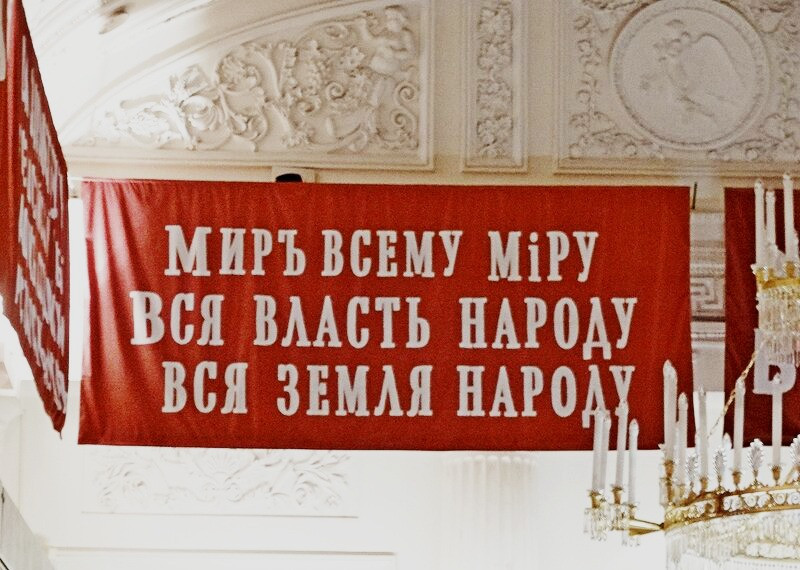
“Peace to the world. All power to the people. All land to the people.”
The myths about a popular uprising, the defense of the rights of the oppressed in the struggle
against a neoliberal elite (oligarchs), or the right to self-determination and “people’s” self-government disseminated by Kremlin fit perfectly into the general values and outlooks of the left. It was precisely these discursive devices that made it possible to occupy parts of Ukraine Leftistshelped entrench such narratives, opening new party cells and occupying administrative posts in the occupied territories.This tactic extends to both the party-based left, as well as the non-systemic left opposition.
Political Technologies: The Occupied Territories of Ukraine and the Destabilization of Power in Moldova
The technologies of interference into the affairs of Ukraine and Moldova often had similar dynamics and were carried out by the same groups. In 2014, after Russian forces occupied territory in Ukraine’s Donetsk and Luhansk regions and created the “Donetsk and Luhansk People’s Republics,” representatives of KPRF (Communist Party of the russian federation) expressed the following reaction:
“Rank-and-file communists and supporters of the socialist choice were the first to stand on the barricades of the ‘Russian Spring’ of 2014, when illegal formations of Ukrainian nationalists were preparing to attack the peaceful population of the Donbas. The people of the Donbas rose up against the unconstitutional coup in Kyiv. Red flags and the flags of russia flew over the buildings of the Luhansk regional state administration and the SBU. Half of the deputy corps of the First Parliament of the LNR was made up of communists. From the very first days of the creation of thesovereign people’s republics, communists stood in the front ranks of the creators, defenders and builders of our statehood.” (source)
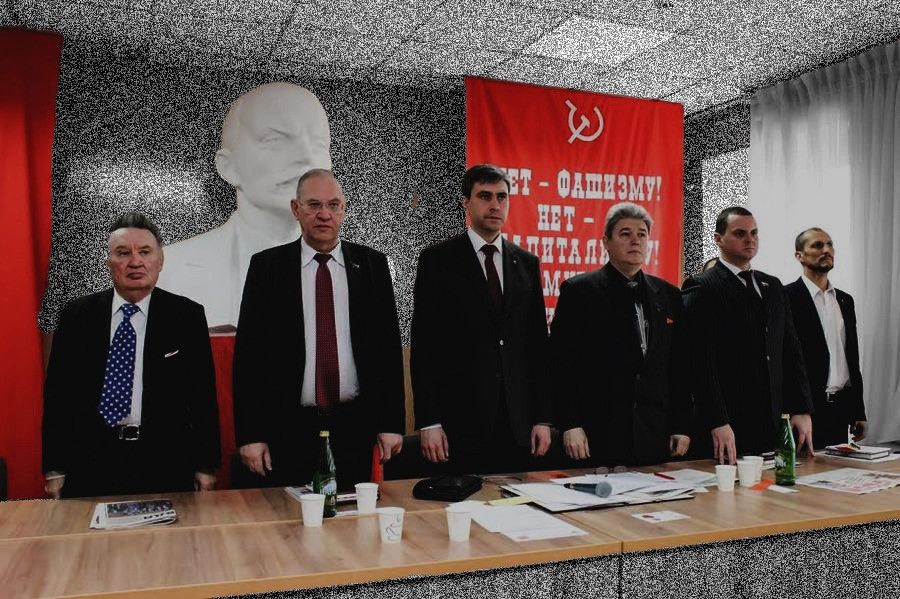
The founding of the Communist Party in the “LNR” in 2014: “No to Fascism!”
What role did the russian left play in the destabilization of the political situation in Ukraine?
In Ukraine, from the first years of independence, the influential Leninist KPU (Communist Party ofUkraine), led by Petro Symonenko, sought the restoration of the USSR. It is not necessary to write about the friendly ideological connections between the russian KPRF and the Ukrainian KPU. Since 2015 the KPU has been banned in Ukraine, but before that it had long been a channel for a direct transit of communist ideology, making possible Russia’s influence and its infiltration of the left political scene via the bridge: KPRF — KPU — “Union of Left Forces.”
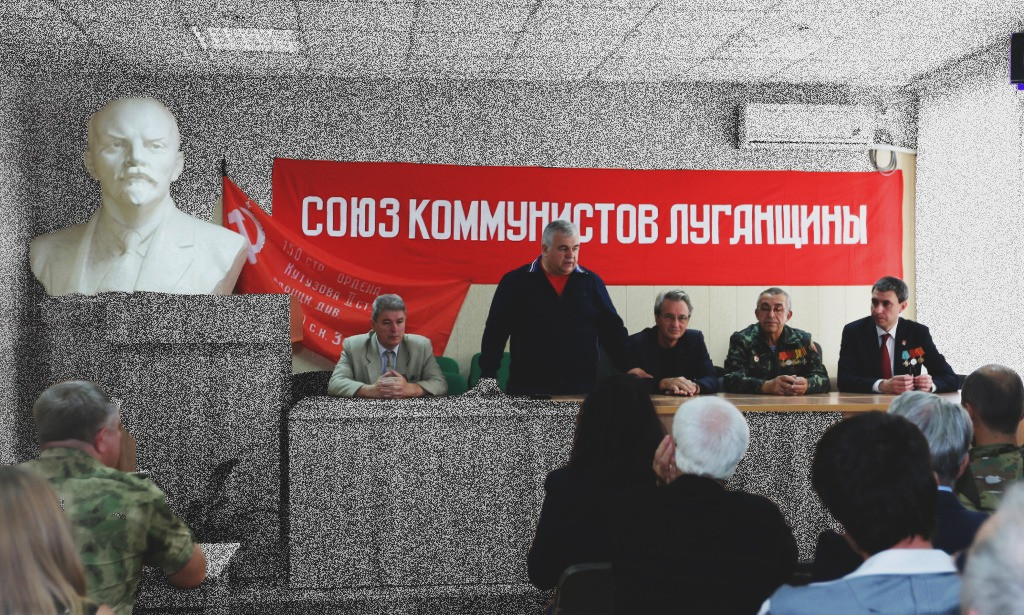
“Union of Communists of Lugansk Region”
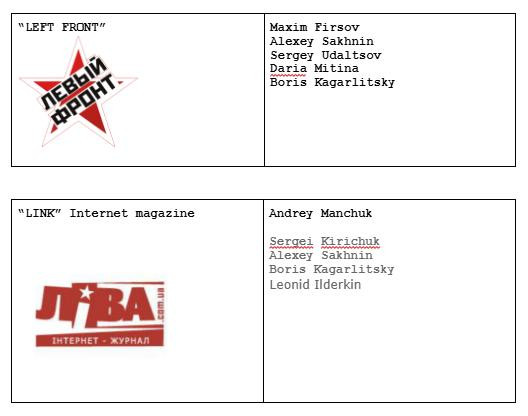
The KPU and its members were prominently visible in the events of the annexation of Crimea, in the movements that initiated the Anti-Maidan, in the chronicles of the war in eastern Ukraine, and in the subsequent division of power and influence in the so-called “DNR” and “LNR.” Following the party-based leftists, other left organizations also came to the occupied territories: in 2015 the russian “Left Front,” led by Maxim Firsov, opened a branch in recently annexed Crimea. In 2014 his “Left Front” colleague Darya Mitina was given the post of the head of the Moscow press service of the “Foreign Ministry” of “DNR”.
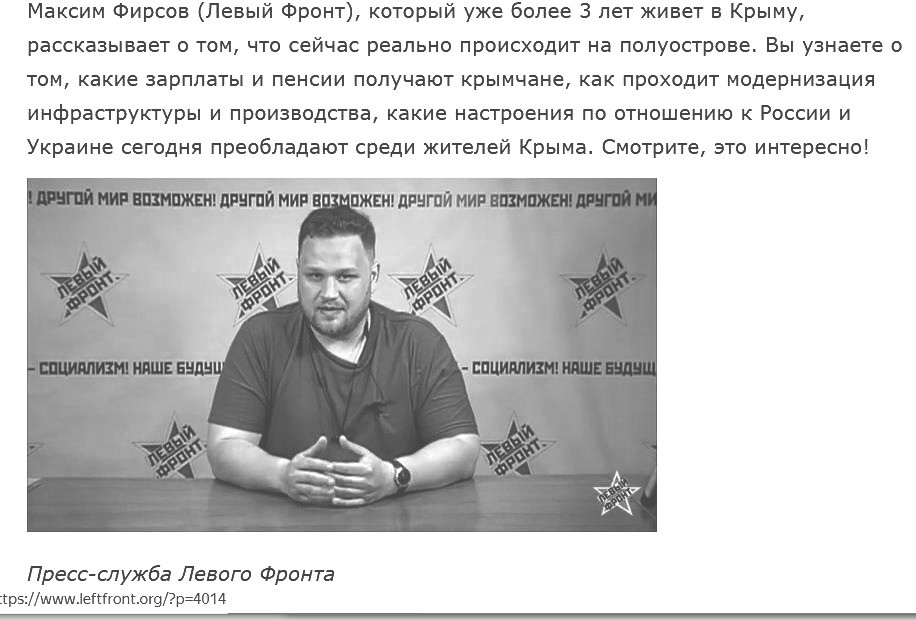
Maxim Firsov (Left Front), the organization’s branch in annexed Crimea.
In Crimea long before its annexation, from 2008 onward, the presence of pro-russian politiciansin leftist unions and parties was being built up with the help of PR campaigns by well-known conduits of the russian influence.
The aim of the parties and organizations created by political technologists was not deep work with the local population. The functionaries and “activists” did not seek to influence the formation of people’s opinions. It was enough to create a an illusion of real media presence by organisingrallies and forums and publishing online content. Within such a strategy, real supporters are not needed to illustrate pre-formulated statements and ideas. Mass and visibility are achieved by squatting the actions of nearby political groups and associations that really engage with local agendas.
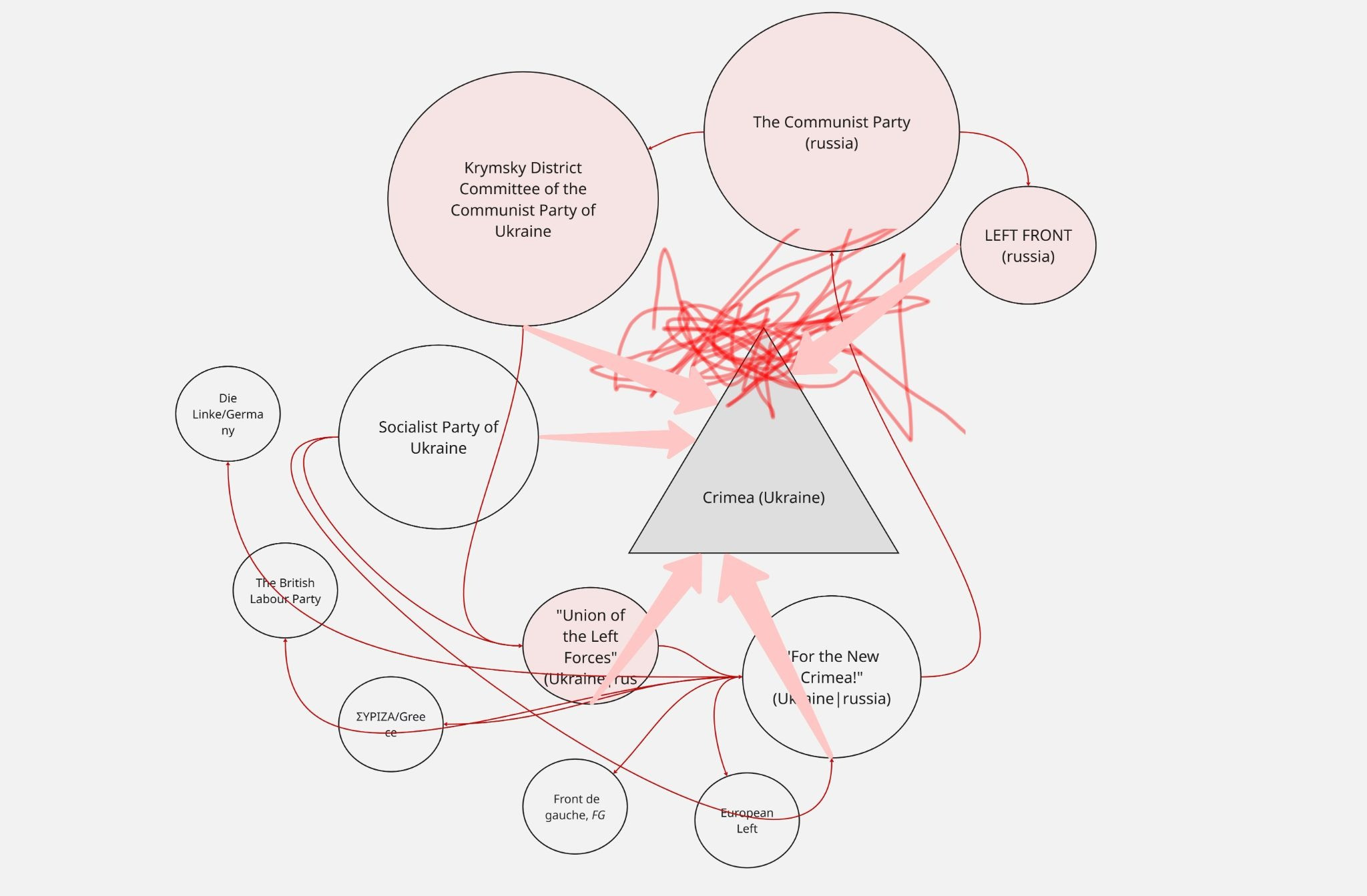
Diagram of leftist circles of influence around the idea of the russification of Crimea from 2008.
The intermediary for the russian KPRF’s activity in Crimea was the Ukrainian parties KPU and the “Union of Left Forces,” led by Vasyl Volha. In September 2008, Vasyl Volha was asked how he felt about his initiative — the “Union of Left Forces” — being called a project of the Kremlin; he replied: “For me this is a great honor. If someone considers us Kremlin’s project, I will accept this definition with great pleasure.” And in 2011 he demonstratively advocated that Ukraine should “be the initiator and active participant of a security territory between russia and the USA; as well as for establishing good relations with all neighboring countries and for restoring comprehensive friendly ties with russia; for granting Ukraine the status of a neutral state.”
At a rally in Simferopol in 2009, the Crimean republican organizations of the Communist Party and the party “Union of Left Forces” announced the creation of Leonid Grach’s bloc “For a New Crimea.” One of the slogans with which the bloc intended to win the votes of Crimeans wasformulated this way: “Broad use of the russian language and maximum financial independence of the
autonomy from Kyiv, up to turning Ukraine into a federal state.” Those gathered at the 2009 rally held placards: “Yes to Crimea. No to NATO,” while speakers from the podium called for the creation of a union with Russia and Belarus.The organization “For a New Crimea” foreshadowed the subsequent annexation of Crimea in 2014. Its goal was to createan illusion of anti-European and anti-Ukrainian sentiment among the population to justify the appearance of the “little green men” in Crimea, as well as the organization of a referendum “for the secession” of Crimea from Ukraine.
On the basis of the local KPU cell, the bloc “For a New Crimea” was launched with the help of Alexander Bludyshev, political technologist from russia. According to the Crimean newspaper “Sobytiya” from the12th of June 2009: “According to staff of the Crimean regional committee of the KPU, russians were allocated a separate office in the building on Kirov Avenue, in which they develop scenarios for PR actions and campaign materials.”
Bludyshev’s name will continue appearing in the chronicles of the destabilization of power in Ukraine and Moldova, carried out by creating pro-russian left organizations supporting “separatism” in Ukraine or pro-russian sentiment in Moldova. Bludyshev was connected with Maxim Firsov mentioned before (“Left Front” — later “Borot’ba”) and with Viktor Shapinov (“Organization of Marxists”), whom we later, after the Maidan, encounter in Moldova with the same goal — destabilizing the central government commissioned by RF’s Presidential Administration. The latter is one of the future ideologues of the separatist organization “Borot’ba” in Ukraine and the author of the book “The Decline of the American World Order: The War in Ukraine. An Experiment in Marxist Geopolitics.”
The russian political technologists Dmitry Kozak and Vladislav Surkov were structurally engaged at this time in implementing Russia’s foreign policy and interests in Moldova and Ukraine, working in the Russian presidential administration. In 2013, V. Putin appointed Surkov as an aide in the Presidential Administration, with responsibilities related to Abkhazia, South Ossetia and Ukraine. Surkov’s work immediately focused on events in Ukraine during the November 2013 Euromaidan and the February 2014 Revolution of Dignity. Dmitry Kozak is a close associate of V. Putin. After russia’s interference in Crimea’s affairs, Kozak was put in charge of strengthening the social, political and economic ties of Crimea with Russia.
The Ukrainian left organization “Borot’ba” pursued the same goals as the organizations named above, but acted as an instrument of grassroots influence, mimicking a youthful, street-based, grassroots protest movement.
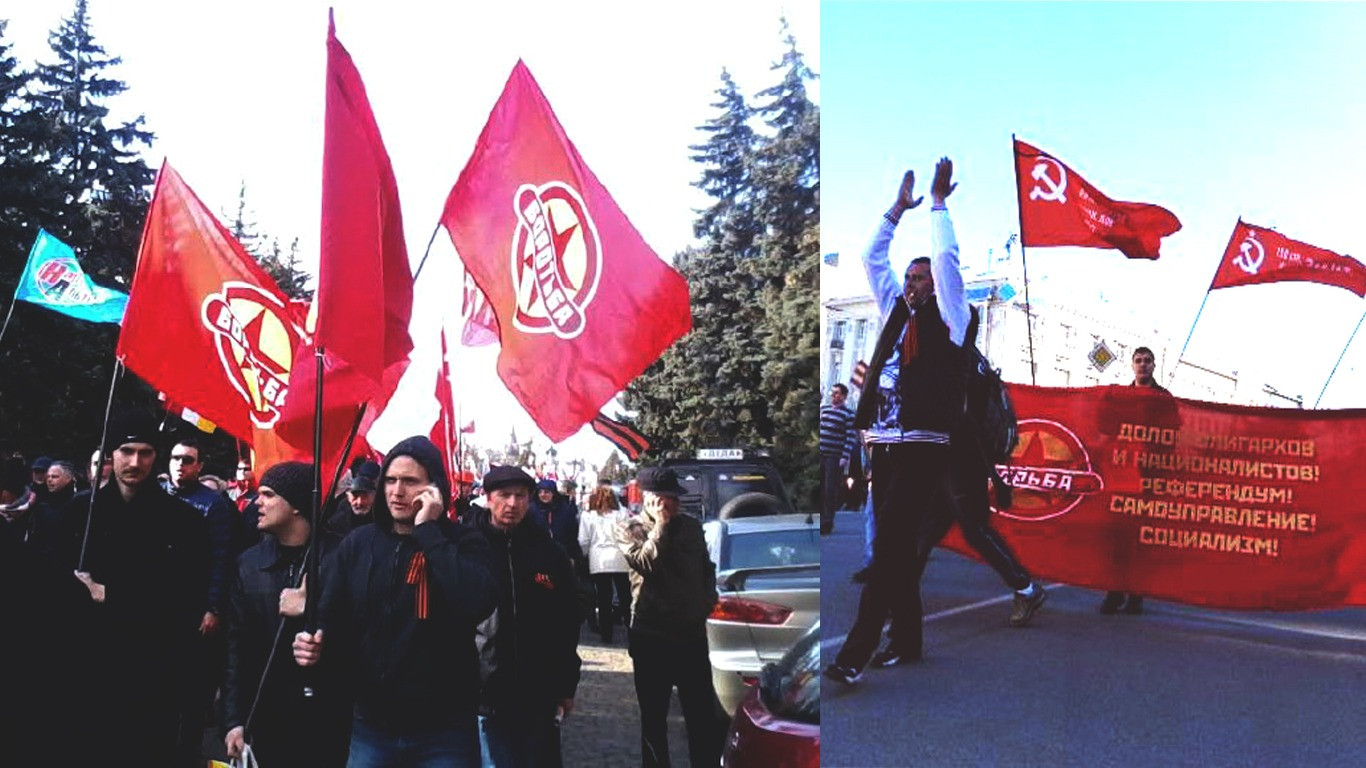
“Borot’ba” during the Anti-Maidan, advocating the secession of Kharkiv and Odesa in 2014: “Down with oligarchs and nationalists! Referendum! Self-government! Socialism!”
“Borot’ba” was infrastructurally and ideologically connected with the russian “Left Front.” Both organizations included Stalinists, Marxists, Trotskyists and socialists, and explained their oppositional stance through a critique of the workings of the logic of capital — of social inequality. What fell out of focus were the problems of russian imperialism, russia’s neocolonialism in relation to the EECCNA countries, unequal distribution of power and resources, gender inequality and other logics of discrimination. “Borot’ba” was an openly homophobic association, full of internal violence,their public and street actions were aggressive and provocative.
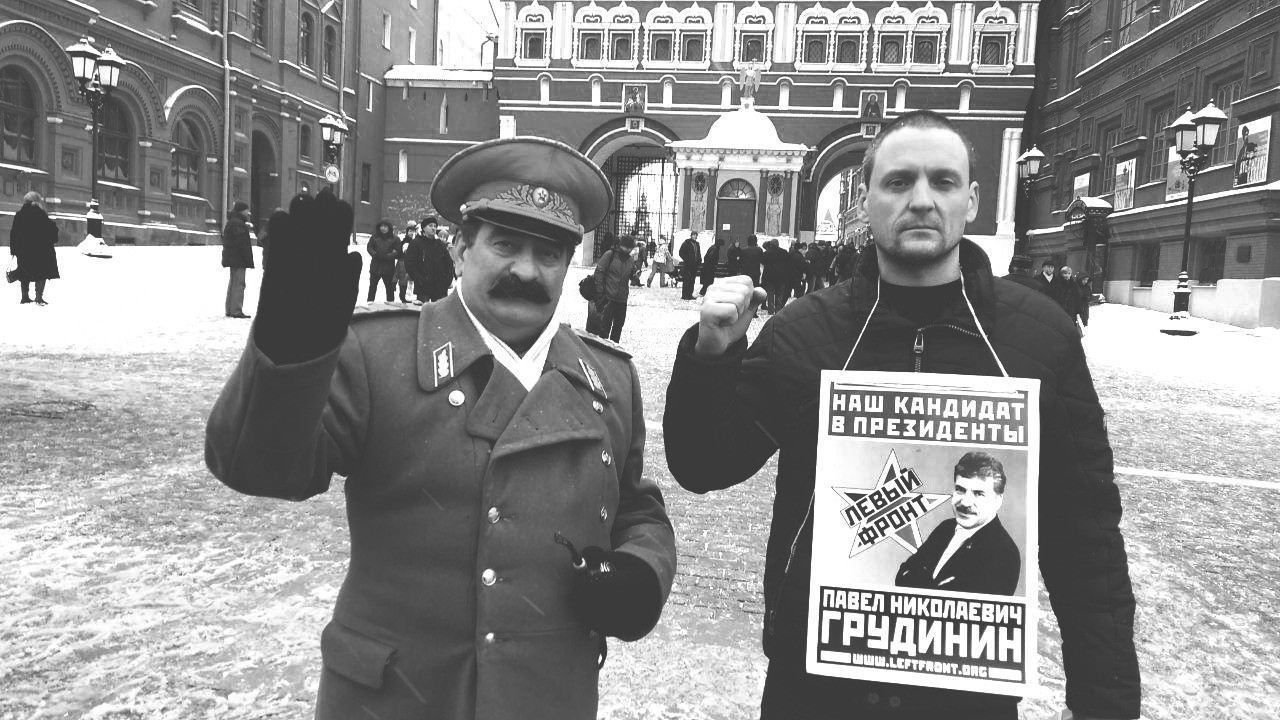
Sergei Udaltsov, leader of the “Left Front.” 2018.
Focusing solely on the class question during a full-scale war is a convenient, moderate and in many ways conformist position. The problems of human inequality are endless under capitalist regimes, so one can point to discontent on this question under any ruling order without posing any real threat to power. Liberals of an anti-imperialist orientation (B. Nemtsov, V. Novodvorskaya) posed a more serious threat than red flags justifying neocolonial wars while demanding a return to (post-)Soviet socialism.
At the core of both parties were shared political technologists who had worked with “United Russia”: directly with Vladislav Surkov and with the Russian security services. Having united Stalinists, Marxists, socialists, Trotskyists, etc., “Borot’ba” called for separatism, the restoration of the USSR, and the introduction of Russian troops. Among the movement’s notable participants were KPU functionaries and party workers, as well as members of the “Organization of Marxists.”
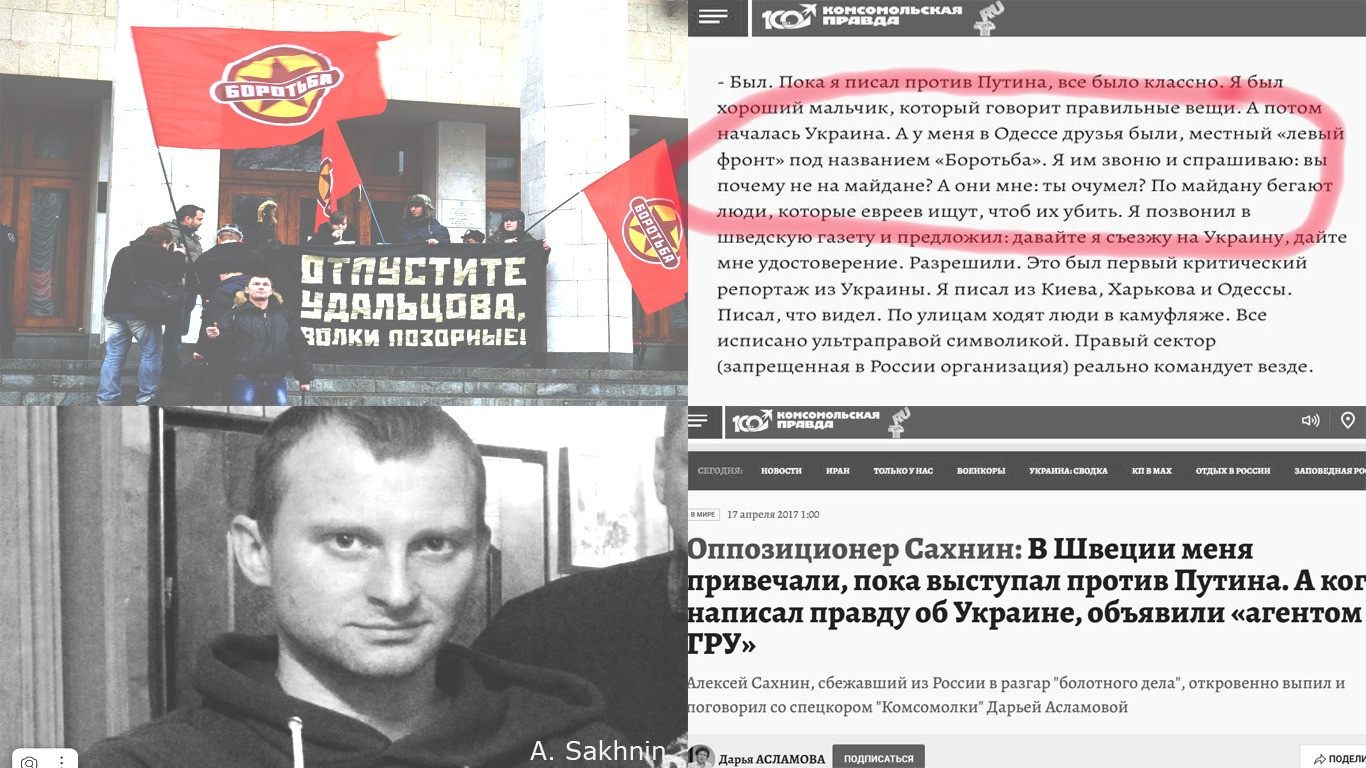
1. A “Borotba” picket for the freedom of “Left Front” leader Sergei Udaltsov: “Release Udaltsov, you shameless wolves.” 2–4. Alexei Sakhnin (Left Front): “I had friends in Odesa, the local ‘Left Front’ called ‘Borotba.’”[Image caption] Alexei Sakhnin: “Freedom for Vlad Voitsekhovsky!” 17 September 2014.
After the sabotage during the Revolution of Dignity, “Borot’ba,” which had actively organized the Anti-Maidan, partly went to to the combat battalion “Prizrak” (“Ghost”) that is fighting in the occupied territories on the side of russia, and partly emigrated.
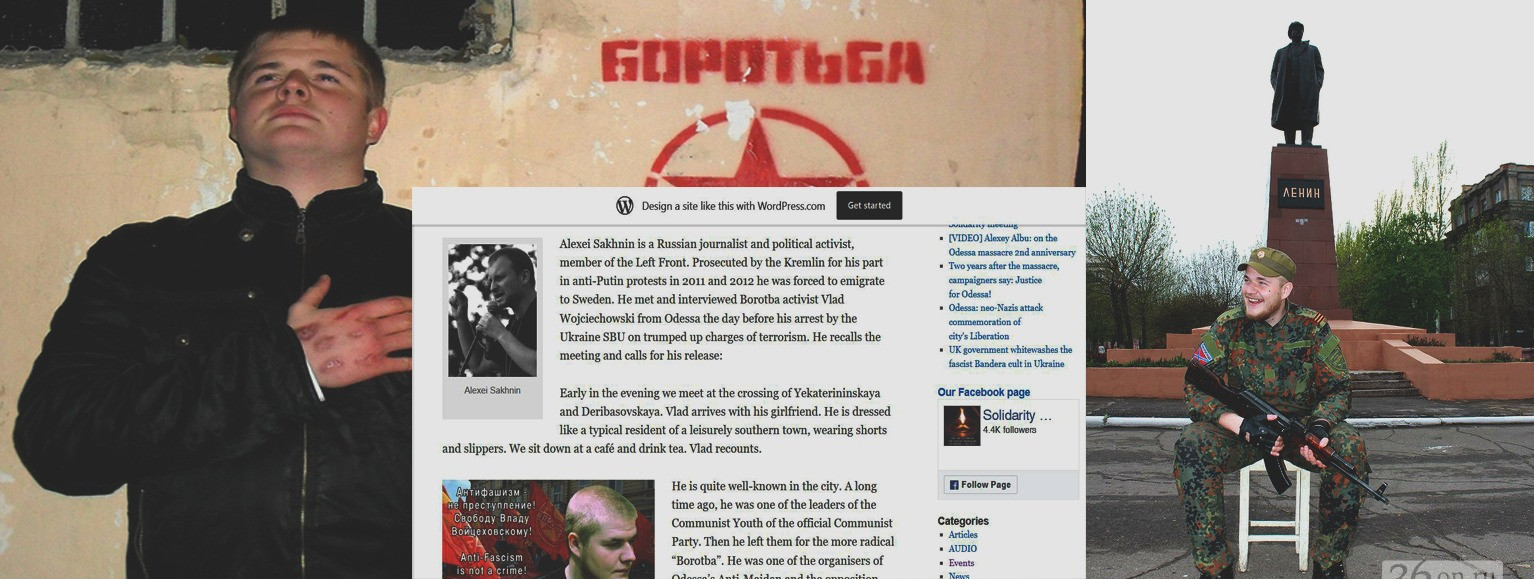
1. Vlad Voitsekhovsky, one of the “Borotba” members who went to fight in the occupied territories among the separatists' combat units (“Prizrak” Battalion). 2. A. Sakhnin (“Left Front”) speaks in support of Voitsekhovsky; his statement is published on a russian propaganda resource.
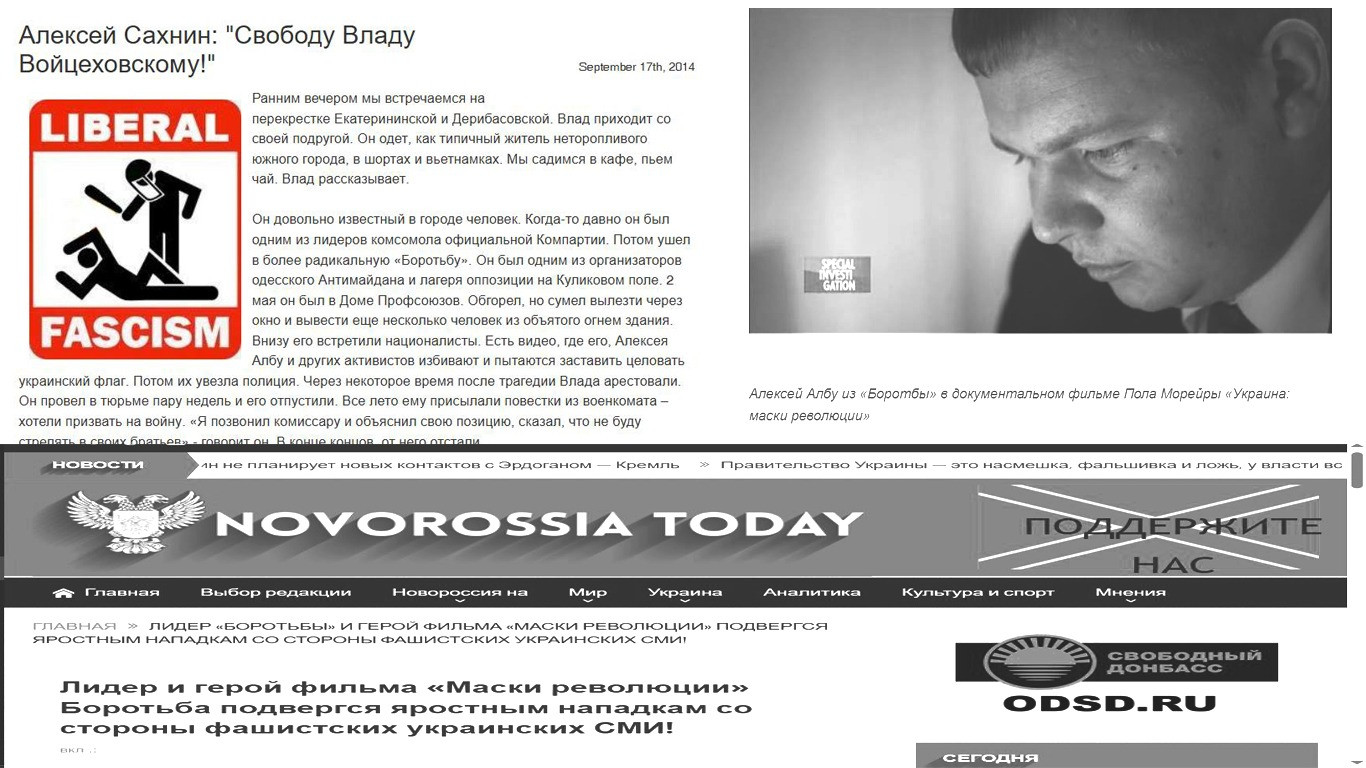
1. Alexey Sakhnin: "Freedom to Vlad Voitsekhovsky!" September 17, 2014: “Vlad tells me. He is quite a well-known person in the city. Once he was one of the leaders of the Komsomol of the official Communist Party. Then he moved to the more radical Borotba. He was one of the organizers Odessa Antimaidan and the opposition camp on Kulikovo Field. 2 Alexey Albu from Borotba in the documentary film "Ukraine — Masks of the Revolution" by Paul Moreira. 3. The propaganda website of Novorossiya published a headline: "The leader and hero of the film "Masks of the Revolution" Borot’ba has been fiercely attacked by the fascist Ukrainian media."
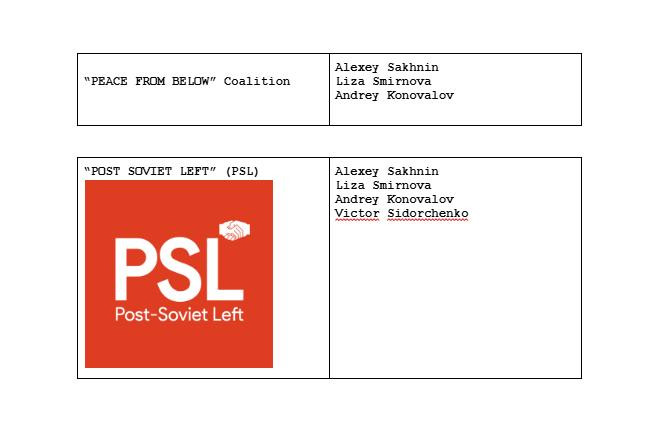
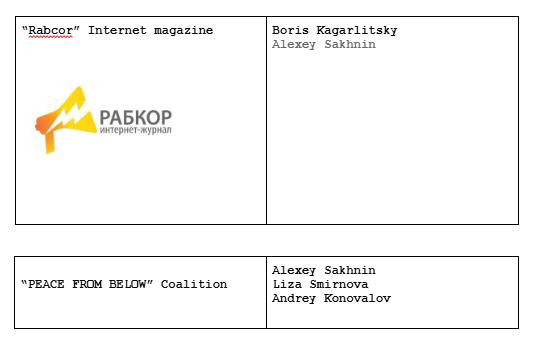
Public figures from the “Left Front,” such as Alexei Sakhnin, side with the defenders of “Novorossiya,” with Anti-Maidan participants and with members of “Borot’ba.” Moreover, A. Sakhnin published on pro-Kremlin media resources. These details are important for understanding the situation after the full-scale invasion and the ideological foundations of new “anti-war” coalitions such as “Peace from Below” (A. Sakhnin, L. Smirnova).
The “Prizrak” Battalion, made up largely of communists and positioning itself as such, openly states that it accepts help from the russian KPRF. The battalion’s left-wing fame attracts international leftists to take part in the war directly or to raise international funding. Volunteers from France, Italy and Spain go to fight for the interests of the “people’s republics.” Some of them consistently support the Russian occupiers with humanitarian aid. Spanish volunteers who fought in the Donbas: “Half of them [the battalion’s fighters] are communists and the other half are Nazis,” they explained. “We fought together, communists and Nazis alike […]. We all want the same: social justice and the liberation of Russia from the Ukrainian invasion.”
The Spanish volunteers were telling the truth. The battalion was left-wing only from the perspective of Kremlin political technologists and of some pro-communist fighters serving in it. The “Prizrak Battalion included (in 2014) the assault detachment “Rusich” — neo-Nazis, successors of the RNE (Russian National Unity). The leader and commander of “Prizrak” — Alexei Mozgovoi — beside using the image of the “Che Guevara of the Donbas,” also loved the uniform of Russia’s White officers, dedicating poems to the latter.
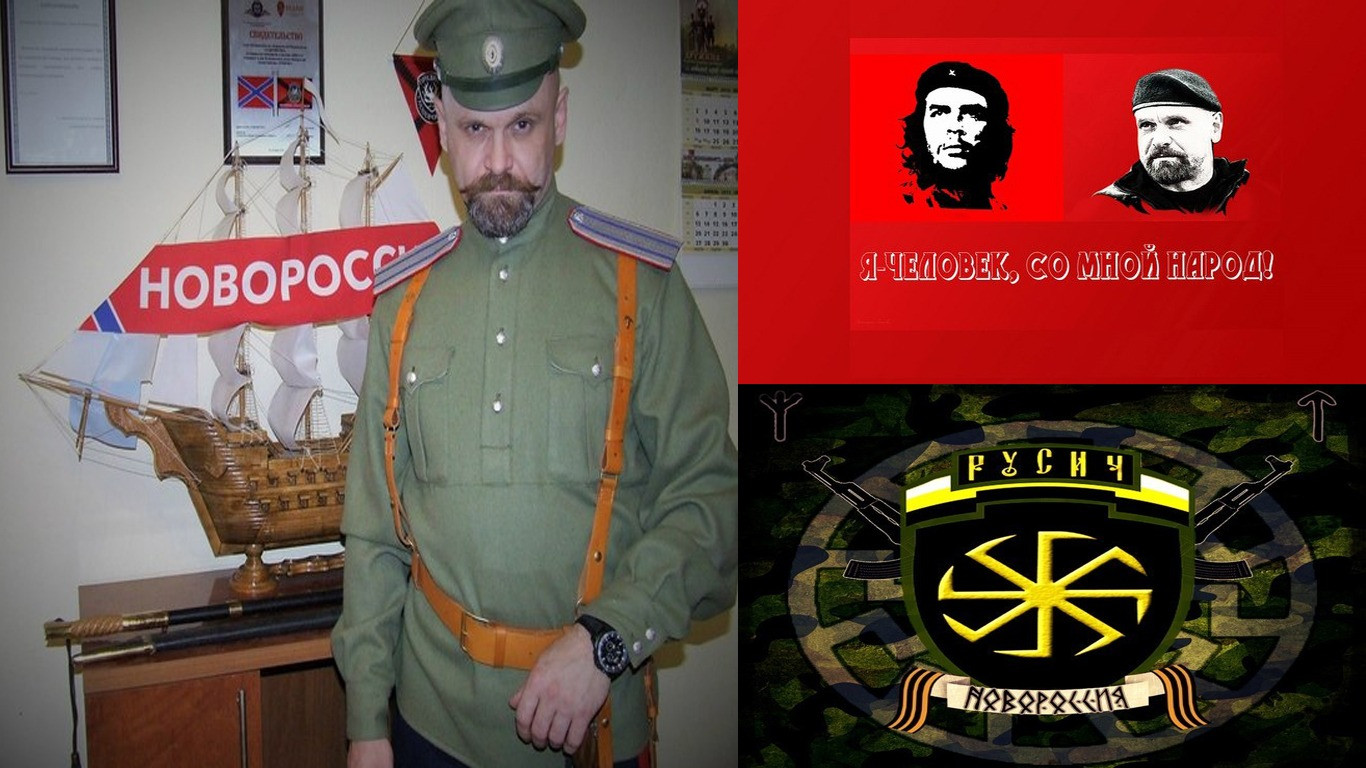
1. Alexei Mozgovoi in White Guard uniform. 2. Che Guevara and A. Mozgovoi in one image: “I am the people, the people are with me!” 3. The emblem of the “Rusich” division combines the flag of the Russian Empire, a black sun, a Slavic swastika (kolovrat), and St. George ribbons.
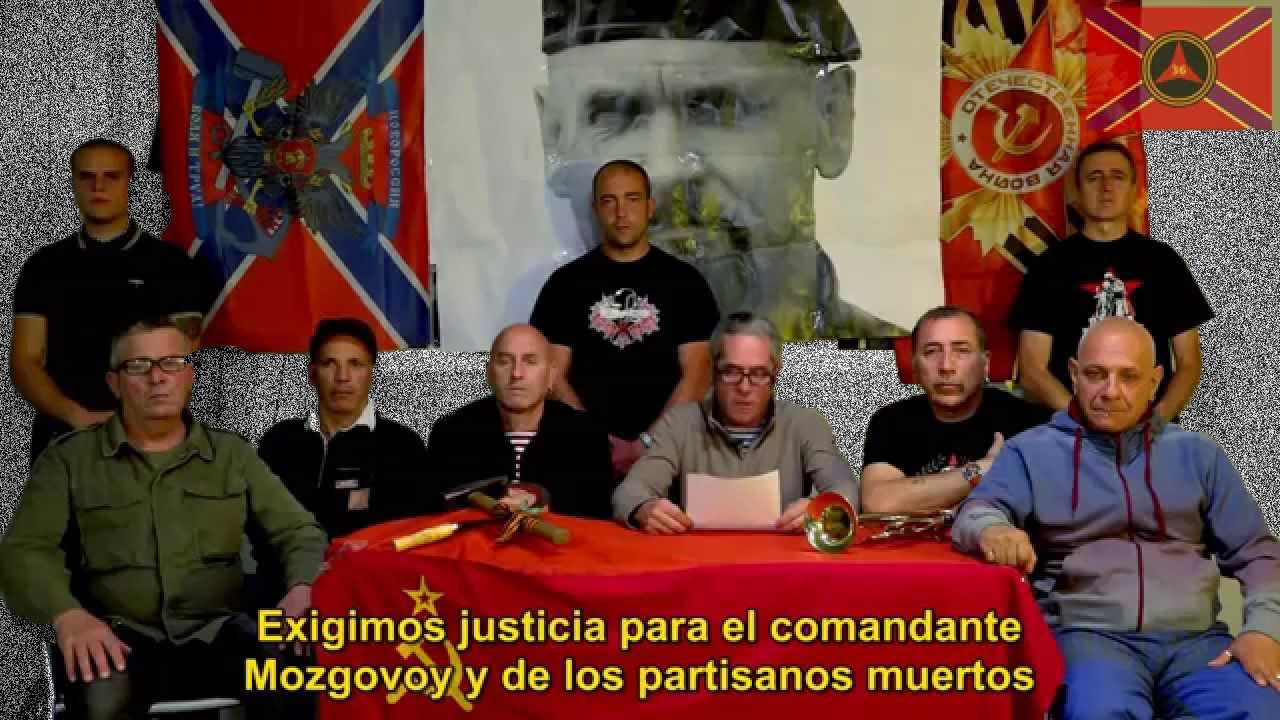
International campaign of support for the “Prizrak” combat battalion, fighting in support of “Novorossiya,” by the Italian rock band Banda Bassotti.
Some collectives approached supporting the Kremlin’s leftists creatively. The Italian communist rock band Banda Bassotti systematically performed and raised money in support of the “Russian Donbas” and “Novorossiya.” Moreover, it even organized an international group, the “Anti-Fascist Caravan,” which has been delivering humanitarian cargo to the occupied territories since 2014.
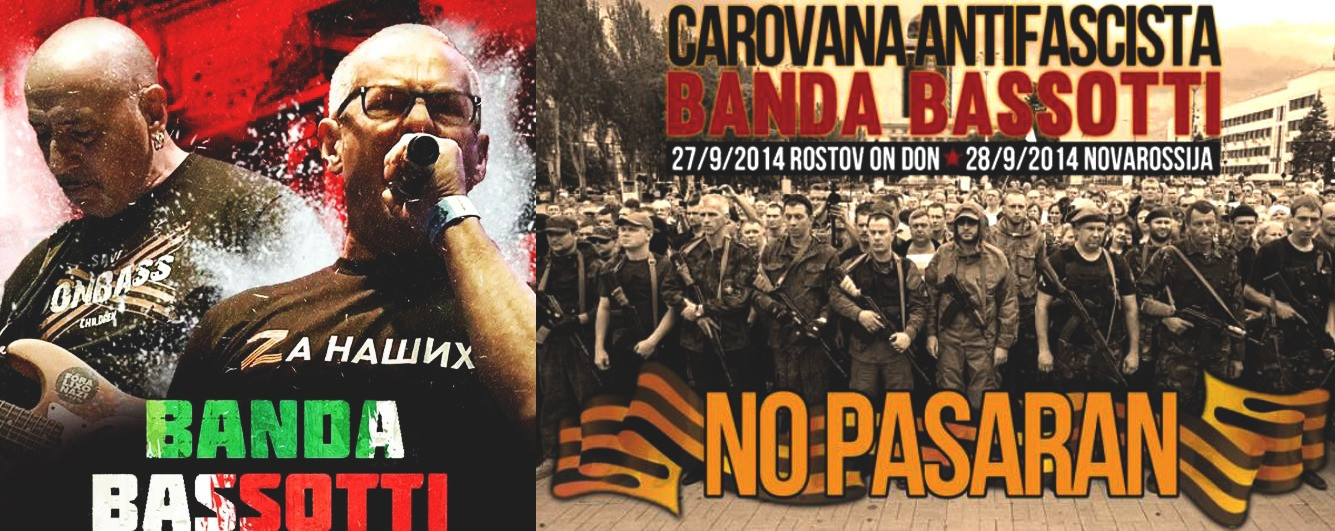
“In 2014 the Italian David Caccione (Banda Bassotti) and his comrades created the ‘Caravan of Anti-Fascists’ — an international group that for all these 12 years has supported the Donbas and delivered humanitarian aid there.” (Reverse)
Political technologists return from Ukraine and Moldova to work in the RF (Alexei Albu, Viktor Shapinov); some of them sabotage elections in Moldova (V. Shapinov, M. Firsov). Other leaders of “Borot’ba” go to Germany, where at international political congresses they continue to bring inthe themes of “Ukrainian fascism” and of the oligarchic class that has triumphed in the country, calling themselves political victims of the struggle against the regime.
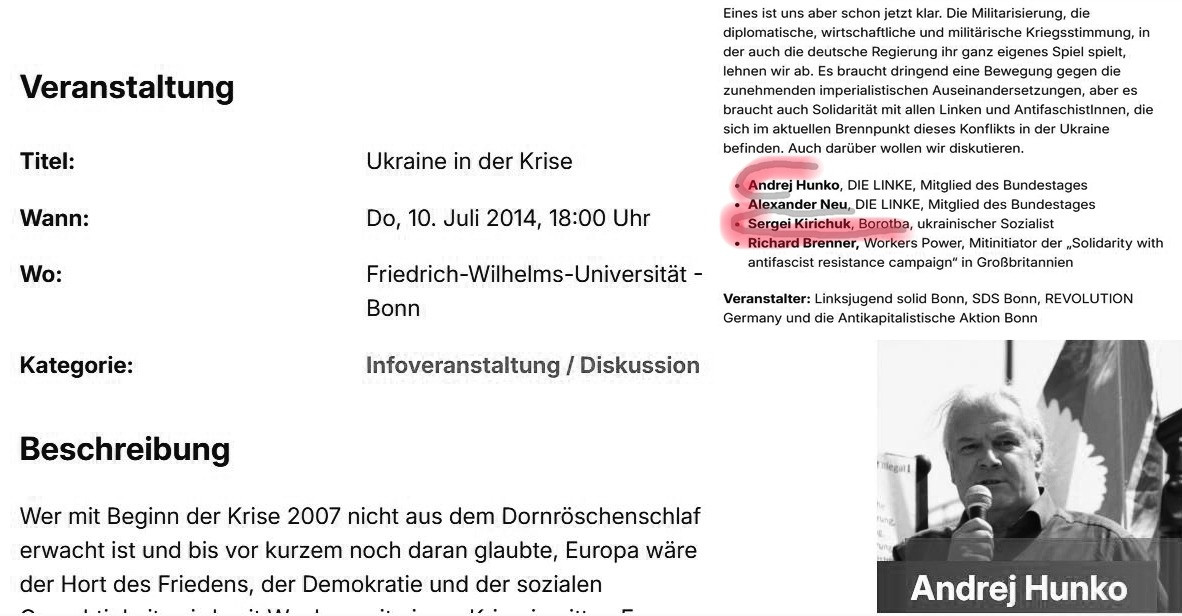
A joint appearance by one of the leaders of “Borotba” (Sergei Kirichuk) and the Bundestag deputy from the “Die Linke” party, Andrej Hunko. Both consistently spread Kremlin narratives about “triumphant fascism in Ukraine.”
The Russian “Left Front,” in turn, supported and validated the Borotba members' speech on international stages. In Sweden they jointly raised money for the armed struggle of the “militia,” and in Germany they legitimized the occupation of Crimea, support for the “separatists,” and the restoration of Soviet ideas.
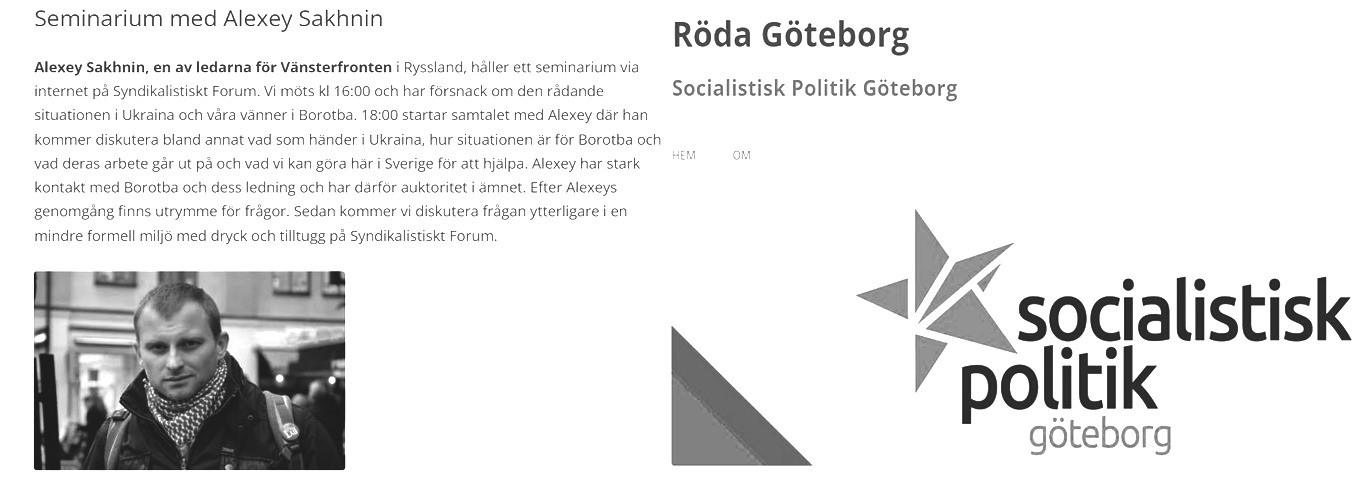
Alexei Sakhnin continues to seek support for “Borot’ba” and its ideas among the European left. “A conversation with Alexei Sakhnin (in 2014 — ‘Left Front,’ and in 2026 — ‘PSL’ (Post-Soviet Left) and ‘Peace from Below’), in which he will discuss, among other things, what is happening in Ukraine, how things stand with ‘Borot’ba,’what their work consists of, and what we here in Sweden can do to help you. Alexei has strong ties with ‘Borot’ba’ and its leadership and is therefore an authority in this area.”
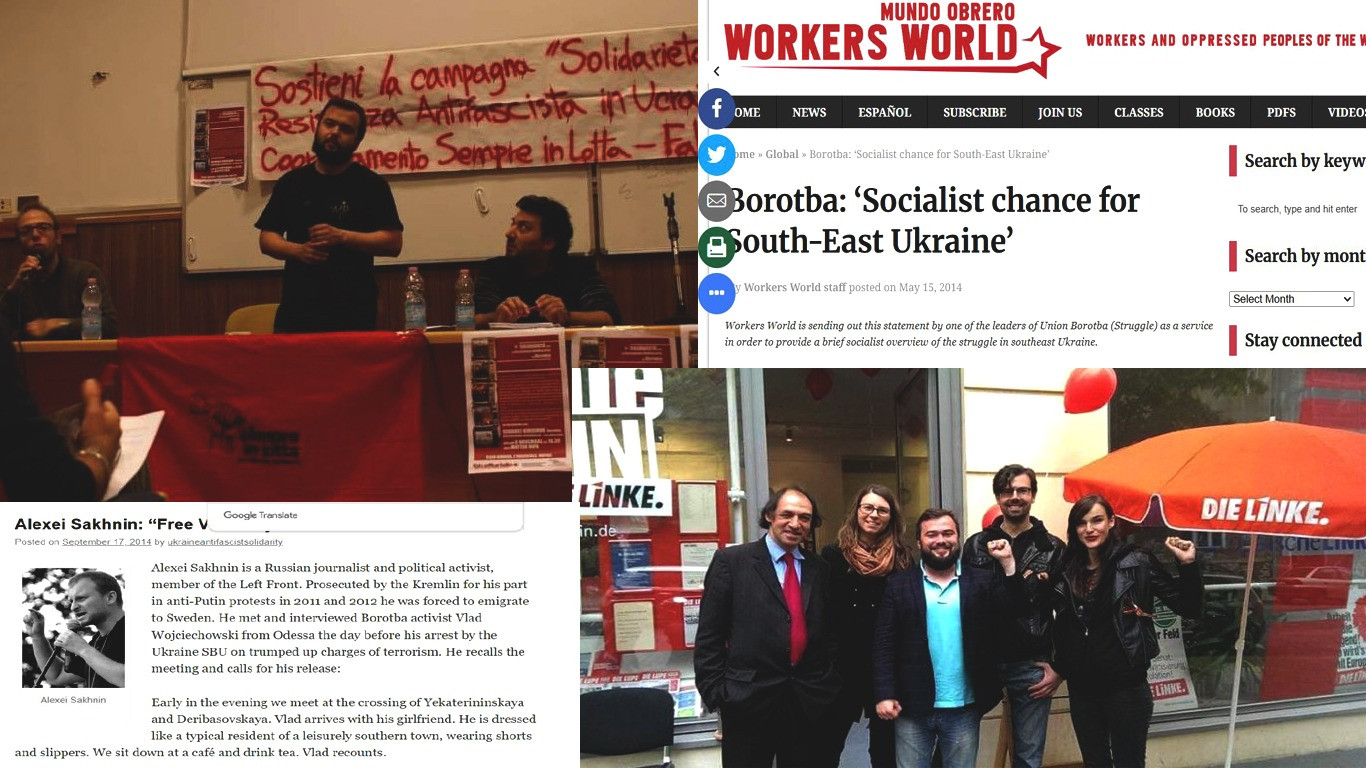
S. Kirichuk (“Borotba”), with the support of the German party Die Linke, and A. Sakhnin (“Left Front”), speaking and writing in European media and on European platforms about “Ukrainian fascism.”
“Rabkor” was also spreading pro-russian narratives within russia and abroad. It is the largest left-wing media platform in Russia, edited by Boris Kagarlitsky. Both “Rabkor” and B.Kagarlitsky in particular actively supported and promoted the ideas of “Novorossiya,” participating in propaganda congresses and conferences, as well as ideologically and structurally reinforcing “Borot’ba.”
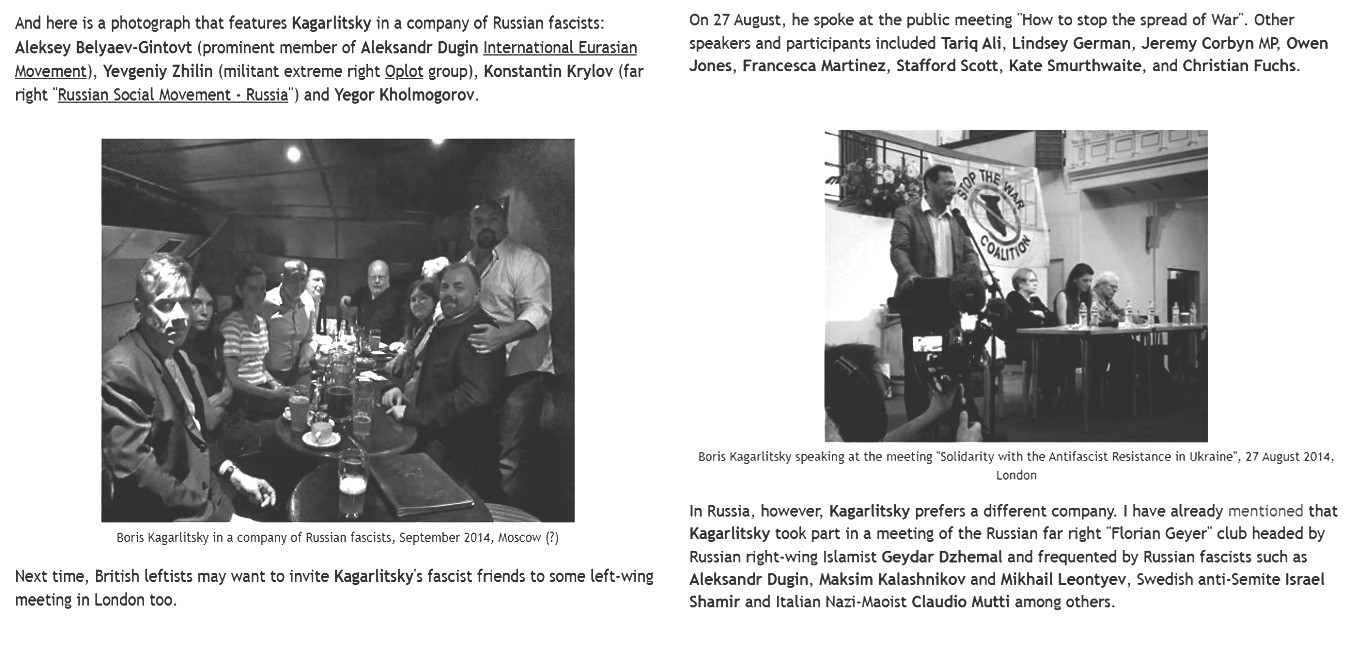
1. Kagarlitsky in the company of Russian fascists: Alexei Belyaev-Gintovt (a prominent member of Alexander Dugin’s International Eurasian Movement), Yevgeny Zhilin (the militant far-right group “Oplot”), Konstantin Krylov (the far-right movement “Russian Social Movement — Russia”) and Yegor Kholmogorov, 2014. 2. Boris Kagarlitsky speaks at the “Solidarity with the Antifascist Resistance in Ukraine” (SARU) meeting, 2014, London.
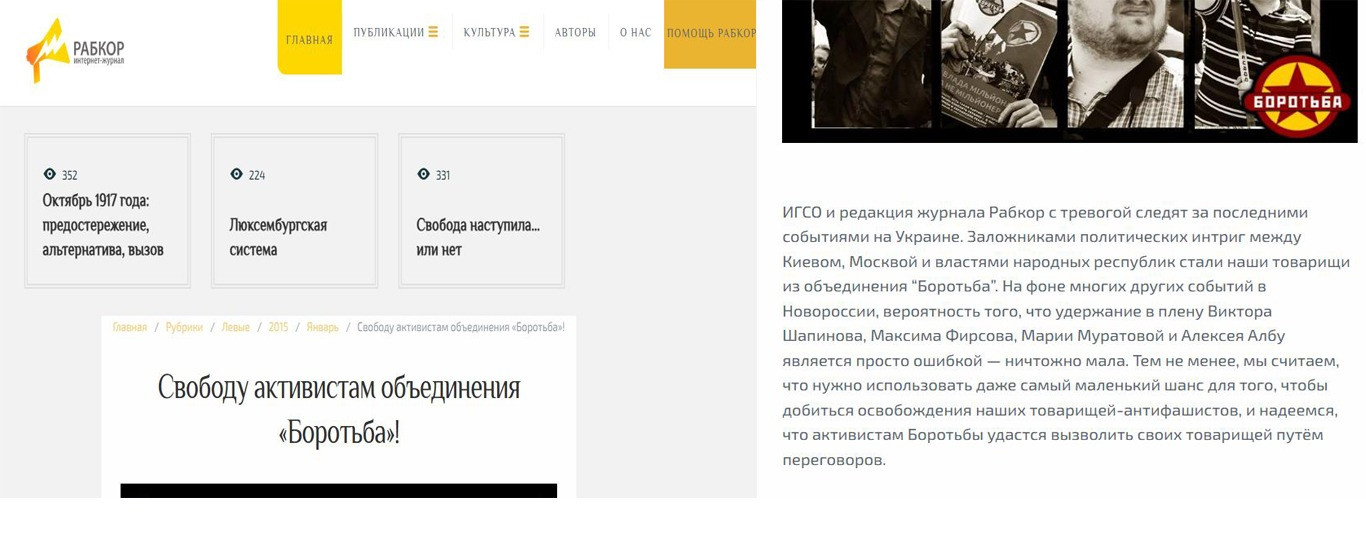
A publication on “Rabkor”: “Freedom for the activists of the ‘Borotba’ association!”
“Rabkor” published the ideological principles of the “Prizrak” battalion and also gave informational support to the “IGSO” (Institute for Globalization and Social Movements) and to the “New Rus” coordination center in running a school for activists from Ukraine and “Novorossiya,” in Belgorod.
Moldova 2014
In 2014, ahead of the parliamentary elections in Moldova, the “Antifa-Moldova” project was launched with the aim of influencing street politics and staging provocations under the cover of urban activism. The organization was created as left-wing and pro-russian. It was supported by Igor Dodon (the future president of Moldova, 2016–2020) and was developed by the previously mentioned political technologist from RF — Alexander Bludyshev.
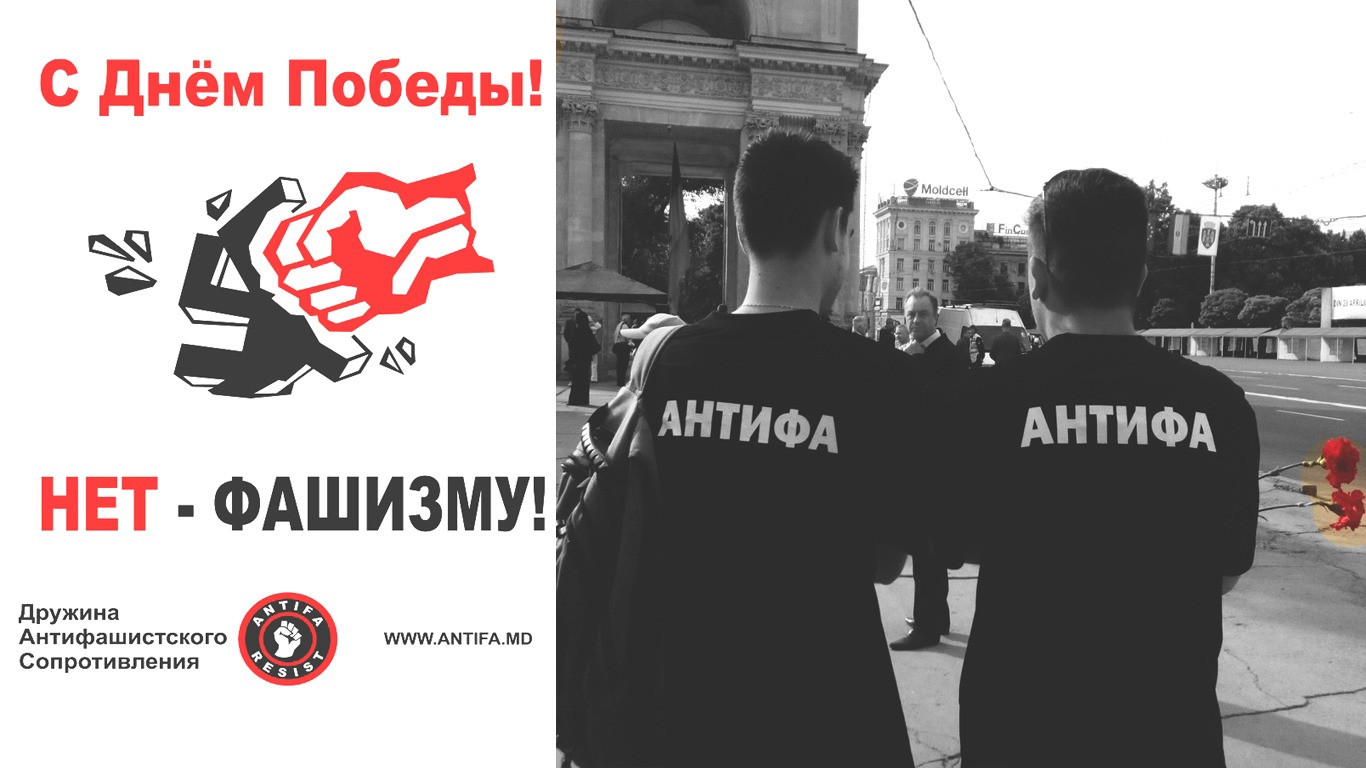
Photo from the “Antifa-Moldova” group, 2014. Placard text: “Happy Victory Day.”
Here one can recall the influence on Igor Dodon, who was handled by an SVR (Russian Foreign Intelligence Service) general, Vladimir Chernov, and by a representative of the RF Presidential Administration — Dmitry Kozak — as well as russia’s subsequent attempts to sabotage elections in Moldova. The handlers' task was to control the country’s foreign-policy course, shifting it toward deals with Russia.
The development of “Antifa-Moldova,” by analogy with the Ukrainian “Borotba,” was the task of Viktor Shapinov and Maxim Firsov. Mark Tkachuk, Grigory Petrenko, Pavel Grigorchuk (organizer of the “Social Forum of Moldova”) and Alexander Roshko — leader of the international youth organization of the European left (“ENGYL”) — were connected with the Central Committee of the PCRM (Party of Communists of the Republic of Moldova). In the autumn of 2014 the main goal of the “Social Forum” was to organize small subversive groups and to stage actions escalating into mass riots. Pavel Grigorchuk’s role consisted of recruiting young people who, for a small fee, agreed to take part in marches and pickets. To organize bolder forays, the leaders and activists of “Borotba” and the “Left Front” came to Chisinau: Viktor Shapinov, Maxim Firsov, Dmitry Kaminsky, Oles Dikiy and Vladimir Khrachev. They did not stay there long, being detained and expelled from Moldova. The prosecutor’s ruling notes:
“[…to] direct measures for destabilizing the socio-political situation during the election campaign,”citizens of the RF arrived: the head of the “radical organization ‘Left Front’” Maxim Firsov, the head of the “separatist organization ‘Borotba’” from Ukraine Viktor Shapinov, as well as Ukrainian citizens Alexei Dikiy, Dmitry Kaminsky, Vladimir Grachev, Alexander Semenets. Through the civic movement ‘Social Forum of Moldova,’ citizens of the RF and Ukraine, in complicity with Pavel Grigorchuk, Boris Tkachenko, Mikhail Amberg and Olesya Vedi (recruited by Mikhail Amberg), initiated actions to prepare for mass riots.”
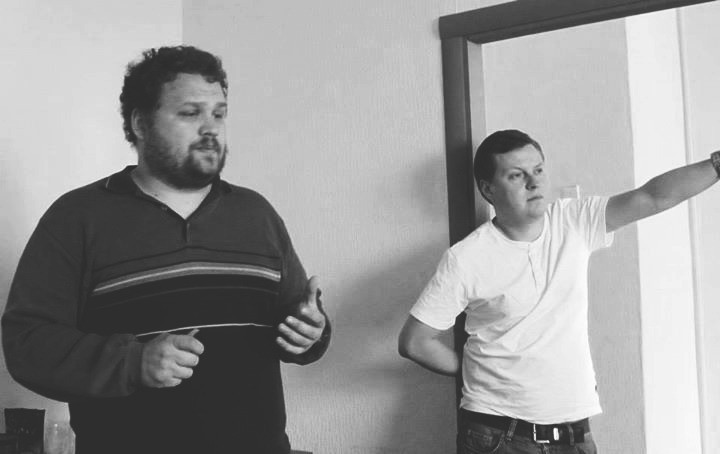
Maxim Firsov (“Left Front”) and Viktor Shapinov (“Borotba”).
This and the sabotage attempts were organised by the same persons on commission from the Presidential Administration of RF: the Russian political technologist Alexander Bludyshev, Viktor Shapinov and the activist Maxim Firsov. The tasks were the same — the creation of external networks of influence to destabilize parliamentary elections in the EECCNA countries. They use through leftist ideas, parasitizing on the infrastructure of the Soviet past.
On the International Connections and Influence of the “Union of Leftist Forces of Ukraine,” “Borot’ba” and the “Left Front” on the European Left
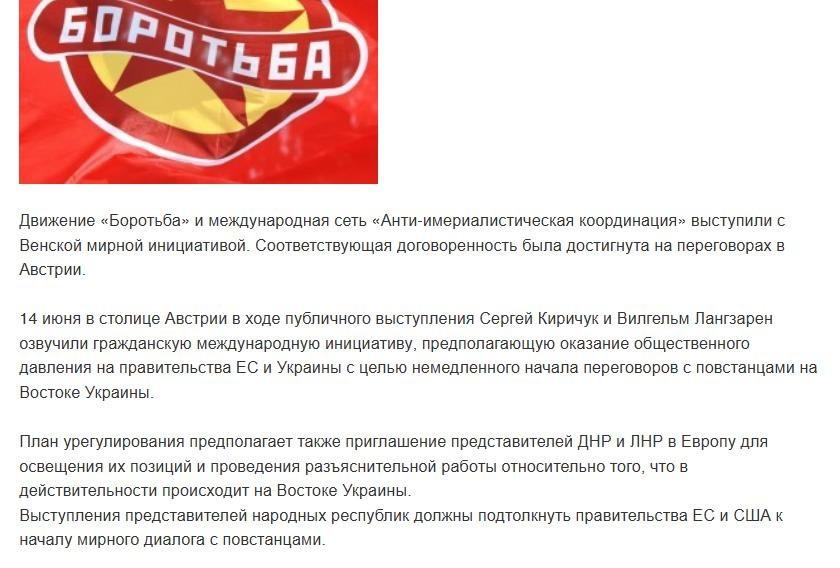
The political device of using the ideas of socialism, Trotskyism, Marxism and communism is a simple and intelligible springboard to an appeal for support among sympathetic Western party and non-party leftists, allowing influence to be built up outside russia. In addition to destabilizing the internal situation and creating the appearance of a presence in street politics, these organizations establish ties with the Western left by taking part in congresses and conferences, making publications, and running campaigns in support of “repressed” colleagues in Ukraine and Moldova.
If within RF politics the party-based left create an illusion of safe pseudo-competition with the
central government (for example, the KPRF), then on the foreign-policy stage of russian influence they play out the scenarios of Kremlin political technologists in left political circles, hiding behind the ideas of socialism, equality, revolution and support for the russian-speaking population of the “people’s” republics.
Many international left organizations take such gestures for grassroots protest politics. Often their delusions are caused by loyalty to, and a lack of a critical view of, the mythologized USSR project.
For various reasons, left media and groups, both after 2014 and after 2022, spread narratives advantageous to the Kremlin. It is hard to imagine more loyal enablers in matters of validating and legitimizing contemporary Russian politics than such left groups and parties.
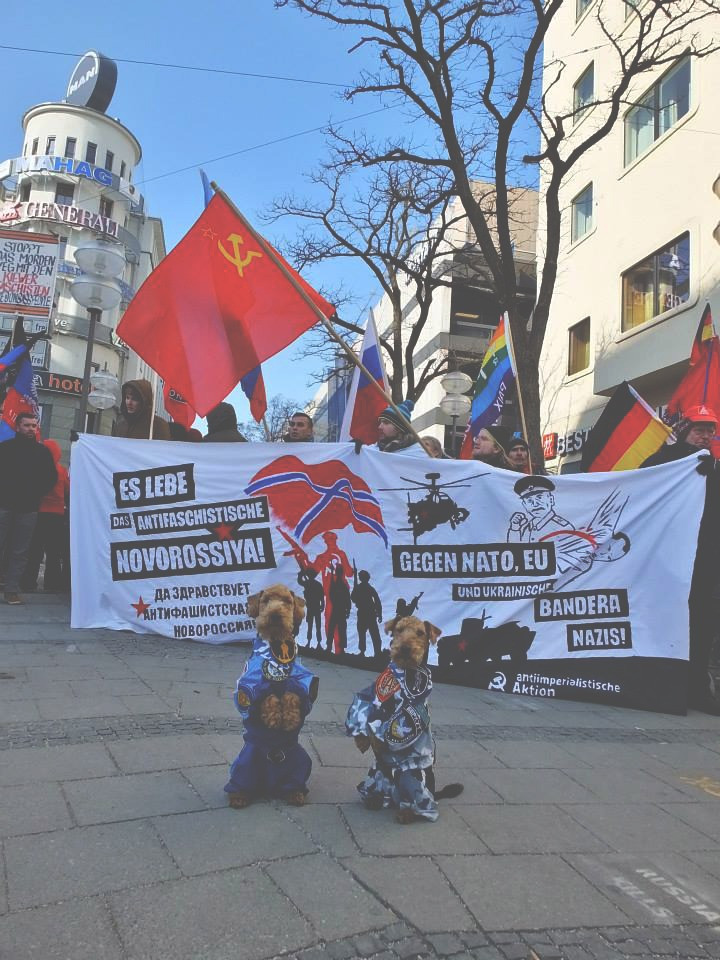
“Long live anti-fascist Novorossiya.” Munich, Germany, 2015.
Vasyl Volha noted the huge volume of work done to “fine-tune ties with the European left political establishment” as early as 2009: “This includes SYRIZA (Greece), and Die Linke (Germany). Die Linke is not in power, but it has representation in both the European Parliament and the Bundestag. These are the socialists of France, and the Labour Party of Great Britain. Before we began these public events of ours, we bound ourselves with contacts and mutual agreements ofmutual support and assistance.”
By 2026 the international loyalists and enablers remain relevant. The parties listed still provide support to pro-russian leftists.
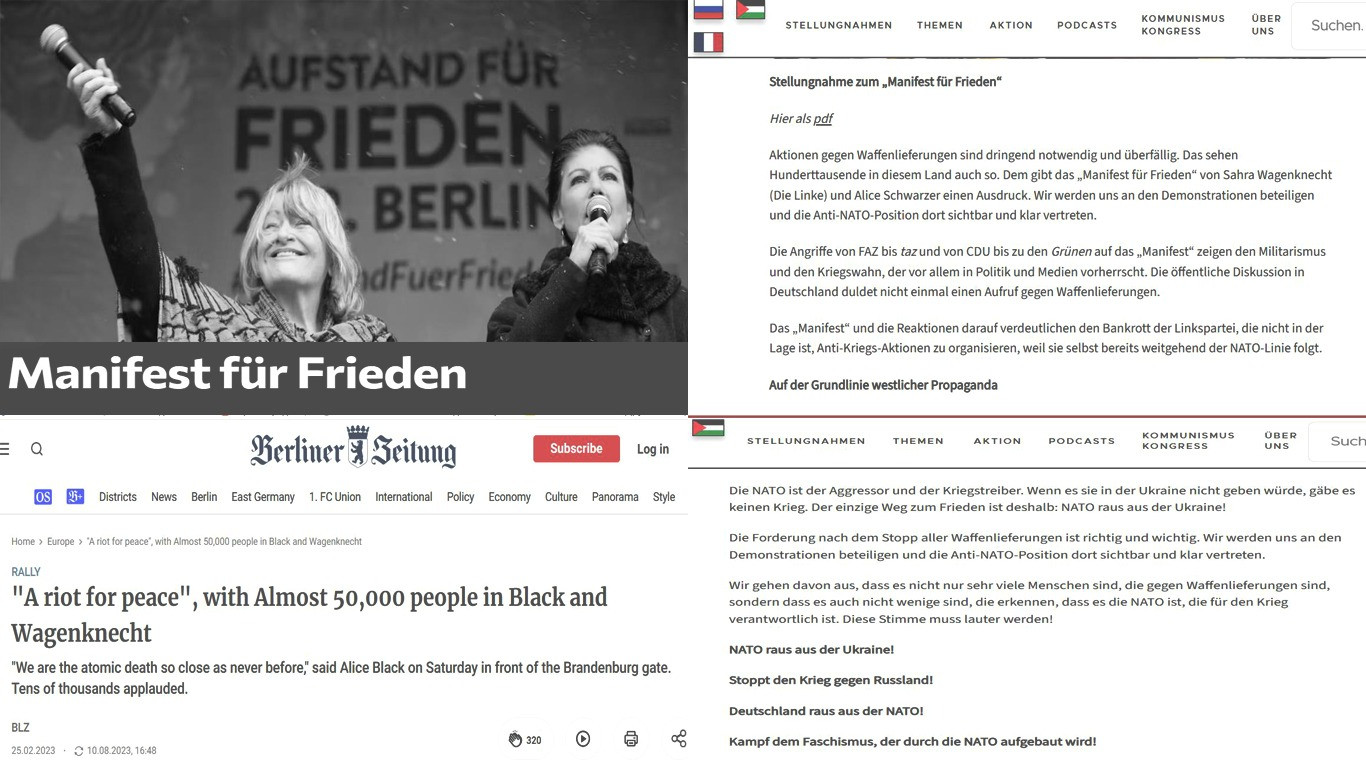
1. The “Manifesto for Peace” is an online petition created in February 2023 by the politician Sahra Wagenknecht and the publicist Alice Schwarzer. The manifesto called on Scholz to immediately stop the “escalation of arms deliveries” and to stand “at the head of a strong alliance” for a ceasefire and peace negotiations.Wagenknecht was a member of the European Parliament from 2004 to 2009 and one of the party’s deputy leaders from 2010 to 2014. From September 2009 to March 2025 she was a deputy of the German Bundestag. She holds a consistently pro-Russian position. 2. Complimentary critique of the manifesto from a pro-Russian communist resource. 2023.
Sahra Wagenknecht, though she left the “Die Linke” party and founded her own “Sahra Wagenknecht Alliance,” still retains influence with the support of Andrej Hunko, whose consistent anti-Ukrainian positions continue to matter in the left political circles of the Bundestag. In October 2024 A. Hunko was in Georgia (Sakartvelo) with representatives of the Council of Europe (PACE), after which he made the following statement: “Against the backdrop of the war in Ukraine, the EU and the USA are putting ever greater pressure on the country, demanding that it join the course of confrontation with Russia. This puts Georgia before a serious test. To give the country recommendations about elections and to promise punishment for the ‘wrong’ choice is wrong and undemocratic.” In so doing, he was preemptively justifying falsification of the voting procedure in favor of the hegemony of the pro-Russian party “Georgian Dream.” A joint statement by the chairs of the foreign- and European-affairs committees of Germany, Lithuania, Estonia, Latvia, Ireland, Ukraine, Poland and Canada, by contrast, called on the European Union not to recognize the results, calling them “neither free nor fair.”
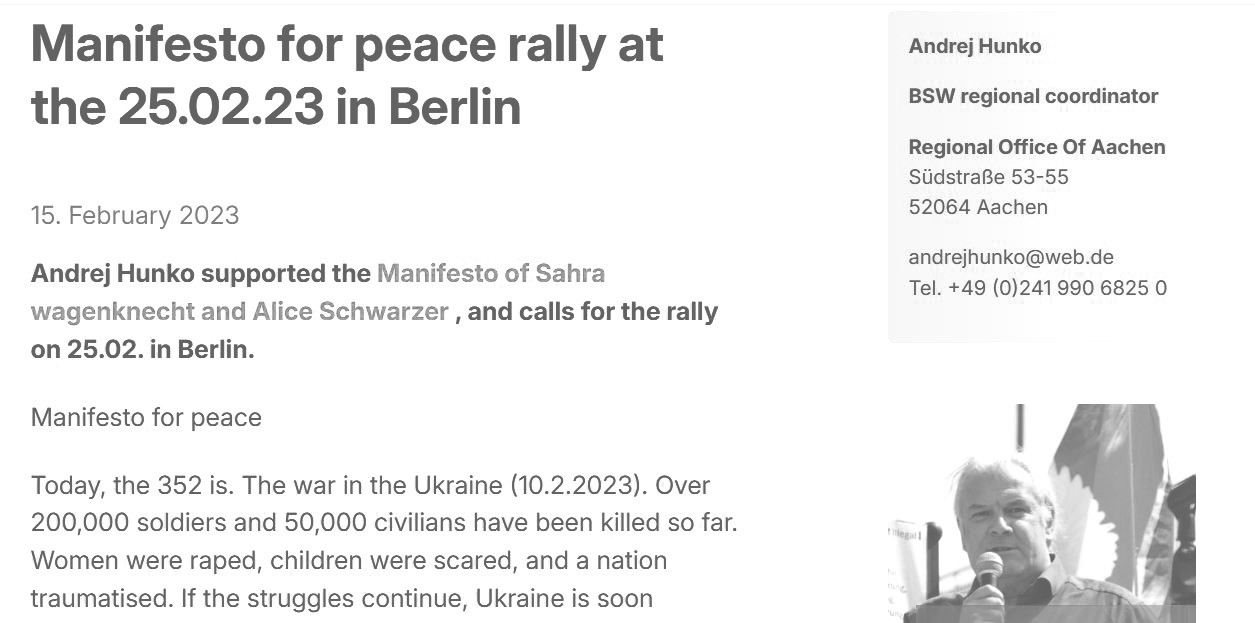
A. Hunko supported the manifesto and online petition against Germany delivering arms to Ukraine and in support of peace negotiations within the framework of Russia’s full-scale invasion of Ukraine. Andrej Hunko is a consistently pro-Russian politician. He has been a member of the Parliamentary Assembly of the Council of Europe (PACE) since 2010. Since 2015 he has been deputy chair of the parliamentary group “Unified European Left,” and since 2020 deputy chair of “Die Linke” in the Bundestag. Hunko left “Die Linke” and in 2023 joined the new party “Sahra Wagenknecht Alliance.”
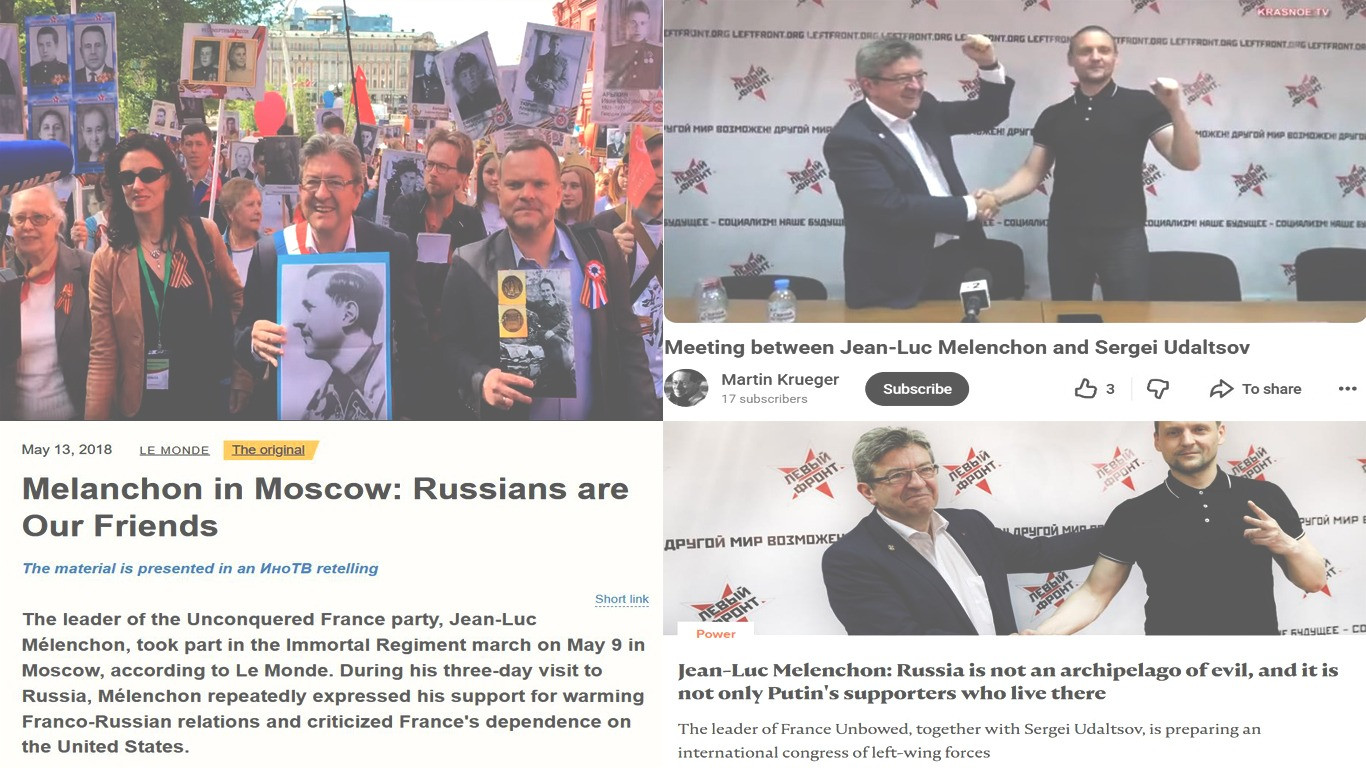
1. “The leader of the ‘France Unbowed’ party, Jean-Luc Melenchon, took part in the ‘ImmortalRegiment’ action on 9 May in Moscow, Le Monde reports.” 2018. 2. “Jean-Luc Melenchon: Russia is not an archipelago of evil and not only Putin supporters live there. The leader of ‘France Unbowed’ together with Sergei Udaltsov is preparing an international congress of leftist forces.”
Jean-Luc Melenchon, leader of the “France Unbowed” party (LFI), has long sympathized with the Russian leftists of the “Left Front.” In 2018, after the annexation of Crimea and the opening of an LF cell in Crimea, Melenchon collaborated with Udaltsov and planned broad joint international work with him. Melenchon also took part in the “Immortal Regiment” action on 9 May in Moscow. At the same time, Melenchon had as his adviser on international and defense matters Georges Kuzmanovic, a figure featured in Cecile Vaissie’s book “The Kremlin’s Networks in France.” He is currently the leader of the movement “Sovereign Republic” (Republique souveraine). In 2024 Kuzmanovic took part in the BRICS summit in Kazan, where he spoke about the possibility of France joining this bloc. In 2025 the La France Insoumise (LFI) deputy Sophia Chikirou also joined the “Immortal Regiment” in Paris. On video from the event she stands beside a Russian flag and calls Ukraine’s possible accession to NATO and the European Union a “provocation.” The “Immortal Regiment” in Paris gathers various participants, including from the left spectrum: “Representatives of France’s Marxist movements take part in the march. ‘I took part last year as well. We communists must not forget the contribution of the Soviet Union to the victory over Nazism,’ noted a representative of the left movement ‘Pole of Communist Revival in France’ (PRCF).
”A woman came to the action with a placard reading the demand to “stop the war that the USA, with Ukraine’s help, is waging against Russia.” “Russians are not our enemies, and I do not understand why so many succumb to Russophobia,” added Selvi. The organizer of the “Immortal Regiment” action in Paris is Georgy Shepelev, who is also head of the Coordination Council of Russian Compatriots in France and a figure in the aforementioned book about the Kremlin' networks of influence.
Reinforcing international faith in the Soviet project of the “unity” of Russia’s “fraternal” “peoples,” the Kremlin invests significant resources in creating “left organizations” in the region of planned sabotage. Most often, such organizations — for example, the “Union of Left Forces” in Crimea and the “Left Front” in Moscow — are built on the basis of old communist infrastructure. However, we also see shorter-lived projects created for rapid-response sabotage: “Borot’ba” in Ukraine, “Antifa” in Moldova, with the same participants as in Ukraine during the Anti-Maidan attempts (Viktor Shapinov, Maxim Firsov). The tasks of these organizations were disinformation campaigns at protests ahead of elections in Ukraine and Moldova, media visibility, provocations in crowds, the organization of pro-Russian rallies, the draining-away of protest, and, of course, the establishment of international ties to build networks of Russian propaganda.
For this, international solidarity campaigns are launched: congresses, conferences, international political coalitions and supporting alliances. The mechanisms for attracting support from the leftists of Western countries vary: often they follow the lead of international delusions and myths about the Soviet Union; somewhere, longtime friends of the Kremlin from European parties, pursuing economic interests, are drawn into the game. And somewhere, the decisive factor turns out to be the GRU’s crypto-infrastructures and their external agents of influence.
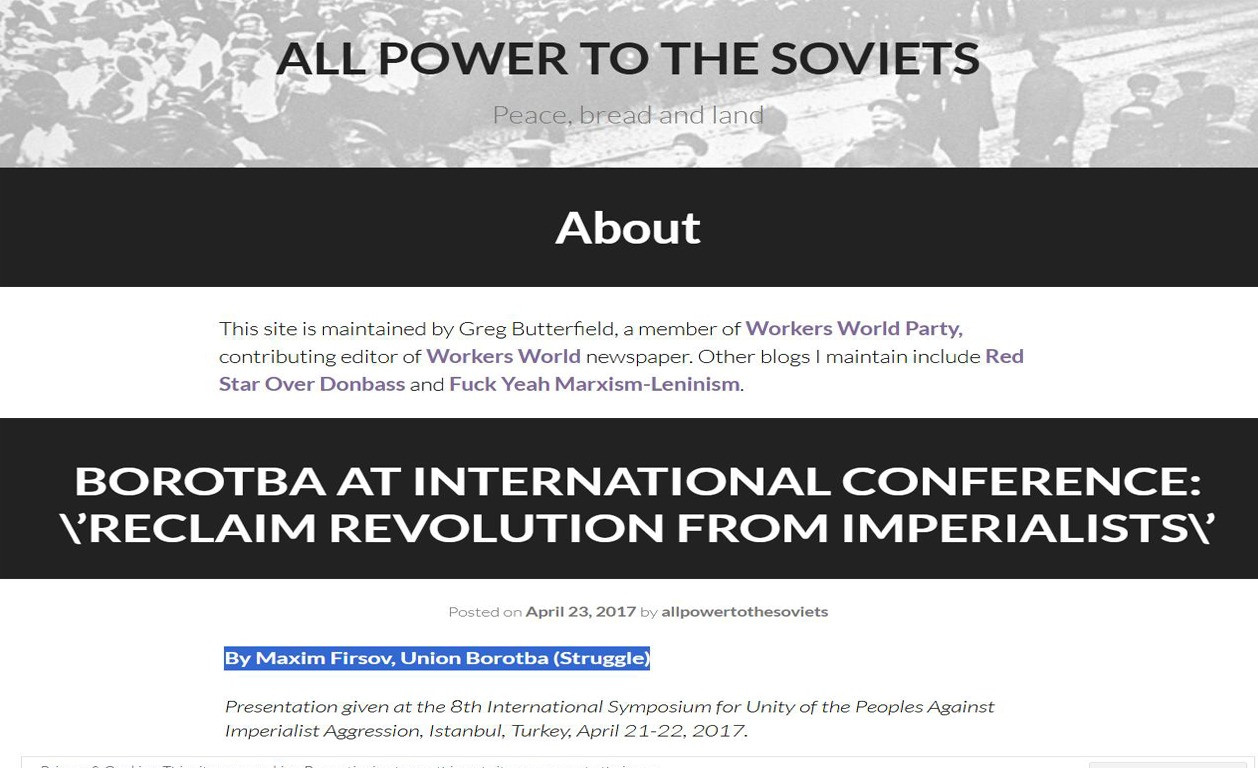
“Left Front” member Maxim Firsov — presented himself as a “Borotba” activist at the international symposium of anti-imperialists in 2017 in Istanbul. Source: “All power to the soviets.”
It is important to note how cynically the agenda of anti-fascist movements is re-signified in these staged organizations, and how political aesthetics and symbols — form without content — are used by political technologists.
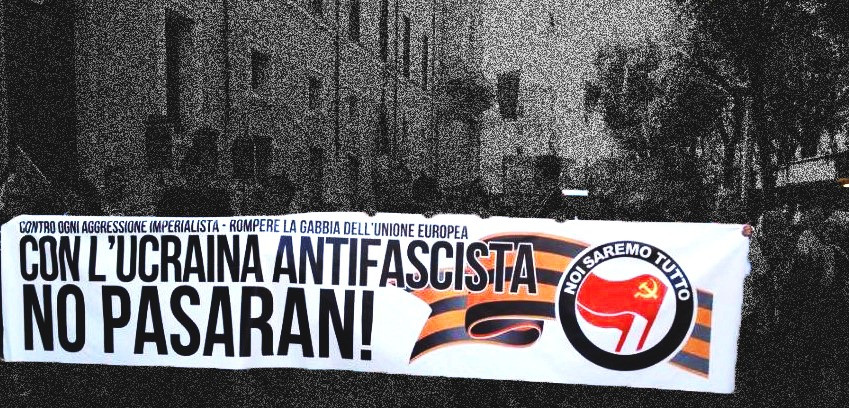
Yet another demonstration against “Ukrainian fascism” with St. George ribbons. Co-organizers: Banda Bassotti, Spain, 2014.
Having served their purposes, the organizations cease to exist, but their heads and participants move from project to project, creating new associations and coalitions.
For the international left scene, networks of websites were created, often cross-linked, with an “educational” (propagandistic) purpose and to form international networks of solidarity with the “militia.” The European left, supporting “the people” with “George ribbons”, antifa symbolism and the unity of workers (hammer and sickle), in fact aided the Presidential Administration.
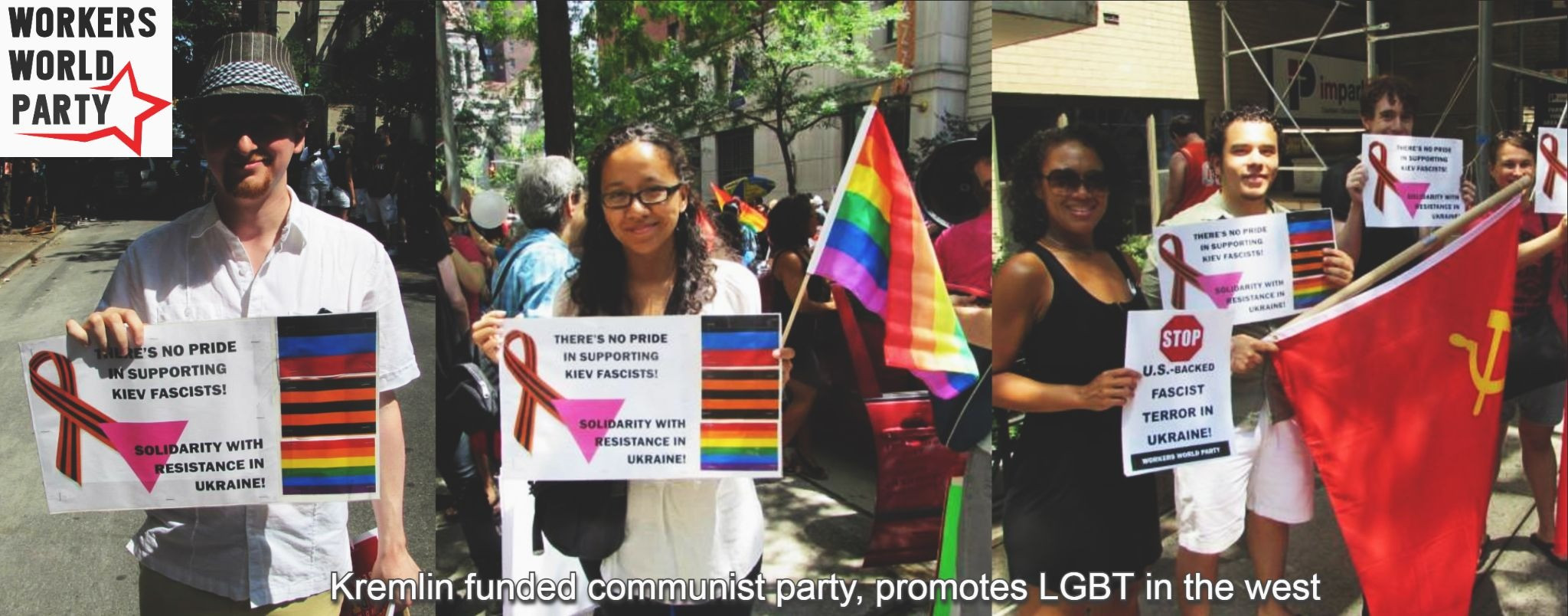
A symbiosis of St. George ribbons (Russian patriotic symbolism) and flags and symbols of LGBT movements (banned in contemporary Russia), united by slogans against “fascism in Ukraine.” New York, 2014.
Examples of Fabricated Networks of “Grassroots Activism” and Campaigns of “Anti-Fascist Solidarity”
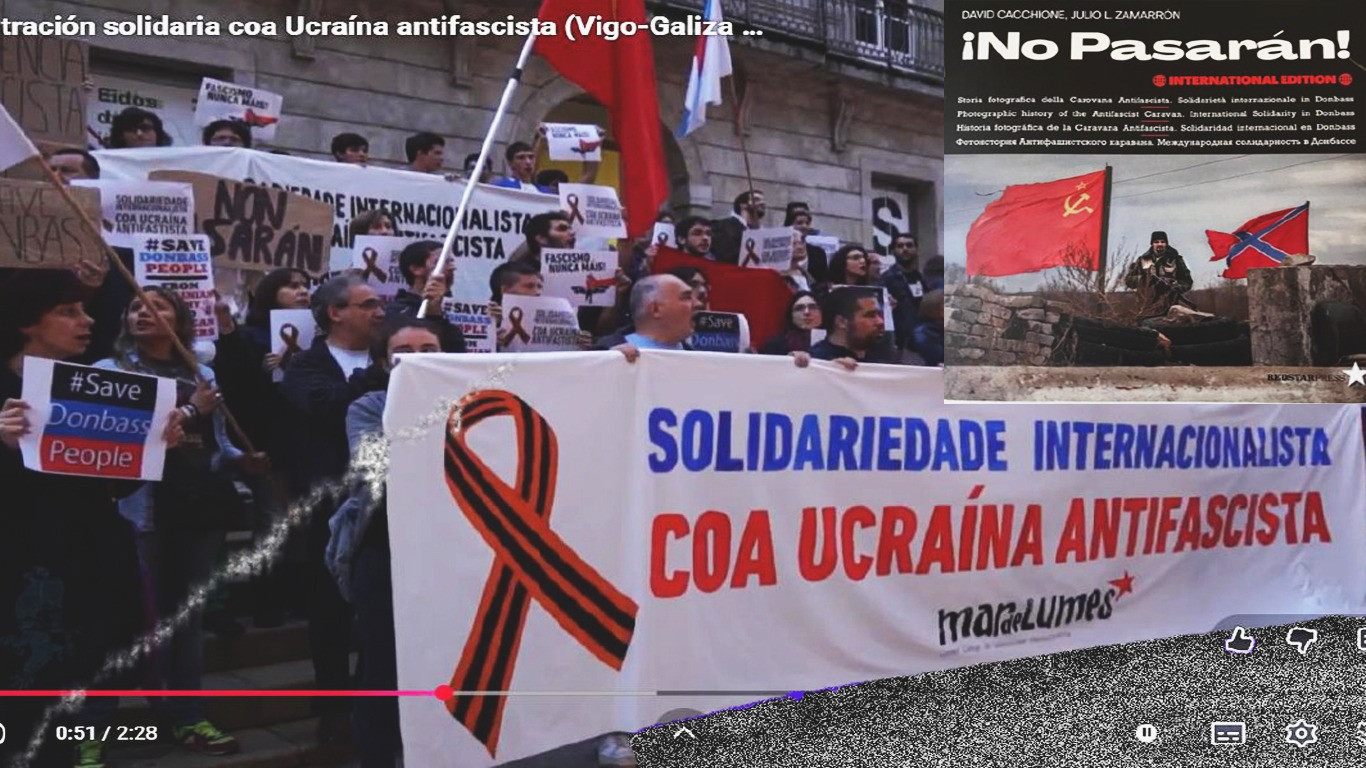
1. The “Solidarity with the Antifascist Resistance in Ukraine” campaign — “Save Donbass.” 2. David Caccione’s propaganda book, Banda Bassotti: “Solidarity is our weapon against fascism.”
Spain / Basque Country, 2014 — present: Euskal Herria-Donbass Elkartasun Komitea (Comite de Solidaridad Euskal Herria-Donbass). Here is how the organization describes itself on its website: “The Committee is, first and foremost, an instrument of assistance to the workers of Novorossiya.[…] Novorossiya calls itself the Union of People’s Republics and has declared that there will be no place in it for a parasitic oligarchy, since one of its goals is to restore the dignity of workersand public ownership. The Committee recognizes these values.”
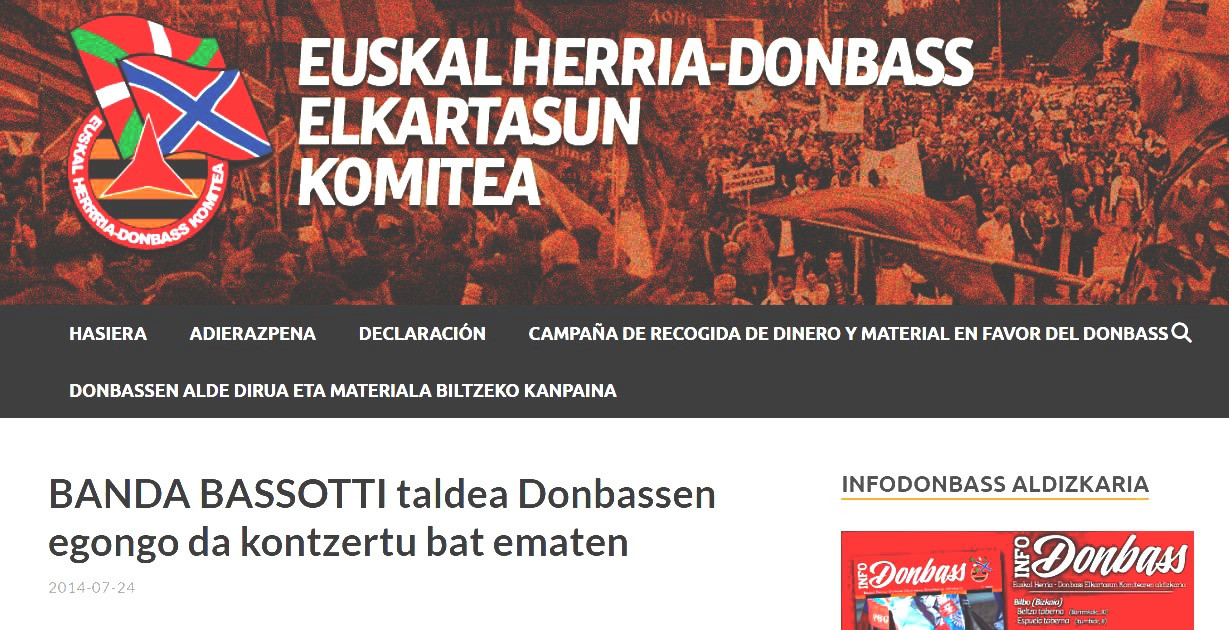
“Since its founding in the spring of 2014, the Euskal Herria-Donbass Elkartasun Komitea (Basque Solidarity Committee with the Donbas) has worked tirelessly for the benefit of Novorossiya.” United Kingdom, 2014–2016: SARU (Solidarity with Antifascist Resistance in Ukraine).The network’s goal was to mount an international campaign to defend the warring separatists from a leftist perspective: “The ‘Solidarity with the Antifascist Resistance in Ukraine’ organization called for a demonstration in protest against the continued cooperation of the UK and the EU with the unelected junta in Ukraine.”
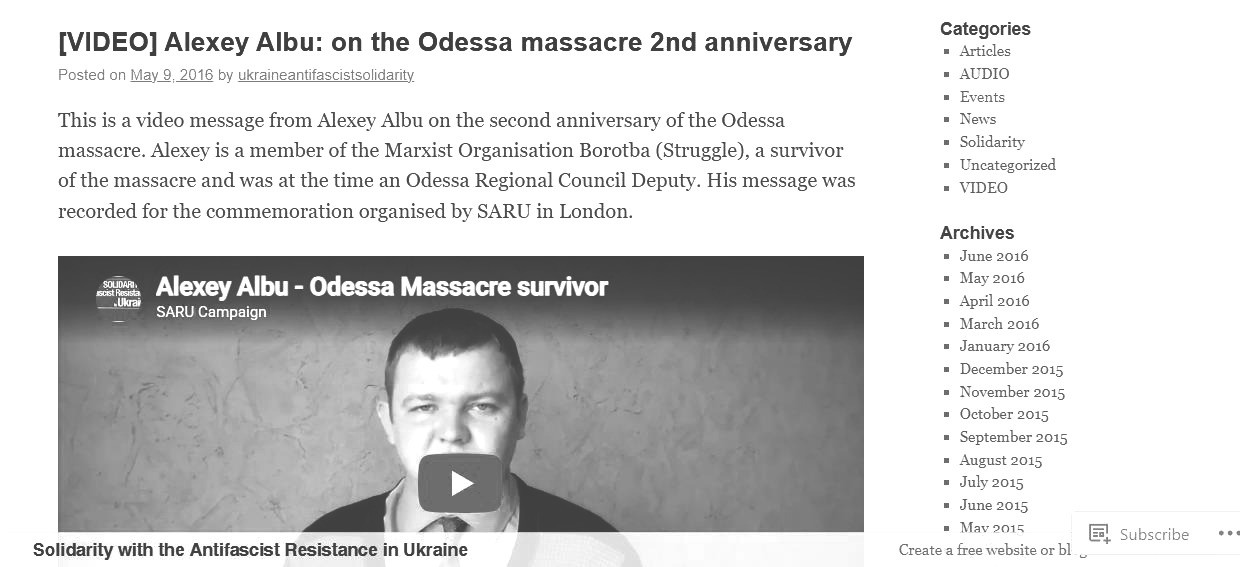
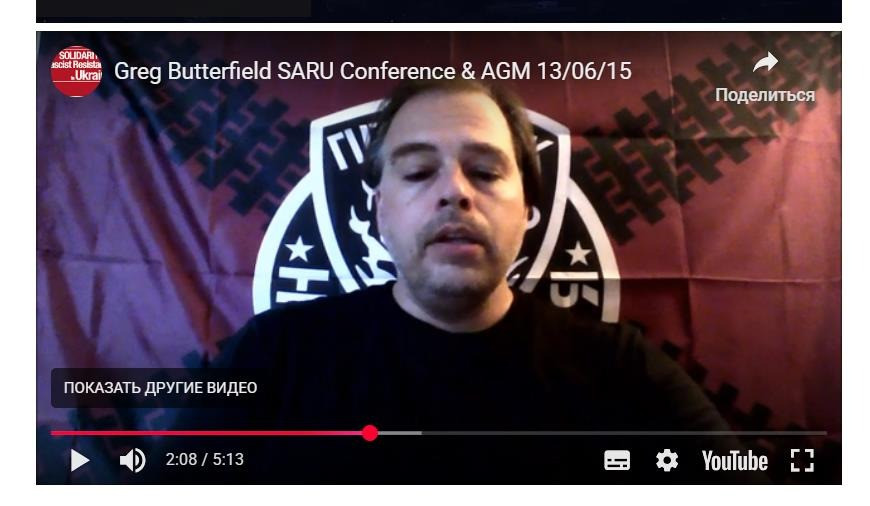
United Kingdom, 2014–2015: Bristol Ukraine Anti Fascist Solidarity: “This site is an information center for residents of Bristol ‘concerned about the rise of fascism in Ukraine and wishing to express solidarity with the anti-fascist struggle in that country.’”
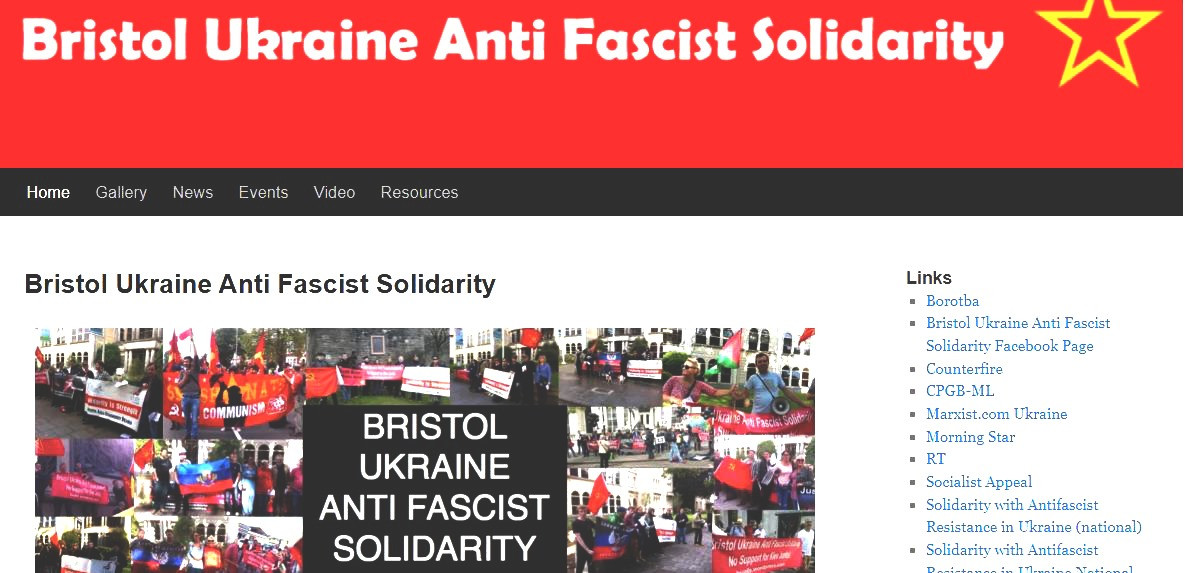
The Bristol solidarity network with placards against support for the “Kyiv junta.”
Sweden, 2014–2021: Donbassforeningen Malmo: “We would like to engage in activism at a level that touches on such issues as concern about the situation in eastern Ukraine. We do this through various demonstrations and manifestations.”
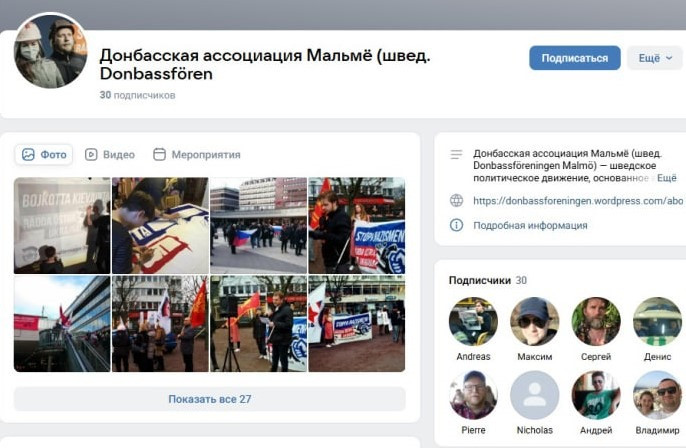
The Donbassforeningen Malmo group at VKontakte
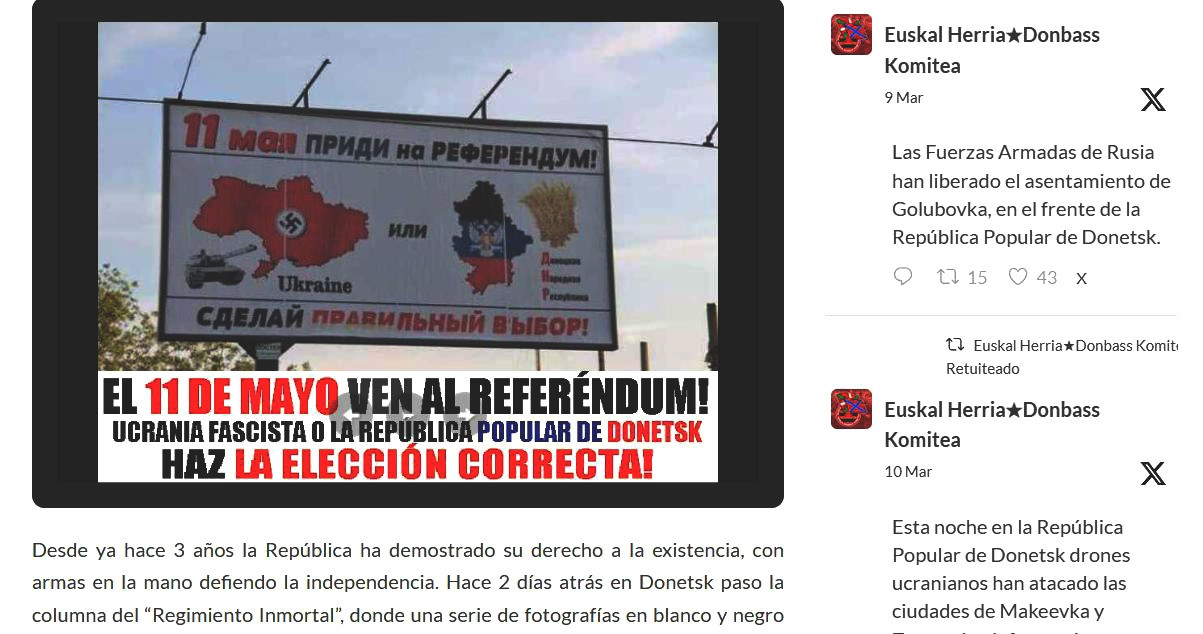
A call for a referendum to form the “DNR” on the Spanish propaganda site Euskal Herria-DonbassElkartasun Komitea. “Come to the referendum! Make the right choice!”
SLAVYANGRAD.org — a propaganda resource supporting the warring separatists of “LNR” and “DNR,” which published materials in English, German and Spanish (2014–2015).
Novorossiya’s Leaders — Strelkov Briefing and Mozgovoi Manifesto: “Oligarchic power in Ukraine must be destroyed, the battle must be carried through to a victorious end. There is no other way. It is necessary to convene the Military Council of Novorossiya as soon as possible. Its task is to confirm the unity of Novorossiya and to continue implementing its revolutionary program.”
Many media platforms remain relevant even now, in 2026.
Both the pseudo-forms of popular activism and these solidarity campaigns are not as marginal and inconspicuous as they may seem at first glance. In the wake of their activity, many of the largest international left-wing media resources published statements of support for the “rebel separatists” between 2014 and 2016, and called for solidarity with the “repressed anti-fascists” in Ukraine.
By “anti-fascism” is meant activists opposing the central government of Ukraine and acting in the RF’s interests. This was presented as a struggle against local oligarchic forces, against neoliberalism, inflating narratives about the dominance of the “Right Sector.” Characteristically, the solidarity actions involved “George ribbons”, often happened against a backdrop of Russian banners and even with the participation of Russian nationalists.
The collaboration of “Borot’ba” and the Russian nationalists of the “Odesa Druzhina” is well known: together they took to rallies for a referendum on the secession of Odessa from Ukraine. Some “Borot’ba” members belonged to the “Odessa Druzhina.” “Borot’ba” also entered into consistent tactical alliances with nationalists and neo-fascists.
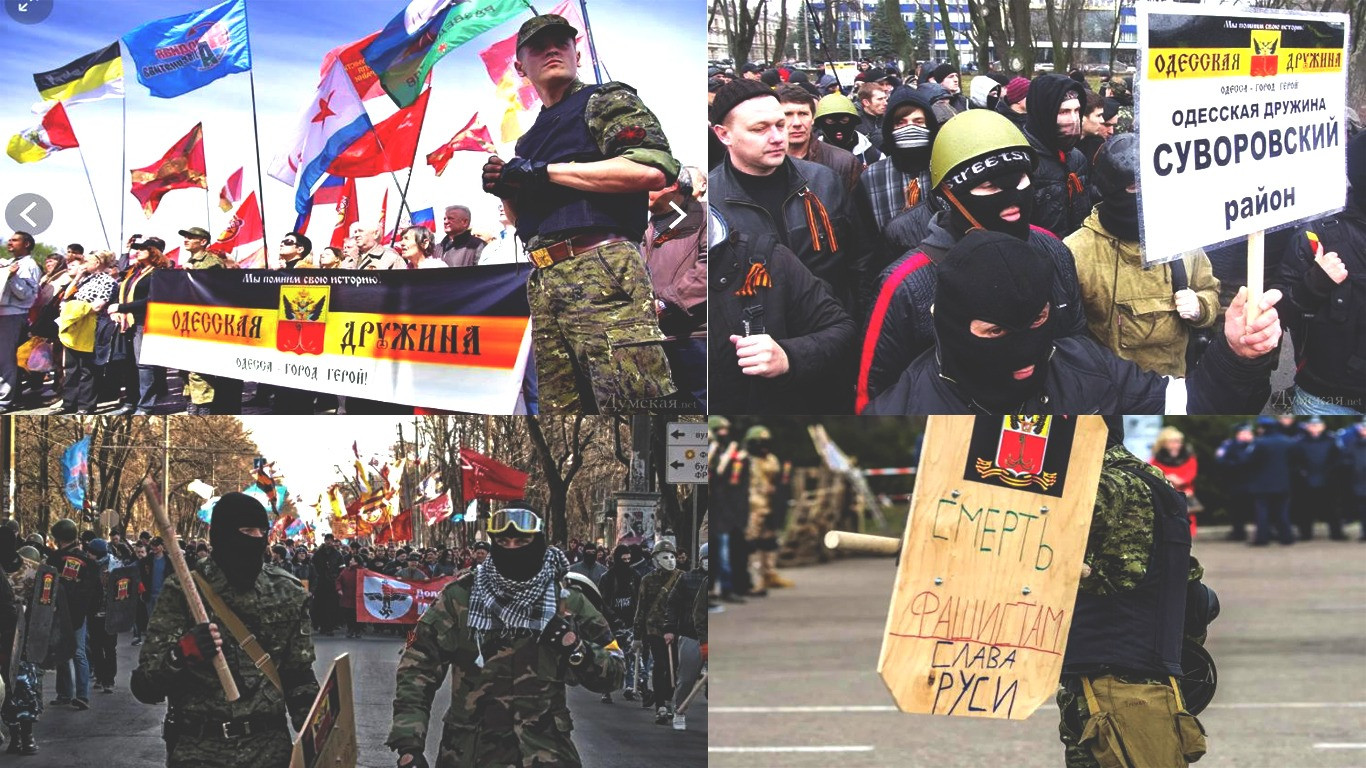
“Borotba” flags fly alongside the flags of the “Odesa Druzhina” and Russian nationalists. Anti-Maidan, 2014.
Reaction: (examples of international delusions)
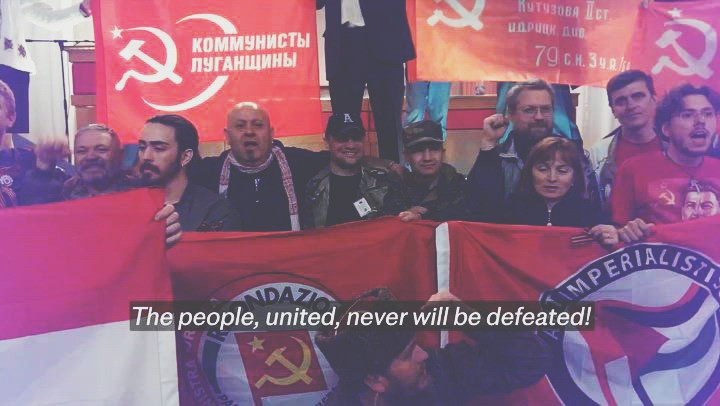
“Communists of the Luhansk region,” 2015. “The head of a trade union that donated money to the Labour Party once posed with a communist flag, chanting Russian slogans in occupied Ukraine. Eddie Dempsey, head of the influential RMT union, was filmed chanting ‘Together we are invincible’ in the Donbas, which a year earlier had been occupied by the Russian army.” link
International Committee of the Fourth International (ICFI) — WSWS is the online publication of the world Trotskyist movement, the International Committee of the Fourth International and its sections in the Socialist Equality parties worldwide. “The political character of the Maidan movement quickly became obvious. Representatives of Ukraine’s ultranationalist and neo-fascist parties found themselves at the center of attention alongside the country’s super-rich.”
Bolshevik Tendency — the international “Bolshevik Tendency” movement. “Russia reacts to imperialist encroachment. Ukraine/NATO/the United States ignore the Kremlin’s red lines”: “We persistently strive to participate in the process of internationally uniting revolutionary cadres on the basis of a program of genuine Trotskyism, as a step toward the long-overdue rebirth of the Fourth International, the World Party of Socialist Revolution.”
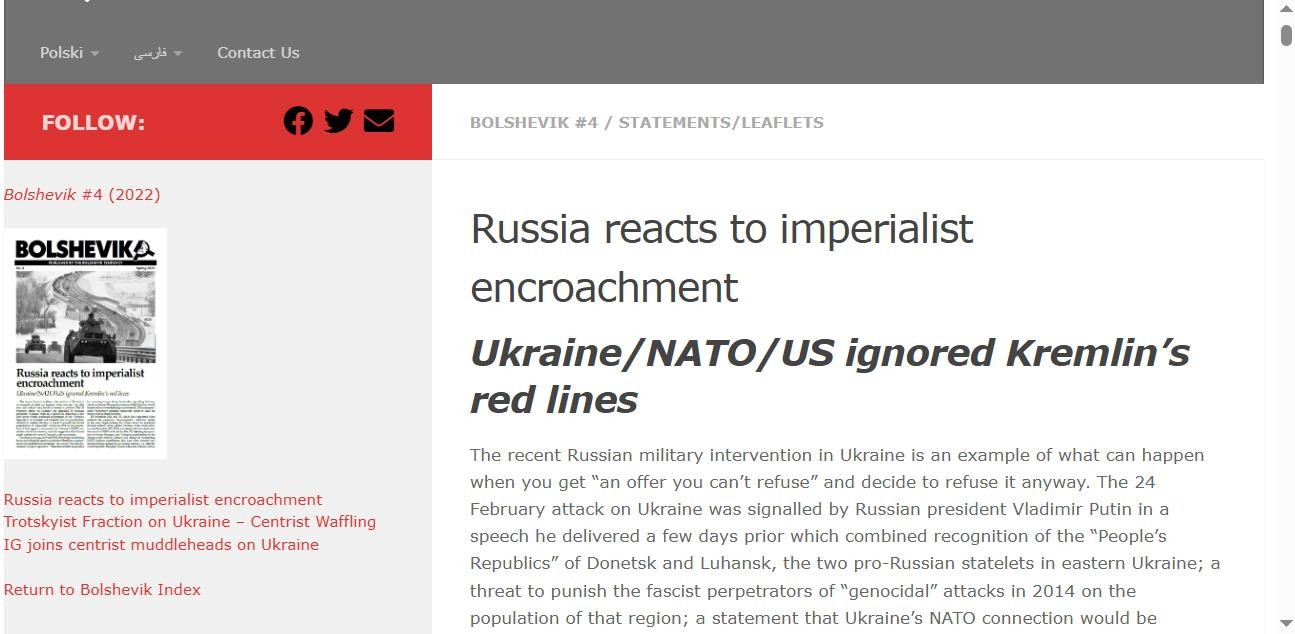
Workers World: the “Workers World Party for a socialist society.” “Borot’ba: A Socialist Chance for South-Eastern Ukraine”: “This alliance of oligarchs and Nazis seems to have come straight from history textbooks, as does the alliance of anti-fascist and anti-capitalist slogans of the opponents of the Kyiv junta.”
International Marxist Tendency (IMT) — a journal of Marxist theory, analysis of current events and the history of the revolutionary workers' movement. “The IMT took part in launching the ‘Solidarity with Antifascist Resistance in Ukraine’ (SARU) campaign.”
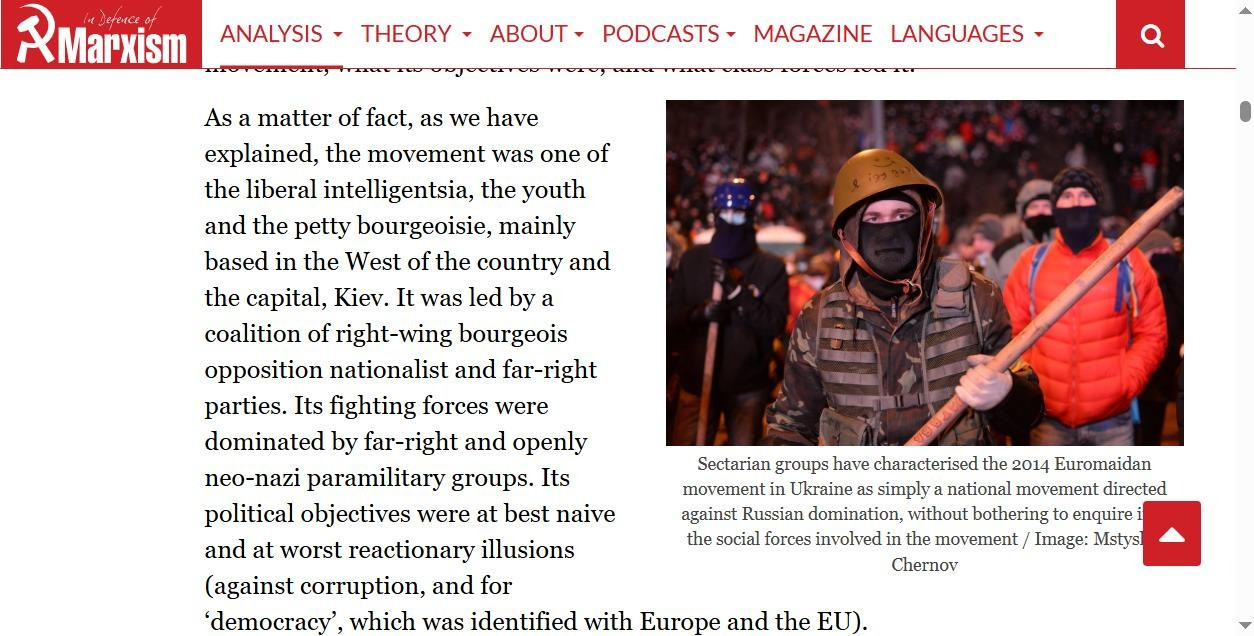
Revolutionary Communists of America (RCA) — a new political party of the American communist movement. They published an interview with a “Borot’ba” activist: “Our struggle is for a socialist Ukraine as part of the struggle for a socialist world.”
Revolutionary Communist Party — the Revolutionary Communist Party (RCP) in Great Britain. The “Solidarity with Antifascist Resistance in Ukraine” (SARU) organization held a meeting of supporters on 11 November at the Marx Memorial Library in Clerkenwell, London.
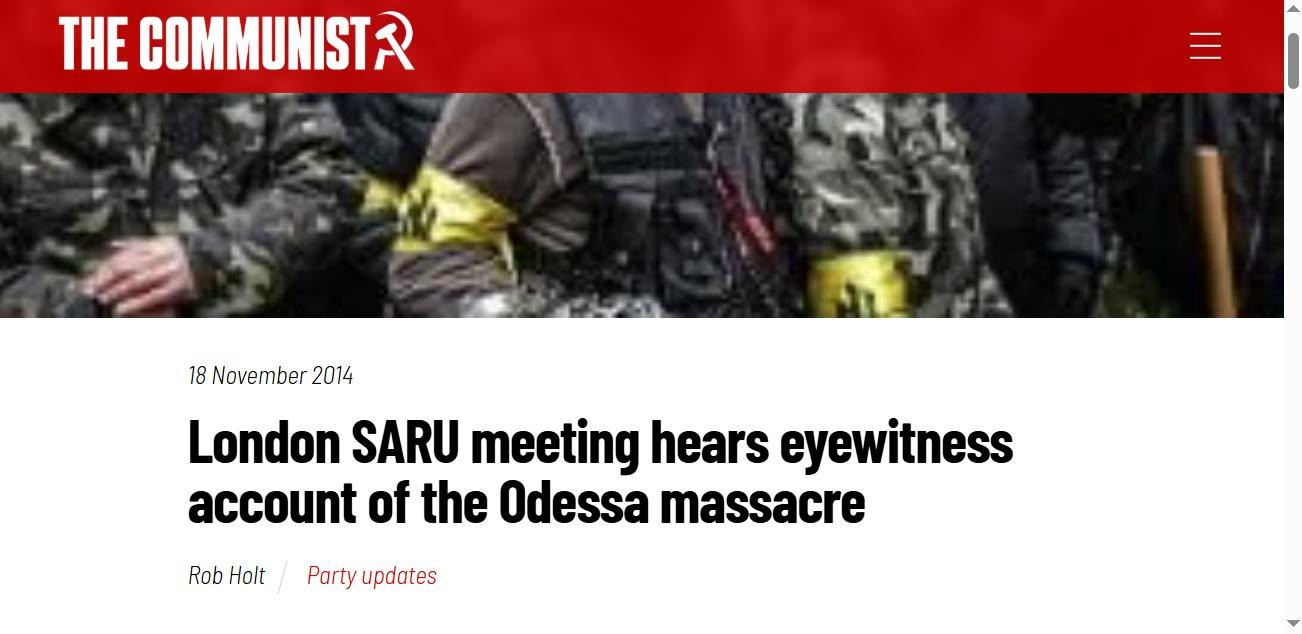
Revolutionara Kommunistiska Partiet (RKP) — the Swedish section of the communist international.
The Swedish communist party comes to the defense of “Borot’ba”: “Dirty lies about the left party’s support for pro-Russian rebels”; “Recently the party was accused of partnership with pro-Russian separatists and of donating money to them. This is merely the latest step in a false campaign against Ukraine that has been waged daily in the American media.”
Socialist Fight — the journal “Socialist Fight,” theory of communism and Trotskyism. “Marxism and the War in Donbass”: “‘Borot’ba’ is often criticized for supporting the people’s republics of the Donbas, our comrades fighting in the militia and helping peaceful state-building in Luhansk (LNR) and Donetsk (DNR). This criticism comes not only from those former leftists who succumbed to nationalist fervor and supported first the Maidan and then Kyiv’s war of conquest in the Donbas. Others criticize us from positions of ‘Marxist pacifism,’ calling themselves the ‘new Zimmerwaldists.’”
marxistische linke — Partnerin der Europaischen Linken. Sergei Kirichuk: “They hate us because we are communists.” The association is named “marxist left — ecological, emancipatory, feminist, inclusive,” abbreviated “marxistische linke E.V.” The association’s headquarters is in Berlin.
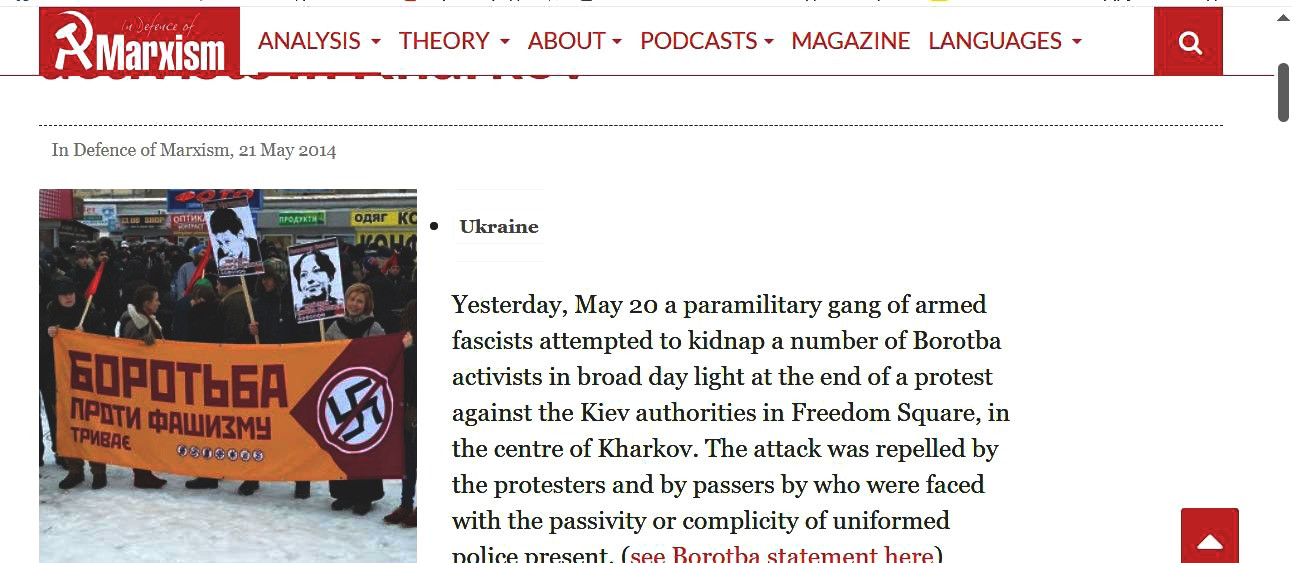
Revolutionary Communist International Tendency (RCIT). “The Ukrainian socialist organization ‘Borot’ba’ published the following statement. The Revolutionary Communist International Tendency (RCIT) is unconditionally in solidarity with the ‘Borot’ba’ activists and demands the immediate release of their comrades.”
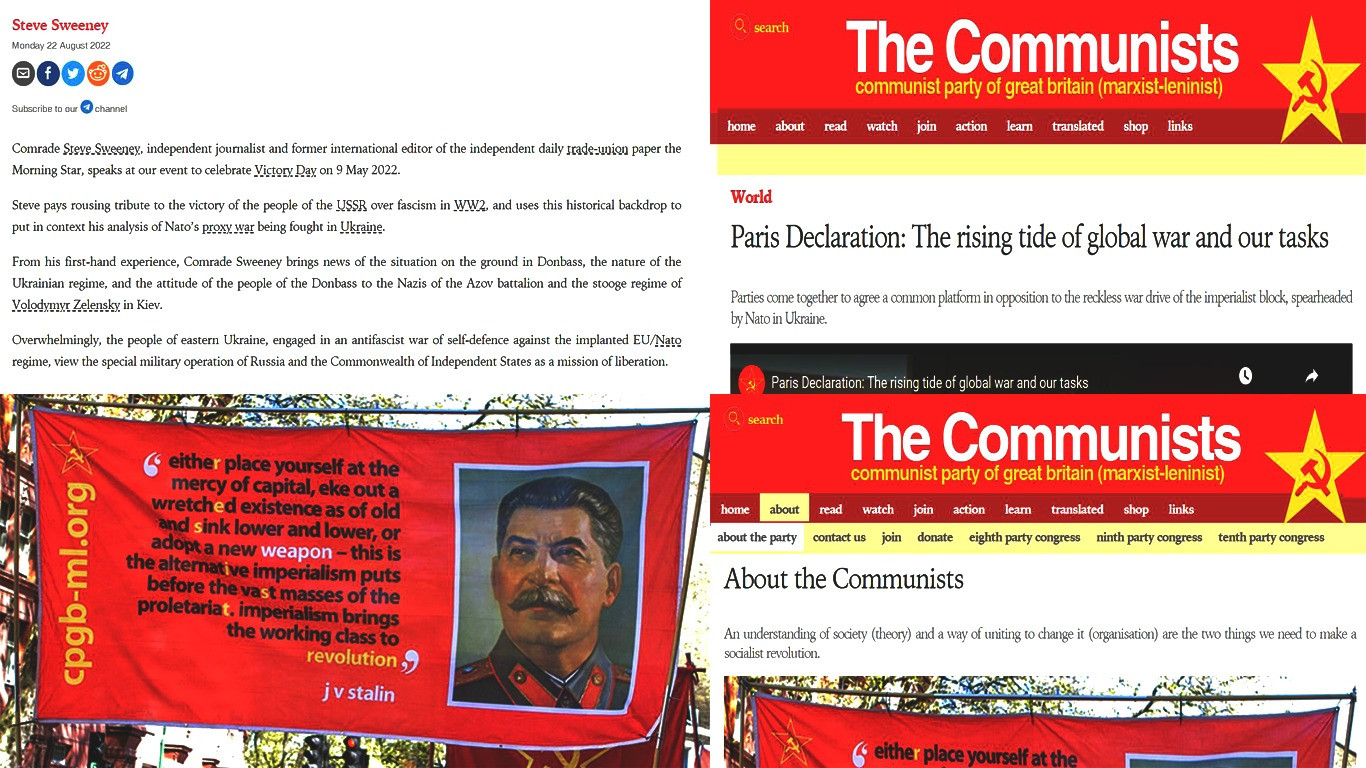
Trotskyist Platform — the Australian Trotskyist Platform: “We oppose the provocative and hypocritical interference of Western imperialism in Ukraine’s affairs and oppose sanctions against Russia! No to NATO expansion! No to deliveries of Western weapons to Ukraine!”
The Communist Party of Great Britain (Marxist-Leninist) — the Communist Party of Great Britain, Marxist-Leninist (CPGB-ML). These are only some examples of major European left platforms that, consciously or unwittingly, spread Kremlin narratives. The chains of international left unity described above are a resource for propagating pro-Russian ideas in the West.
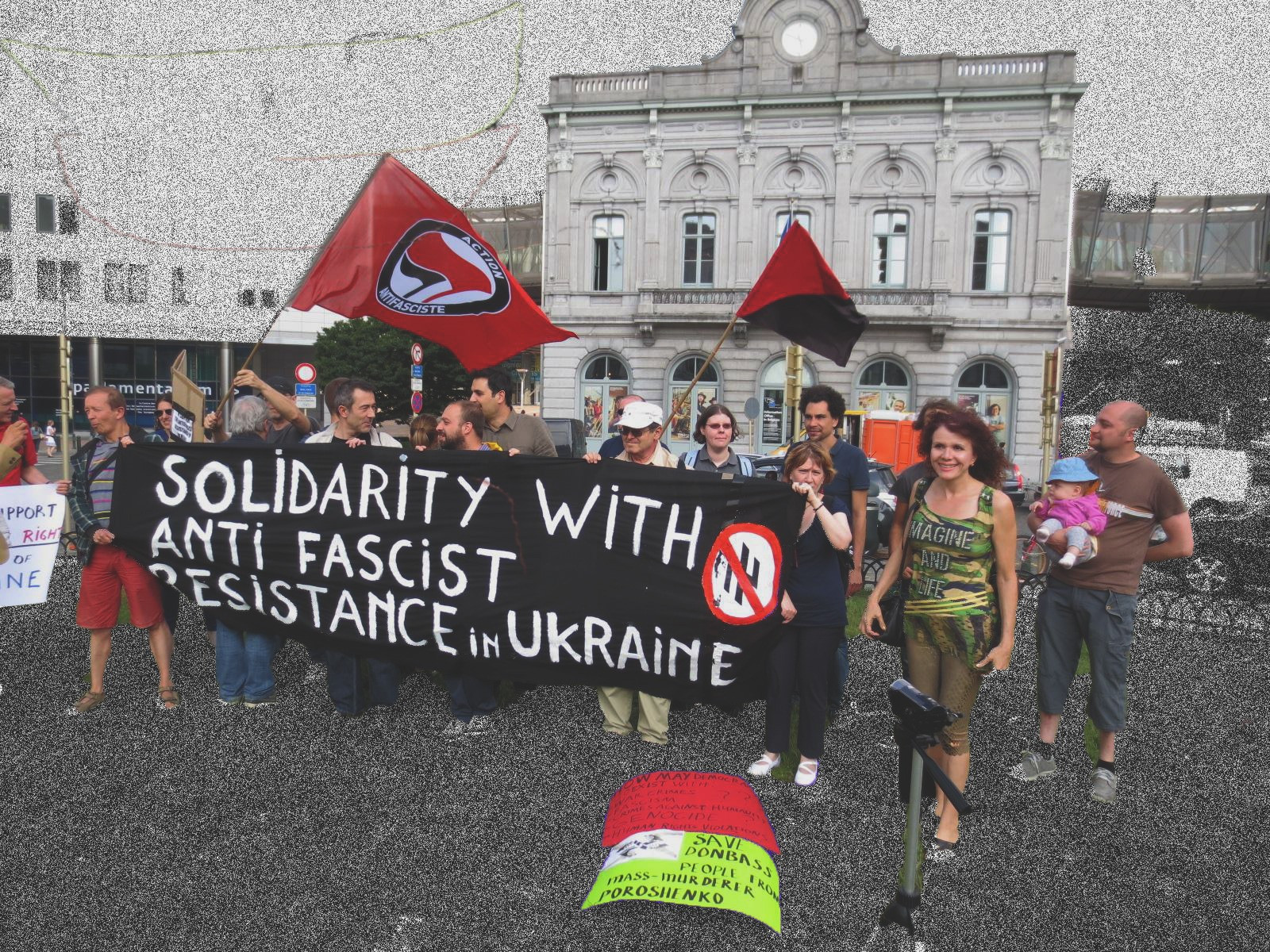
Yet another rally in the EU in support of the Russian Donbas.
Front left organizations are validated by local left associations, international solidarity campaigns are launched, international resonance provokes support among Western left, which influences voting procedures in the European Parliament, and subsequently leads to the emergence of leftist European parliamentaries relaying Kremlin ideas. A more detailed study of Russian influence on European politicians can be found elsewhere.
Contemporary Situation: The Problems of Pacifist Ideas and Sabotage Actions in the EU
The KPRF has unequivocally supported the war and actively participates in it.
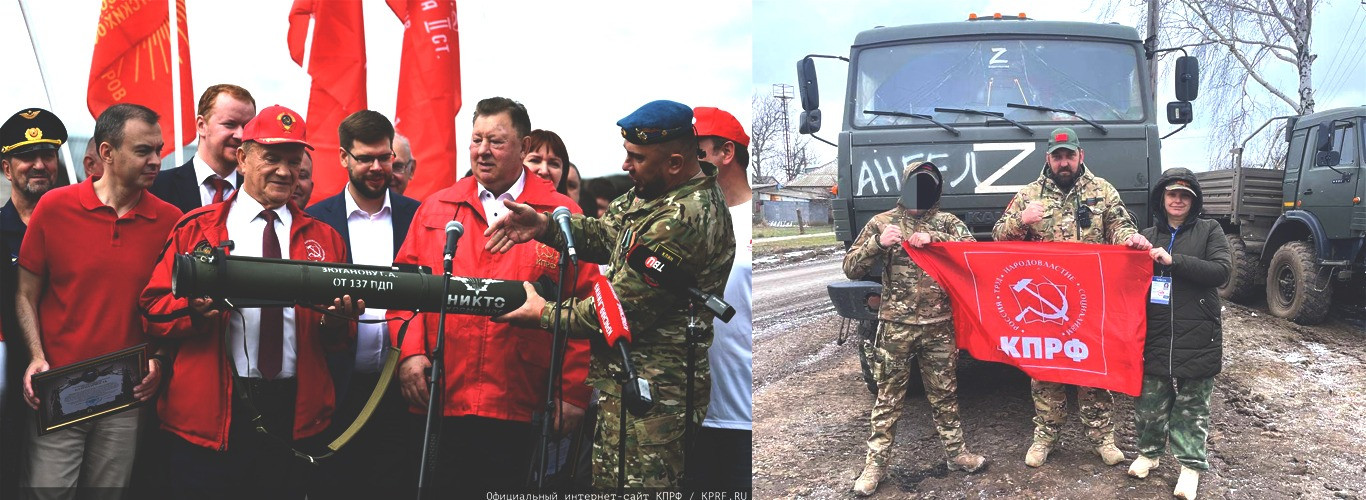
“On 8 September 2025 the KPRF sent its 143rd humanitarian convoy to the ‘SVO’ (special military operation) zone.”
The Russian organization “Left Front” actively supported Russia’s full-scale invasion of Ukraine. Having survived a split in opinion, the “Left Front” supports the war and collects humanitarian cargo.
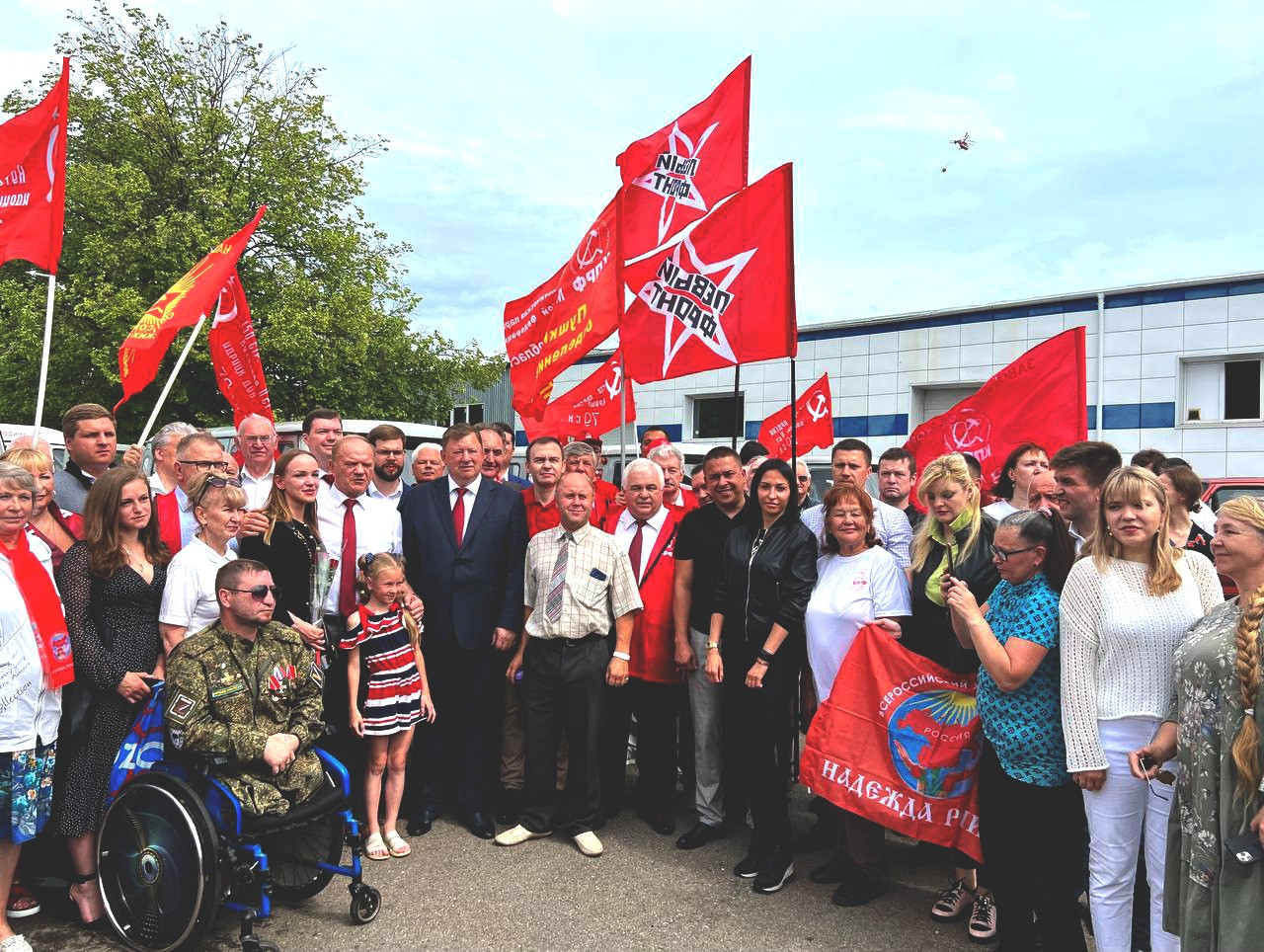
The “Left Front” took part in forming and sending a KPRF humanitarian convoy to the combat zone in Ukraine, 2024.
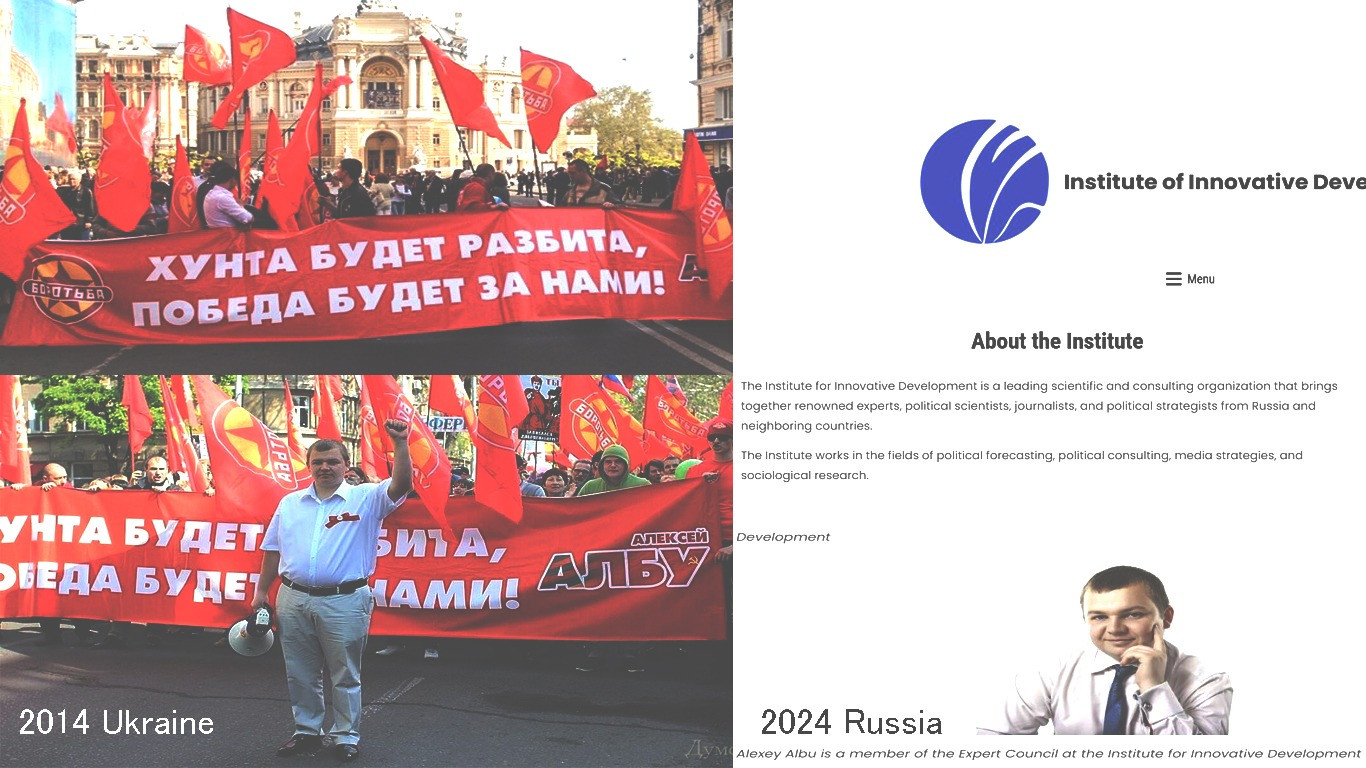
Alexei Albu, one of the leaders of “Borotba” during the Revolution of Dignity in 2014 in Ukraine, in 2024 already works openly in Russia as a political expert.
“Borot’ba” collects money and humanitarian aid for the Russian military, having organizational cells in Russia. Persons involved in the related organizations (“Left Front,” “Borot’ba,” “KPU,” “Organization of Marxists,” “Liva,” etc.) actively work in the interest of Russia:
A. Albu — one of the founders of “Borot’ba,” who actively called for the secession of Odesa, works in the “LNR” as deputy chairman of the “New Labor” trade union, is a member of the expert council at the “Institute of Innovative Development,” and heads the center for political transformations at the “Institute of the New Society.” The “Institute of Innovative Development” engages in political forecasting and consulting, media strategies, and sociological research. On the institute’s website one can see several of A. Albu’s articles about “Banderites” and “Ukrainian fascism.” The “INO” positions itself as “an association of researchers and experts studying Russian and global economic processes.” Both institutes resemble simulacra working in the interests of the RF.
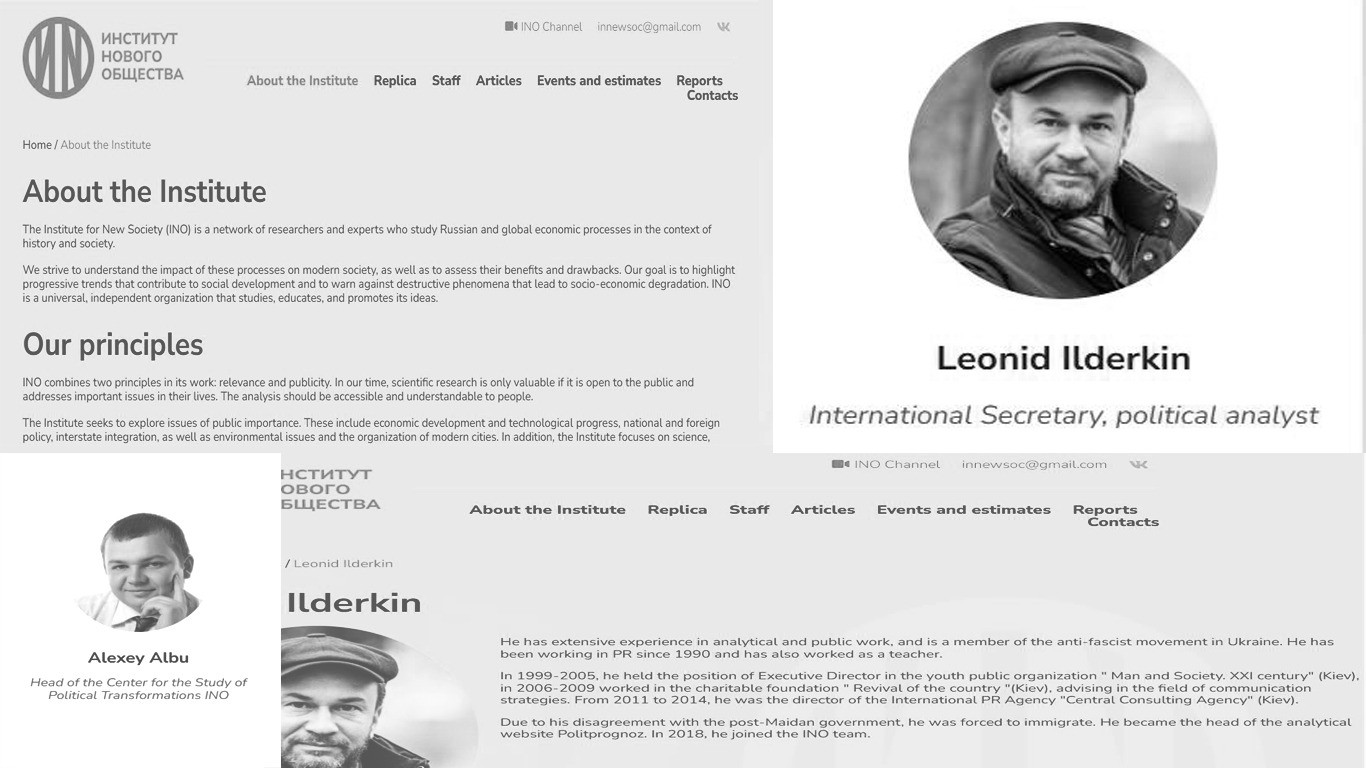
Leonid Ilderkin, a former member of the KPU and of “Borot’ba,” has worked from 2018 to the present together with A. Albu at the “Institute of the New Society” in Moscow.
In 2022–2023, “Borot’ba’s” old ties with the European left were reactivated. On European platforms a series of “pacifist,” pro-Russian-oriented meetings and street actions took place with the participation of former “Borot’ba” members, now staff of the “Institute of the New Society” in Moscow. A. Albu and Leonid Ilderkin curated and participated (remotely) in actions aimed at blocking arms deliveries to Ukraine by EU countries. At communist congresses and rallies in Germany, A. Albu’s direct speech about “Ukrainian fascism” and the need to block arms deliveries was heard again: “The German comrades took an interest in information about the coup that occurred in Ukraine in 2014, as well as about the eight years of the AFU’s preparation to attack the Donbas and Crimea. Alexei Albu called on the public to resume protests against arms deliveries to Ukraine. In his words, this is the only way to stop the war,” writes an Italian war correspondent fighting “for the Donbas” and Russia.
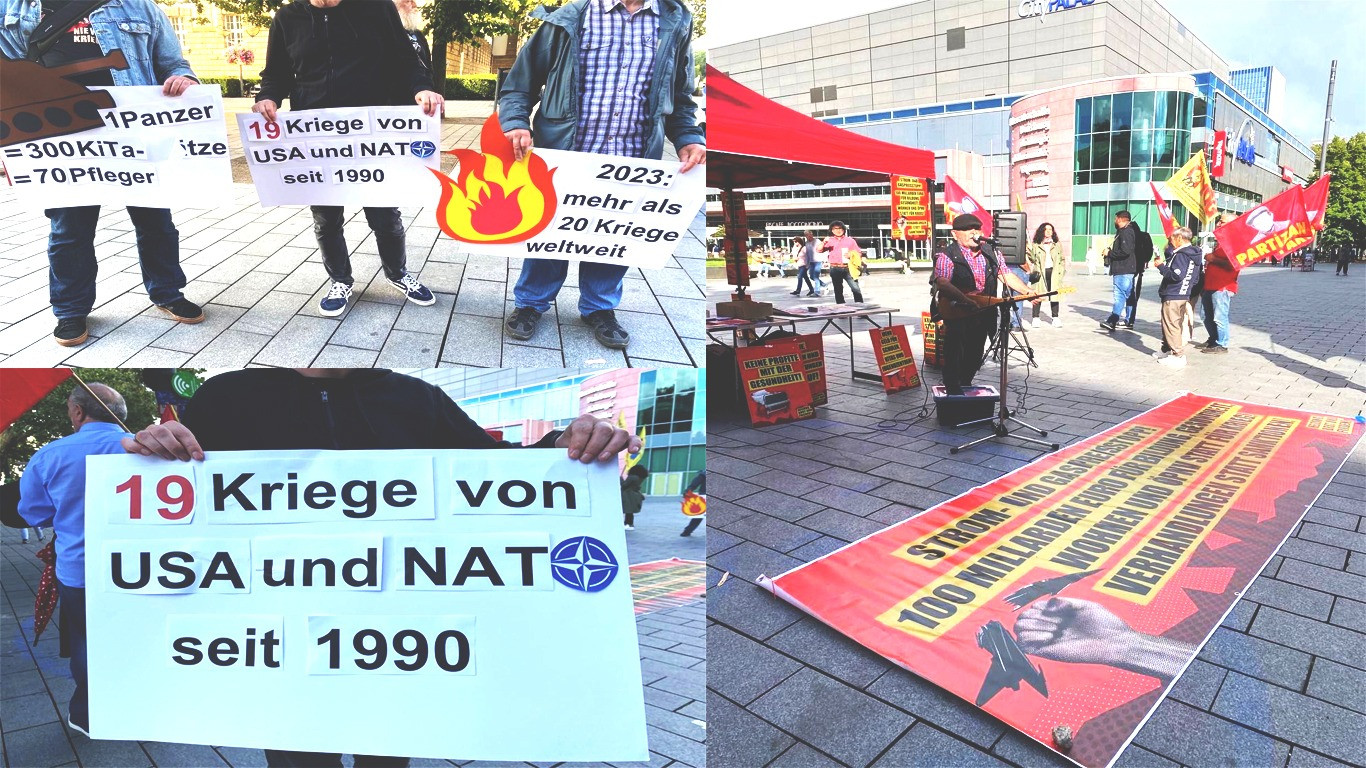
Demonstration against NATO in Duisburg, Germany: “On 1 September, the anniversary of the start of the Second World War, a demonstration was held in Duisburg demanding an end to the war in Ukraine. Participants read out an address by Alexei Albu, one of the leaders of the Ukrainian Marxist organization ‘Borotba.’” 2023; placard text: “19 wars of the USA and NATO since 1990.”
In 2024 “Dossier” published the material “Sabotage from a Safe Distance. Who Is Behind the GRU’s New Tactic in Europe,” where, on the basis of official materials connected with the GRU colonel Denis Smolyaninov, the following is published: “it follows from the briefing note that network work with the European left was planned to be deployed on the basis of a certain ‘Molotov Club’ and the pro-Russian Ukrainian organization ‘Borot’ba,’ which was to provide contacts with coordinators. We found plans to organize far-left demonstrations against NATO and Ukraine. The latest handler promised the colonel to hold actions of 15 people across Western Europe, from London to Athens, under blunt slogans: ‘no to dragging our country into war,’ ‘NATO is our common enemy,’ ‘for withdrawal from NATO and the closure of military bases,’ ‘sanctions harm not only the Russian economy but ours too.’”
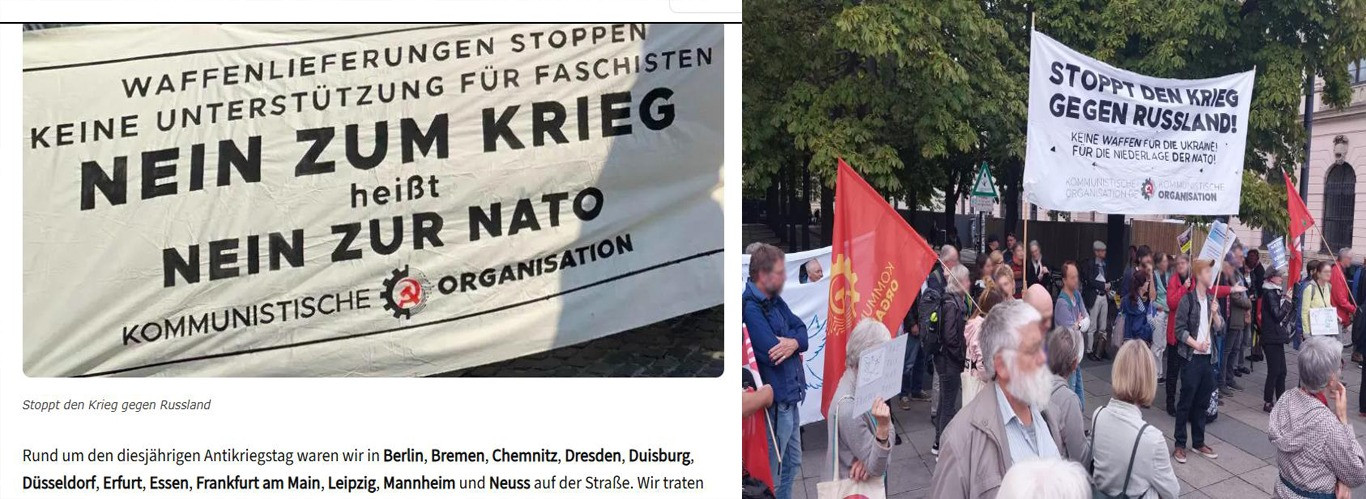
“Stop the war against Russia.” Around the anti-war day this year we were on the streets in Berlin, Bremen, Chemnitz, Dresden, Duisburg, Dusseldorf, Erfurt, Essen, Frankfurt am Main, Leipzig, Mannheim and Neuss. We spoke from militant positions against NATO, advertised the upcoming Communism Congress, distributed our Congress Newspaper and this year’s World Peace Day Statement, gave speeches, carried the greeting of the Ukrainian comrade Alexei Albu of Borotba, and held discussions. 2023.
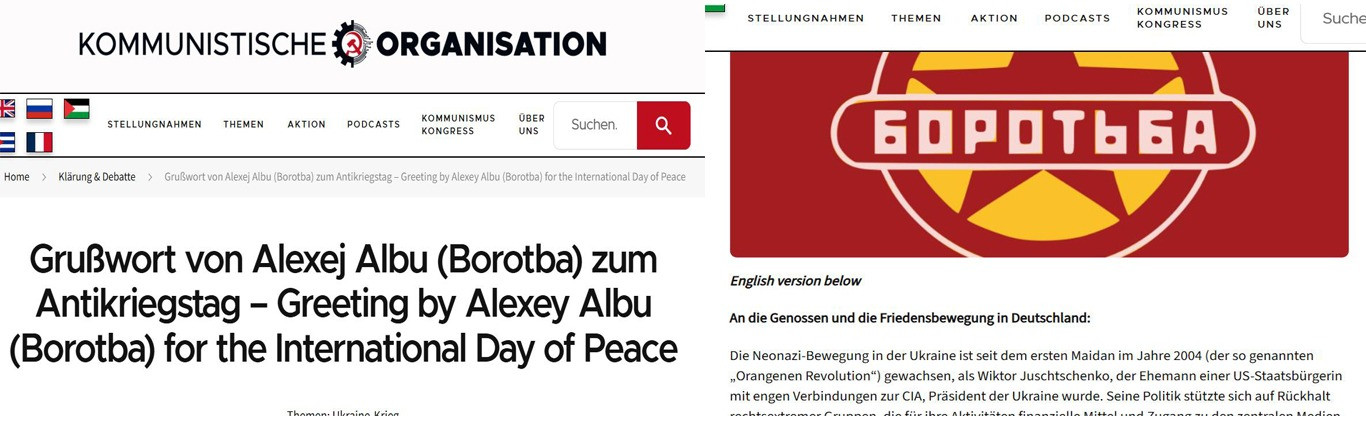
“Greeting of Alexei Albu (Borotba) for the Anti-War Day — congratulation of Alexei Albu (‘Borotba’) on the International Day of Peace.” 2023.
Some reports on actions planned by the GRU are seen in the screenshots above. Ilderkin is also seen cooperating with pacifist organizations such as “CODEPINK.” Leonid Ilderkin is connected not only with the KPU and “Borotba” in the past, but also, in the present, with the “INO,” the Moscow “Union of Political Emigrants and Political Prisoners of Ukraine,” and as a co-organizer of “Red Square — Molotov Club.” The “Molotov Club” describes itself thus: “The Molotov Club is an international Think Tank consisting of many political groups from all around the world.” This is a left-wing pro-Russian association that includes such figures as Darya Mitina and Maxim Firsov of the Left Front, and other members of the “OKP” (United Communist Party) (Russia).
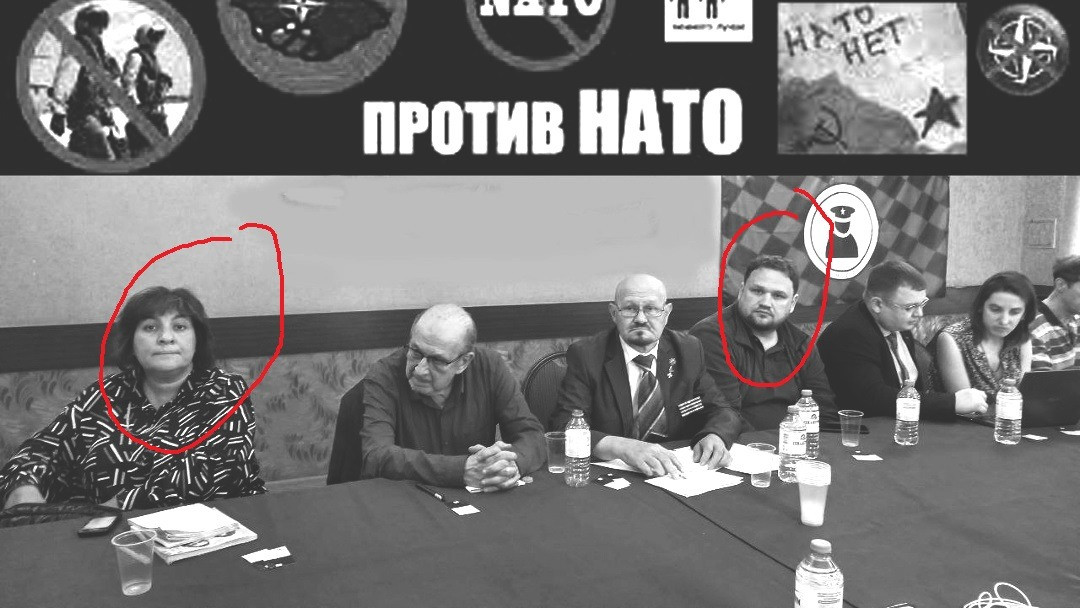
“On 24–25 May 2023, the international conference ‘Stop NATO’ was held in Moscow, organized by the ‘Red Square — Molotov Club’ in cooperation with and with the support of the news agency ‘M.A.R.T. Corp.,’ the ‘Union of Political Emigrants and Political Prisoners of Ukraine,’ left parties and public organizations of Western Europe, Latin America, India, and a number of Russian public associations, including the ‘Union of Officers’ of Russia and the OOS.” Among others in the photo: Maxim Firsov and Darya Mitina.
In 2023 the “Molotov Club” issued a memorandum at its 6th congress in Moscow: “Stop NATO!
Peace to the peoples!” where it is said, for example: “For many years, since 2014, the Russian Federation pursued exclusively a policy of peace and negotiations with the Kyiv authorities. However, by 2022 Ukraine had finally lost its political independence, turning into an aggressive NATO enclave aimed at conflict with Russia.” The memorandum is generally aimed at calling for a refusal of military aid to Ukraine and for lifting sanctions against Russia, explaining the need for these actions from socialist, anti-fascist and anti-imperialist perspectives. Besides holding congresses, the “Molotov Club” has a network of aggressively patriotic communities on VK for forming a young generation of communists.
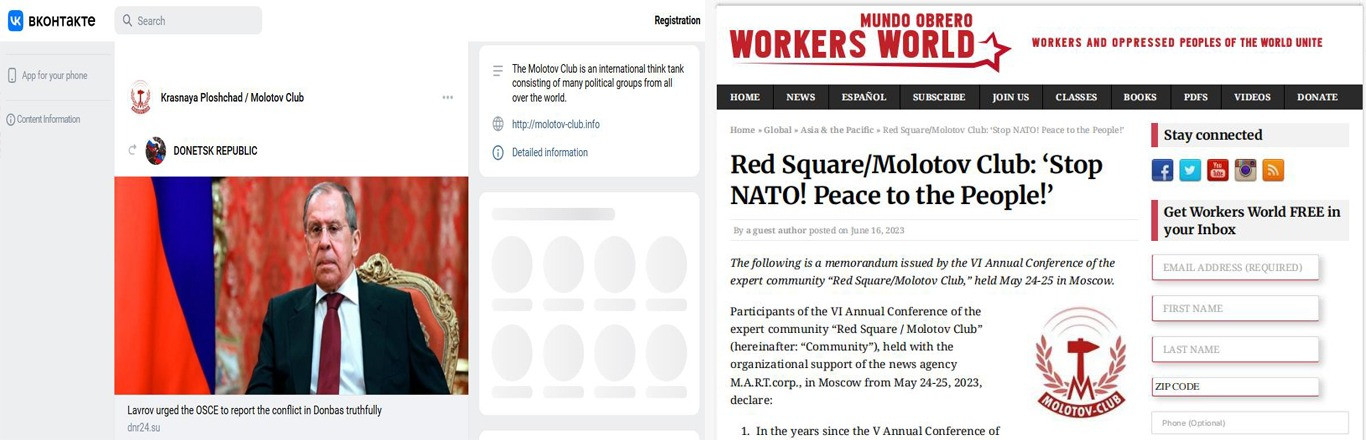
1. “Molotov Club,” post on Russian social networks: “The OSCE in Ukraine must recognize its responsibility for full coverage of the conflict in the Donbas. This was stated by the head of the Russian Foreign Ministry, Sergei Lavrov,” 2021. 2. Memorandum published following the 6th annual conference of the expert community “Red Square / Molotov Club,” held on 24–25 May in Moscow, 2023.
L. Ilderkin continues to be in Russia, also being a member of the “OKP.” During and after the reorganization of “Borotba,” Ilderkin was known for active propagandistic, pro-Russian activity — he wrote texts about “Ukrainian fascism” and spoke about the “Kyiv junta” at congresses and symposia.
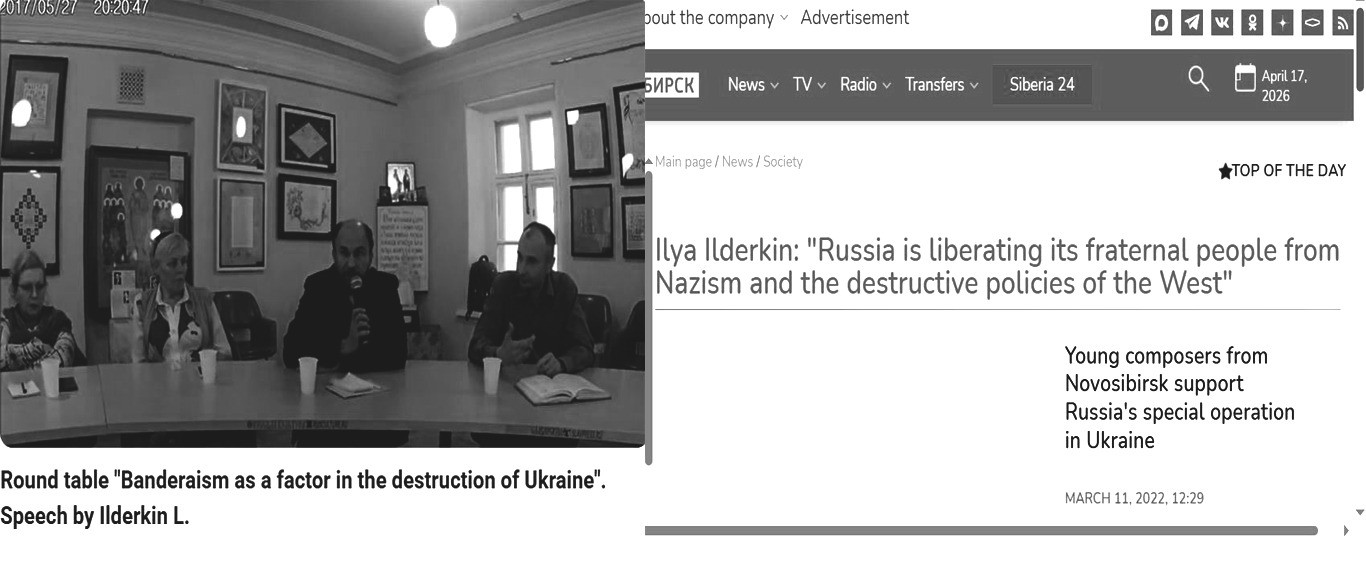
Speeches and publications of L. Ilderkin (“Borotba” — “Molotov Club”).
Further, it follows from the “Dossier” report that “for unified coordination of activity across the CIS countries (the republics of the former USSR),” the GRU planned to create: “An information-analytical agency, possibly not on the territory of the RF (options being Kyrgyzstan, Armenia), through which to covertly finance the activity of the subnetwork under various pretexts.”
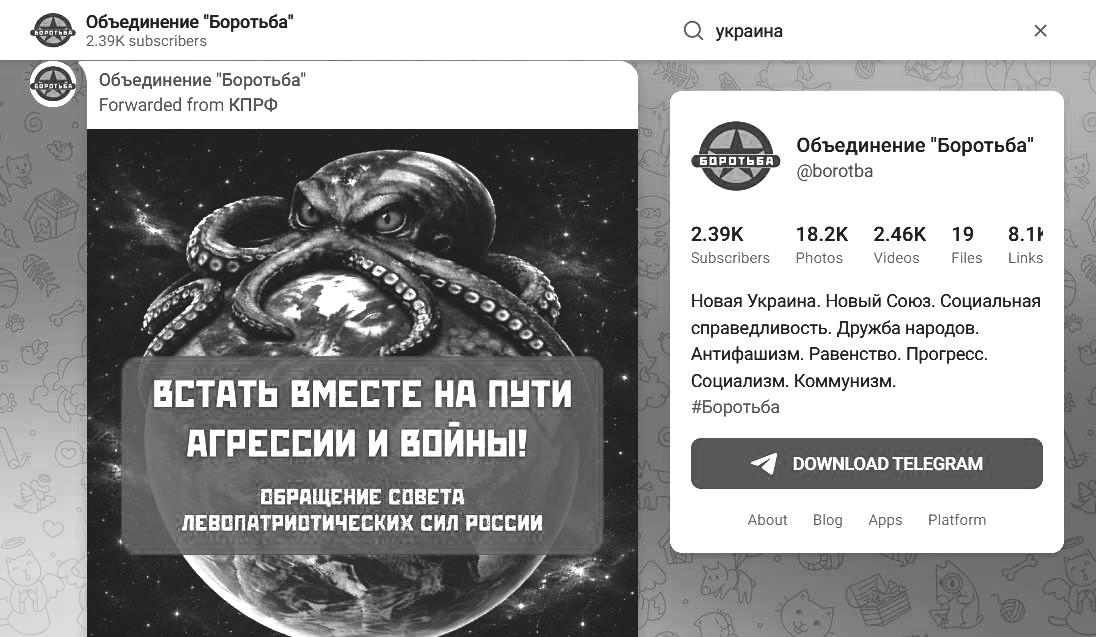
The “Borotba” Telegram channel in 2026, a cross-repost of the KPRF. Appeal of the council of left-patriotic forces of Russia: “Stand together in the path of aggression and war!” The “anti-war” Borot’ba.
Andrei Manchuk, editor-in-chief of the once-active online magazine liva.com.ua and a coordinator of “Borot’ba,” who publishes anti-Ukrainian texts and books, is in Russia too.
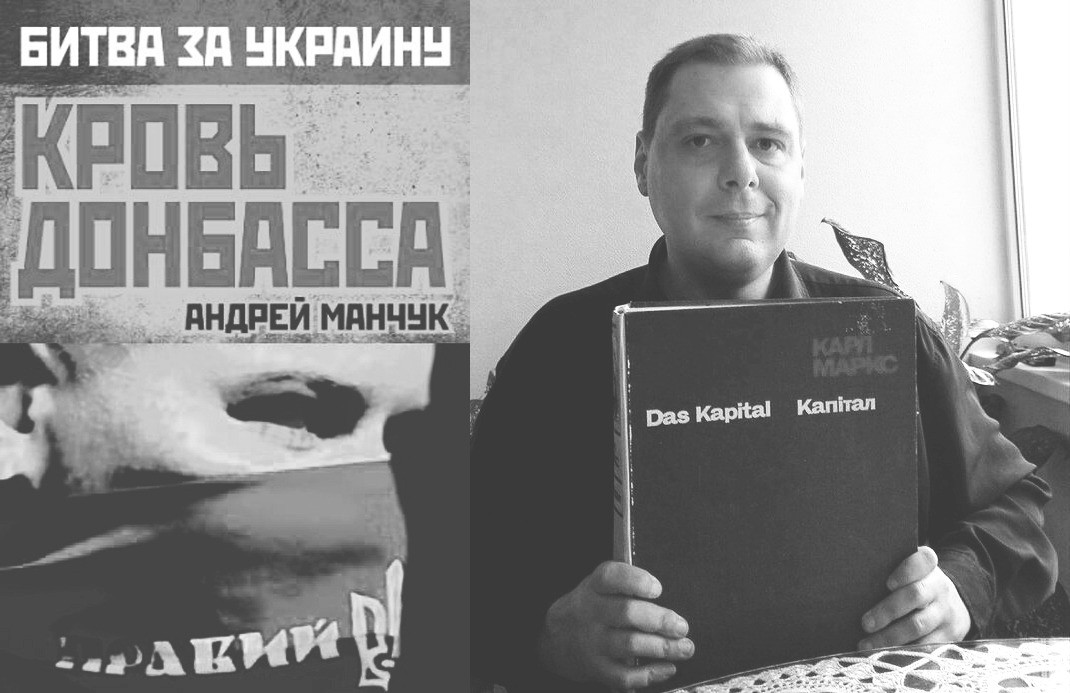
Andrei Manchuk, former coordinator of “Borotba” and editor-in-chief of the magazine “Liva.” Manchuk’s book “The Blood of the Donbas”: on the cover, a person with a covered face and the inscription “Right Sector.” “Besides his journalistic work, the author is also an activist of the ‘Borot’ba’ movement, which from the very start of the Ukrainian events opposed the oligarchic ‘Maidan’ and then took a hard line of defending the residents of the Donbas from the punishers of the Kyiv junta,” reports the Russian site where the book can be bought.
Some leftists from the ecosystem of “Borot’ba,” the KPU and the “Left Front” (Alexei Sakhnin, Viktor Sidorchenko), having left the RF and Ukraine, organized themselves into the initiative “Post-Soviet Left,” which began public activity in 2023. Their agenda comes down to lobbying for the need to reduce arms deliveries to Ukraine in EU countries, to calls for desertion from the Ukrainian and Russian armies, and to defending the rights of men evading military service in Ukraine. Also, to an intense critique of all Ukrainian institutions of power, culture and civil society after 2014 (the “PSL” leaders consider them symmetrical to Putin’s dictatorial regime). These theses sit alongside drawing attention to the problem of poverty, due to class inequality, of many Russian contract soldiers. “PSL” are active now on the same European platforms (the German Die Linke, La France Insoumise — Melenchon’s party) to which the traces of the earlier political activity of the “Left Front,” “Borot’ba,” and the “Communist Party of Ukraine” lead.
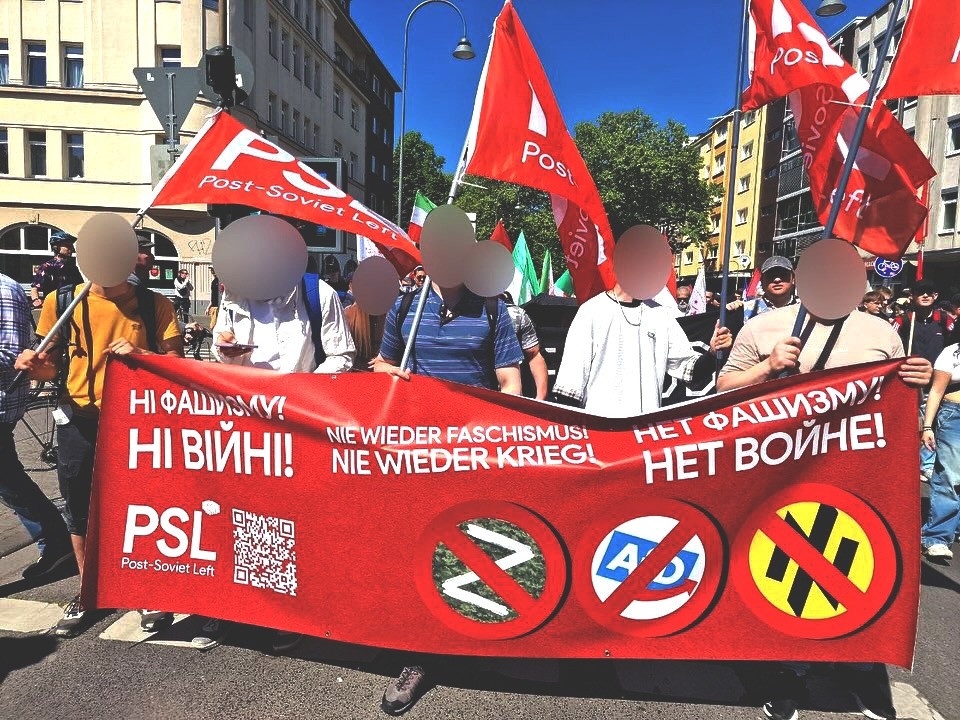
“PSL” rally in Berlin, 2025. “No to fascism. No to war.”
“PSL’s” comrades in Russia are the organization “Interfront,” whose name refers to the like-named “Interfront” — the movement whose goal in the 1990s was to preserve the Soviet Union as a single Marxist-Leninist state. “Interfront” had branches in Estonia, Latvia, Lithuania, Moldova, Ukraine and other independent states, against whose independence its participants stood. The contemporary “International Front” calls itself an organization united by the goal of building a communist society.
Characteristically, “PSL” chose precisely these comrades. In the direct speech of one of the “PSL” participants, Viktor Sidorchenko (former secretary of the Kharkiv city committee of the KPU), he openly speaks of his sympathy for the USSR.
“Peace” Movements
To speak of a truce from one’s own safe, non-combatant position is a privileged gesture. To deny the ability to defend against a country that started the war of aggressionmeans strengthening the inequality of power dynamics. Ukraine has the right and must have the ability to defend itself.
Over the four years of Russia’s full-scale invasion of Ukraine, against the backdrop of news about pushing the latter toward a truce, pacifist summits are being reactualized. They often include world-famous pacifist organizations, as well as speakers offering “expertise” on questions of Russian-Ukrainian relations. One of the obvious intentions is to force Ukraine to accept terms disadvantageous to it. The task of such summits and rallies is to create the appearance of public pressure. Accordingly, new organizations created for this task arise. Individual media personalities (including bloggers) and the bot farms attached to them gain visibility. Public opinion is stirred up, intensifying discontent within Ukraine, fed by the crisis of forced mobilization. At the same time, demands for peace almost always come bundled with slogans against NATO, for canceling arms deliveries to Ukraine, and such as “enough deaths,” “the people are tired of war,” “the arbitrariness of the TCC (draft offices),” “the terror and dictatorship of Zelensky,” and others.
The activisation of pacifist movements and the use of the popular and intelligible “for peace” narrative is an old and well-known technique of the KGB, and of the official rhetoric of the CPSU.
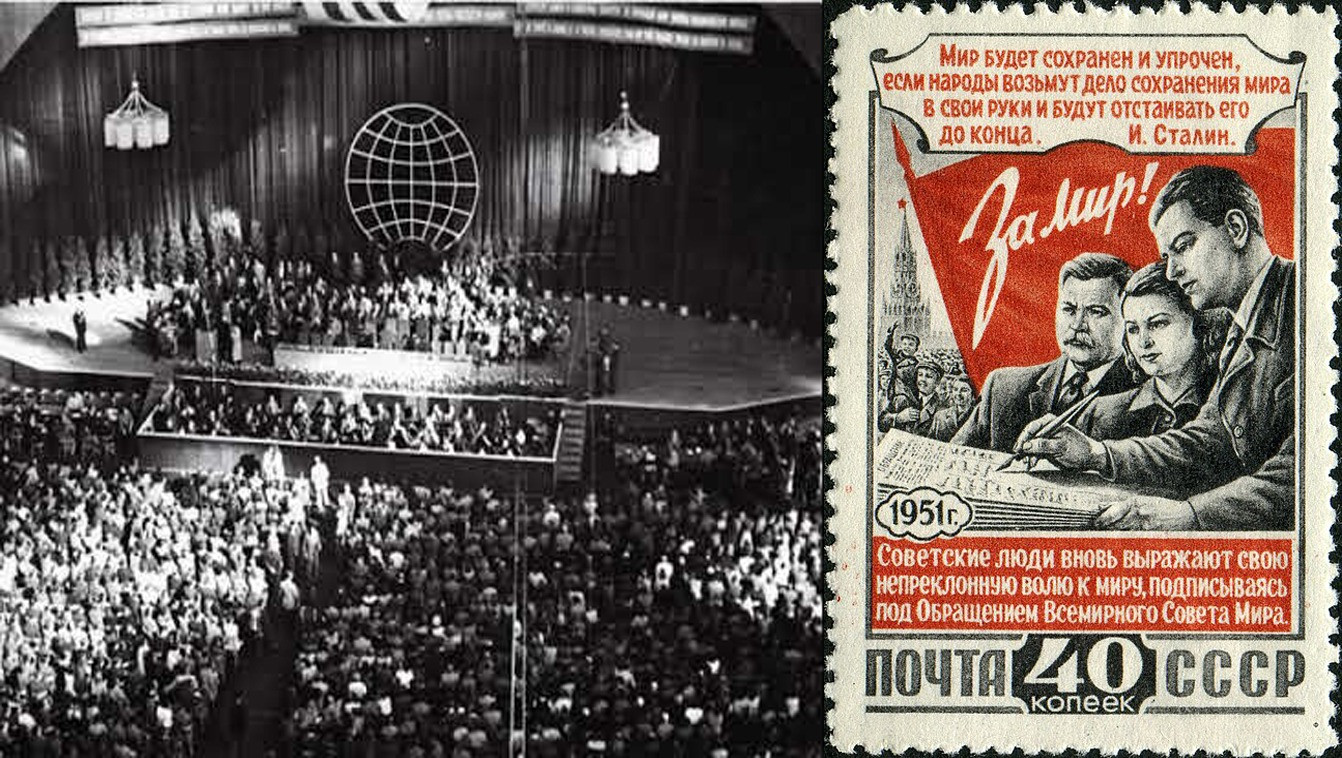
In August 1948, through the initiative of the Communist Information Bureau (Cominform), a “World Congress of Intellectuals for Peace” was held in Wroclaw, Poland.
For example, the “World Peace Council” was created by the CPSU in 1948–1950 to advance Soviet foreign policy and to fight against nuclear weapons at a time when only the USA had them. At a session of the Cominform, M. Suslov declared: “the task of the Communist and Workers' parties is to lead the struggle for peace of all the mass public associations and to give it a purposeful and effective character,” where NATO is the main target.
The main goal of the Soviet-sponsored peace movement was to counteract the North Atlantic Alliance. Suslov stated: “Special attention must be paid to drawing into the peace movement the trade unions, women’s, youth, cooperative, sports, cultural-educational, religious and other organizations, as well as scientists, writers, journalists, activists, cultural workers, members of parliament and other political and public figures, men and women, who stand in defense of peace and against war.” That is, special significance was attached to the trade unions led by communists, organized into the “World Federation of Trade Unions.” The old unipolarity of the communist world, as it is preserved in the Kremlin’s narratives, is also readily reproduced by the left on the international stage in the spirit of “Russia opposes NATO.”
The “World Peace Council,” in turn, was connected with a network of front organizations (“Communist Front”) created to spread the influence of the Soviet Union. Its own armed operations, such as the suppression of the anti-Soviet uprising in Hungary in 1956, the “WPC” justified.
Among contemporary pacifist summits, congresses and organizations, attention should be paid to those organized by the “International Peace Bureau,” which cooperated with the USSR and continued to cooperate with Russia in the interests of the latter’s security services; the “Austrian branch of the International Fellowship of Reconciliation” (International Fellowship of Reconciliation Austria), the “Austrian branch of the Women’s International League for Peace and Freedom,” the “Action Alliance for Peace, Active Neutrality and Non-Violence” (Aktionsbundnis Frieden, aktive Neutralitat & Gewaltfreiheit) — financed by the “Communist Party of Austria” and the “transform! europe!” network. And separately — “Code Pink: Women for Peace” (CODEPINK).
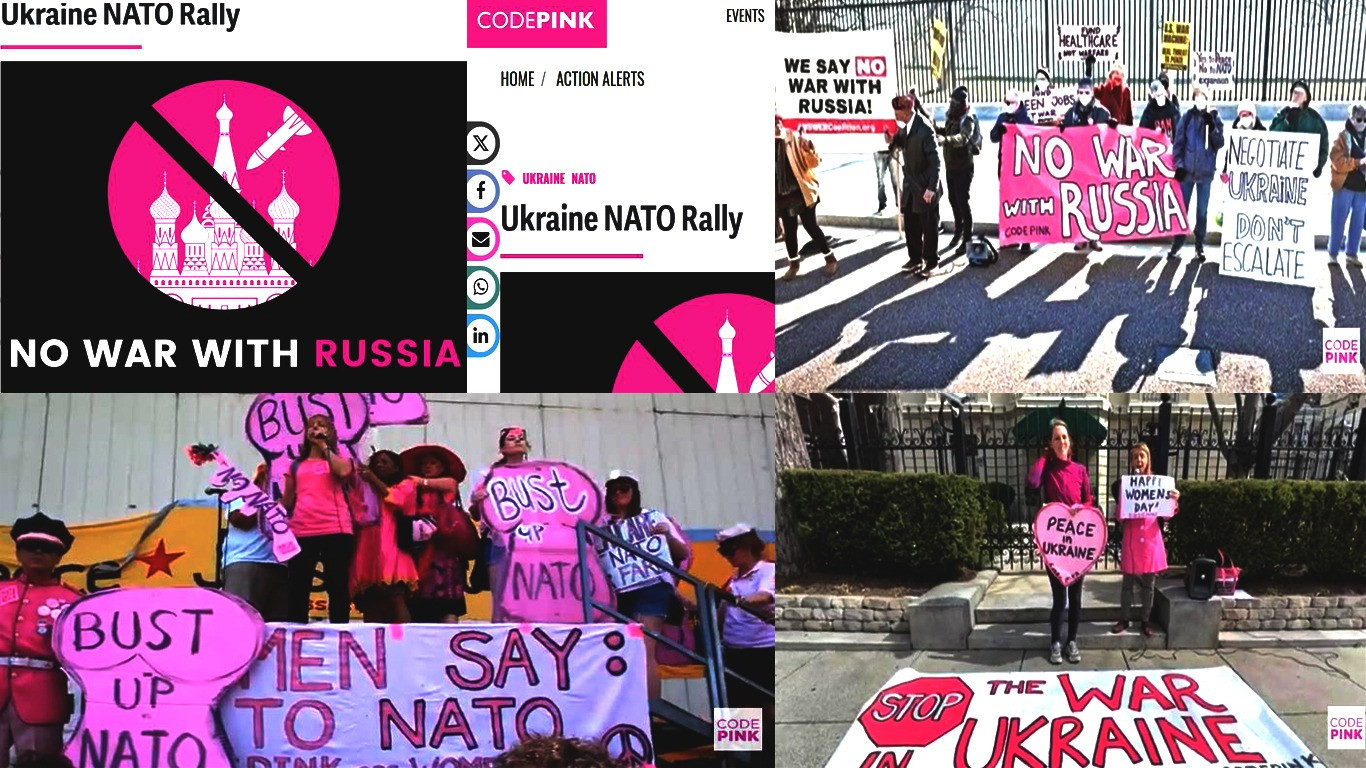
CODEPINK: Russia Is Our Friend!
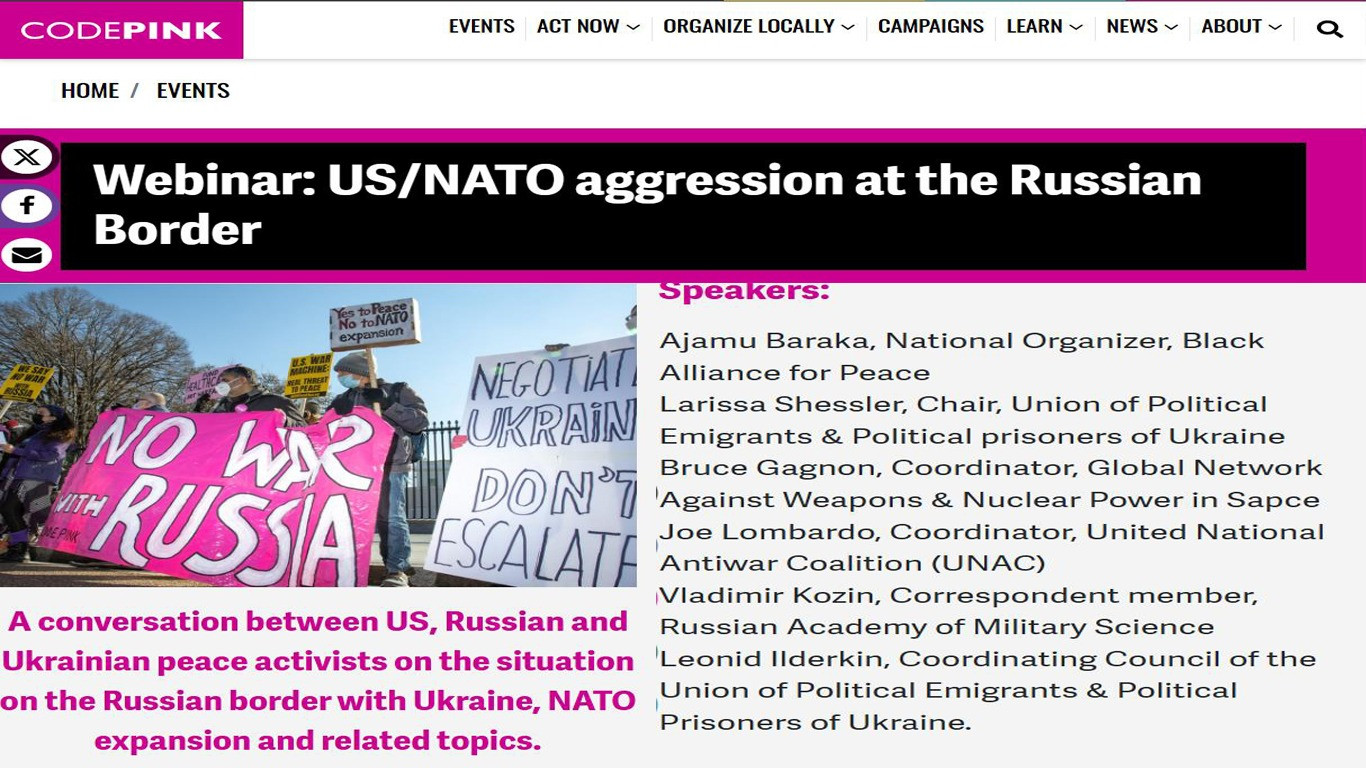
CODEPINK: A conversation among American, Russian and Ukrainian peace activists about the situation on Russia’s border with Ukraine, NATO expansion and related topics. Speaker: Leonid Ilderkin, Coordination Council of the Union of Political Emigrants and Political Prisoners of Ukraine.
Another telling example of pro-Russian “for peace” rallies is the Dutch community “Peace Demonstration” (Vredesdemonstratie), cooperating with the Moscow organization — the “Union of Political Emigrants and Political Prisoners of Ukraine” led by L. Ilderkin. Activists organized a series of demonstrations in the Netherlands demanding “resignation of Zelensky” and blocking military aid to Ukraine.
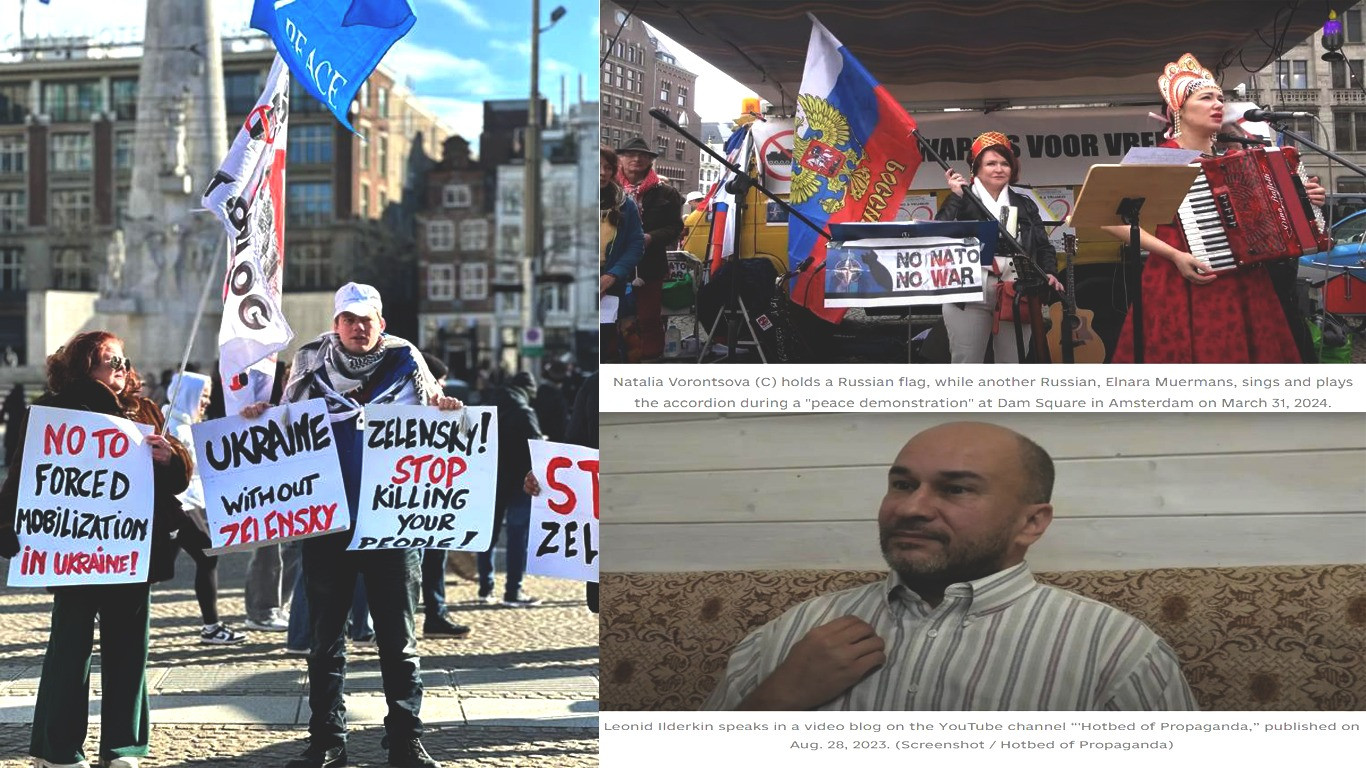
1. April 2025, the Netherlands. 2. Among those who posed with a Russian flag at a recent protest was Natalia Vorontsova, also known as Nata Hizen. As a co-organizer, she plays a key role in almost all the “For Peace” movement’s actions. 3. Ilderkin appeared in a video address to participants of the “Peace Demonstrations” as a so-called “representative of the Ukrainian opposition in exile.”
“PSL” and the associated initiative “Peace from Below” (A. Sakhnin, L. Smirnova) also support the agenda of canceling arms deliveries to Ukraine. The strategy of “Peace from Below” is aimed at “defending peace between fraternal peoples.” Both organizations are concerned with the rights of “draft evaders” and the “arbitrariness of the TCC” in Ukraine. They are supported by the “Die Linke” party and “France Unbowed,” founded by Jean-Luc Melenchon. A. Sakhnin and A. Konovalov appear in this connection as experts from Russia and Ukraine. Meanwhile, Melenchon’s position on the war in Ukraine is this: “NATO bears responsibility for the tensions in relations with Russia.”
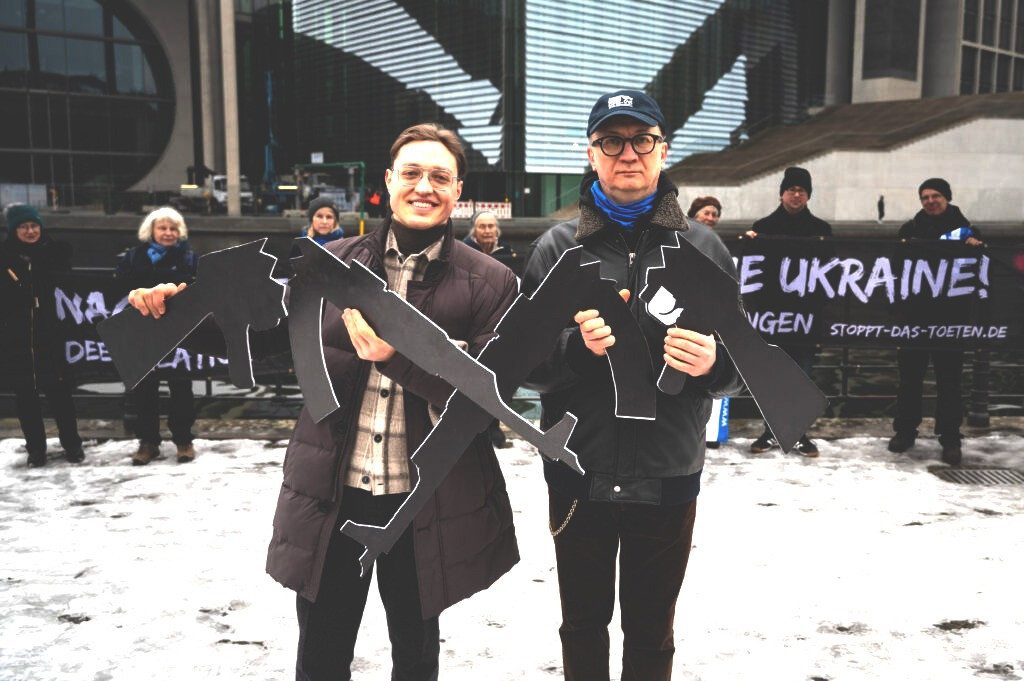
“PSL” activist A. Konovalov and “Stoppt das Toten” against arms deliveries to Ukraine. 2025, Germany.
Visible comrades of “PSL” and “Peace from Below” in their pacifist calls for the disarmament of Ukraine and propaganda for desertion are the “Kharkiv Assembly” (Ukraine), the “Olga Taratuta Fund” (France, Paris), “CAS” (Czech Internationalist Anarchist Group, Czech Republic), KRAS (Russia), and several European pacifist organizations holding congresses and street rallies “for peace.” Notably, the listed initiatives place themselves within an anarchist perspective.
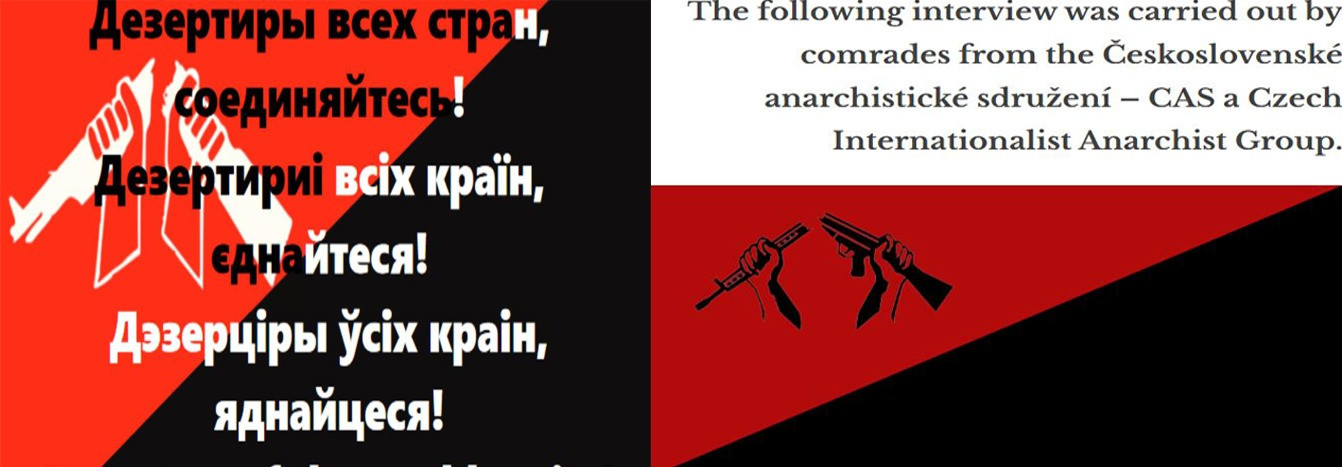
1. Initiative de solidarite Olga TARATUTA. 2. CAS — a Czech Internationalist Anarchist Group.
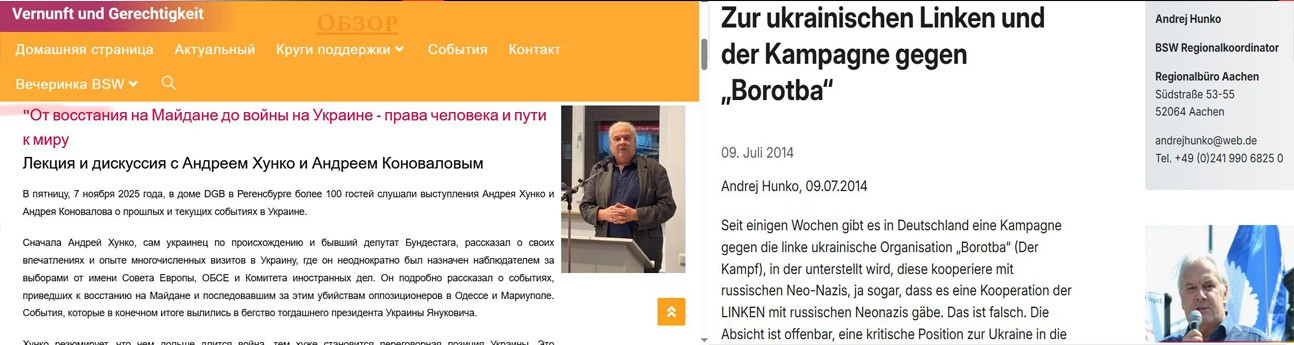
1. Andrej Hunko, notorious for his “expertise on Ukrainian questions,” a former member of the Die Linke party (Germany), does not lose interest in the war in Ukraine. Announcement of a discussion with A. Konovalov (PSL). 2025. 2. Hunko for “Borotba,” 2014.
It is worth recalling that the leftist activists listed above, together with many other well-known
anti-Ukrainian figures, signed similar resolutions “FOR PEACE” and against NATO in 2014
(“Zimmerwald 2014”)–2016. Here, for example, is the slogan of the Final Declaration of the “Social Forum” in Wroclaw (2016): “STOP MILITARIZATION! DISBAND NATO!” Its participants “expressed their special support for the people of Ukraine, now under pressure from NATO.” A. Sakhnin, who signed the declaration, is presented there as an activist from Ukraine. At the congress the leftists call the war in Ukraine “a civil war and military conflict that followed the victory of neoliberals and nationalists at the Kyiv ‘Euromaidan,’ which claimed hundreds of lives and contributed to an unprecedented rise of chauvinism and xenophobia in Ukrainian and Russian society.” In substance, such resolutions do not differ from the GRU’s “pacifist” campaigns discussed above.
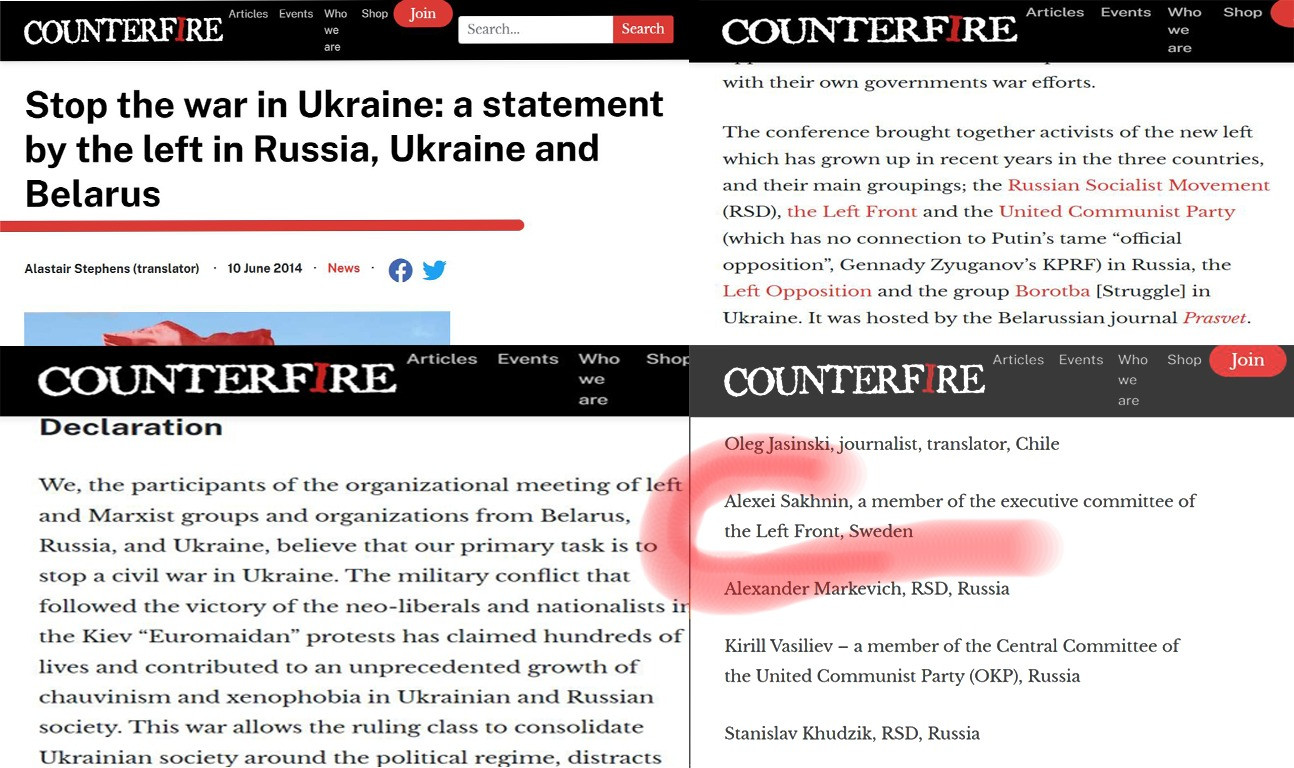
The “Zimmerwald 2014” declaration was signed, among others, by: A. Sakhnin and the Borot’ba members.
The Kremlin’s influence on the European left does not end with this list. If one looks at the voting records in the European Parliament, one sees that it is precisely the left who vote in Russia’s interests.
Left parties in the European Parliament advocate an alternative foreign-policy approach, often criticizing the Western world and portraying Russia as a peacekeeping power, historically challenging Western military interventions and seeking to reduce the influence of the USA and NATO in the EU.
A group of researchers published in 2024 in the “ECPR journal” the article “The foreign policy of the European radical left after Russia’s invasion of Ukraine: a hardening of rhetoric toward Russia.” They studied the reaction of European left parties to Russia’s invasion of Ukraine in 2014 and 2022 and concluded that in 2014 the majority supported the Russian version of events, according to which the responsibility lies with NATO expansion, US imperialism and the EU’s drive to capture new markets. Whereas during the full-scale invasion in 2022, the percentage of support and loyalty declined. Many left parties openly condemned Russia’s invasion, but still did not join the demands for arms deliveries to Ukraine.
Against the backdrop of the prospects of 2026 and the obvious threat of war in the countries of Europe, the European left still has no unconditional consensus on providing full military support to Ukraine.
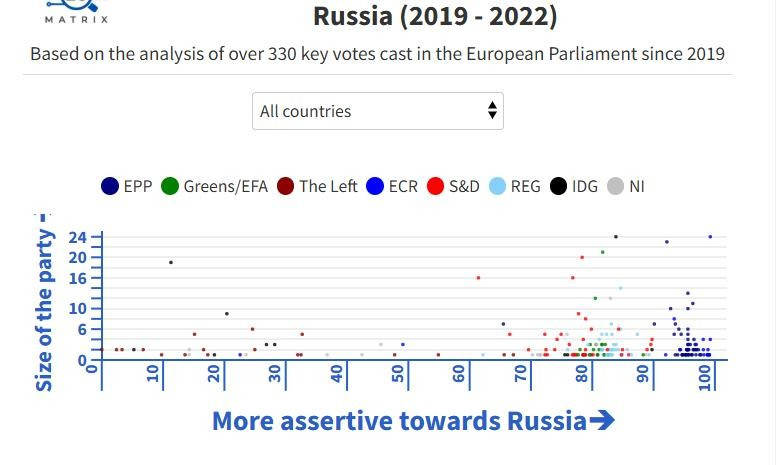
“Political index of EU-Russia relations: what is each side’s position?” An interactive diagram on the site shows that political parties increasingly converge on the view that the EU should take a tougher stance toward Russia, but it is precisely the left of the European Parliament who are most loyal to the Kremlin’s policy.
Thus, the schemes of influence described perfectly fulfil their goal of manipulating substantial political forces and the decisions they make — as in the case of the votes in the European Parliament.
The Systemic Logic of Destabilizing Power and Territorial Integrity in the Post-Soviet Space
Russia is a revanchist state, feeling “aggrieved” after the collapse of the USSR. Putin came to power at the height of Russia’s second colonial war in Ichkeria (Chechnya) in 1999, and consistently develops the militarist logic begun in Soviet times and continuing after its collapse: the Chechen wars (1994–1996 and 1999–2009), the war in Syria (2015–2017), the wars in Karabakh (1988–1991, 1992–1994 and 2020), the wars in Sakartvelo (Georgia) 1992–1993 and 2008, the annexation of Crimea (2014), Transnistria (1992), the war in the Donbas and the full-scale invasion of Ukraine (2014 and 2022).
What unites these military conflicts is that Russia interferes in the local politics of neighboring, independent countries with the aim of destabilizing the central government, violating territorial integrity, expanding its own military presence and, accordingly, its influence on the region. At the same time, Russia more often calls military invasion something other than war: instead, euphemisms are used — “counter-terrorist operation” (Chechnya), “special military operation” (Ukraine), “special tasks on the territory of the Syrian Arab Republic” (Syria). Or else, sending Russian occupation troops into a region to “stabilize” the situation (Moldova, Ukraine), it labels what is happening as civil war.Russia considers it possible to interfere in the politics of neighboring countries precisely by military means, after that transferring power in those countries to persons controlled by the Kremlin. Often, this scheme of loyalty and of changing power is implemented with the help of economic and infrastructural blackmail.
Maria Dmitrieva
Translated by Victoria Kravtsova.
Links:Российская партия коммунистов, “Коммунист Ленинграда” 2014 г (срез левых мнений)
Ежегодный отчёт ЦК КПЛНР коммунистам Луганщины
Создание Компартии ЛНРМИД ДНР Максим Фирсов: Что сейчас реально происходит в Крыму?
Union of Left Forces (Ukrainian)
Vasyl VolhaВолга Василь. ДОСЬЄ
Леонида ГРАЧА РАСКРУЧИВАЮТ РОССИЙСКИЕ ПОЛИТТЕХНОЛОГИСегодня День России — праздник для крымчан знаковый
Dmitry Kozak Vladislav Surkov
Запрет на вещание трех украинских телеканалов, связанных с кумом Владимира Путина Виктором МедведчукомViktor MedvedchОт мелких мошенников до убийц. Очерк о политической эволюции сталинистов на примере организации БоротьбаThe party United Russia Разбор слитой переписки Суркова и БоротьбыEssay on the evolution of stalinists at the example of Borot’baБоротьба проти фашизму біля стін Верховної РадиКак части немецких левых поддерживают фашистов на Украине, часть 2: О Красной помощи, бригаде Призрака и многом другомКиричук: Украина: Начались открытые репрессии против левых сил[Боротьба — Украина] Хунта объявила войну собственному народу"Алексей Сахнин, политический беженец из России. Член партии «Левый фронт» и один из организаторов массовых антипутинских демонстраций в 2011–2012 годах. У него есть друзья в украинской антифашистской социалистической партии «Боротьба».The Prizrak BrigadeИдейные принципы бригады «Призрак» им. А.Б. Мозгового на Рабкоре“Скажи мне кто твой друг”. Немного об Алексее Сахнине и его защитникахИнтервью с Бригадой «Призрак» им. Алексея Мозгового“We fought together, communists and Nazis alike, for the liberation of Russia”Как части немецких левых поддерживают фашистов на Украине, часть 3: Товарищ Мозговой и его »коммунистический« призракWie Teile der deutschen Linken Faschisten in der Ukraine unterstützen, Teil 1: Die »ukrainische« Kampagne der Roten Hilfe im KontextСовершенно новая жизнь в »Новороссии« и ответственность в ФРГФранцузские добровольцы в ДНР: «Мы хотим поскорее вернуться на Донбасс и начать наступление»Statement by: Socialist Fight — Britain; Coletivo Lenin — Brasil; Resistência Popular Revolucionária — Brasil; Liga Comunista — Brasil; Tendência Militante Bolchevique — Argentina.The four Borotba militants kidnapped by the Vostok Battalion to assist in brokering a sell out to Kiev“All power to the soviets”МЫ В ДНРBanda Bassotti Российская оппозиция переезжает в КиевПредставитель Левого фронта Алексей Сахнин рассказал "Сегодня" о том, что они создают заграничное бюро в нашей столицеBorotbaАндрей Гунько и партия «Боротьба»: пропаганда от Кремля до БундестагаПочтовая рассылка “Боротьбы”Гомофобия и “Боротьба”Обращение музыкальной группы "Banda Bassotti".В 2014 году итальянец Давид Каккионе со своими товарищами создал «Караван антифашистов» — интернациональную группу, которая все эти десять лет поддерживает Донбасс и возит туда гуманитарную помощь
интервью: Алексей Албу из „Боротьбы“ о фашистском терроре и войне на УкраинеВторой фронт битвы за Донбасс. В ШапиновBoris Kagarlitsky, a Kremlin’s mole in the leftist movementСергей Киричук:"Они ненавидят нас, потому что мы коммунисты"
Дебаты Алексея Сахнина, ШвецияА.Албу Новороссия: дорожная карта
Linke Opposition und »Linke Opposition« in der Ukraine
“Die Aufstände im Osten sind sozialer Natur”
Kurzbesuch ukrainischer Kommunisten in Berlin — sie sprachen mit Gysi und Wagenknecht. Gespräch mit Sergej Kirichuk
The German opposition party, Die Linke (Left Party), and the Rosa Luxemburg Foundation (Rosa-Luxemburg-Stiftung) held an international conference in Berlin on 5th May to discuss the issue of rising nationalistic and neo-fascist manifestations in Ukraine.Andrej Hunko: Ukraine in der KriseРабкор.ру — Продаются левые. Дешево.
«Манифест Народного фронта национального освобождения Украины, Новороссии и Закарпатской Руси»Boris Kagarlitzky: Neoliberale Logik stimuliert die NATO-Expansionspolitik
Boris Kagarlitsky on eastern Ukraine: The logic of a revoltКоллектив ИГСО выступил ключевым организатором школы для политических активистов Украины и Новороссии в Белгороде. Дарья Митина: Не всё, что вы хотели знать о Центре координации "Новая Русь". Но многое:)
Мы уже не раз указывали на растущую угрозу активизации экстремистов в Молдове по «донбасскому» сценарию. Как Кремль вмешивается во внутреннюю политику соседних стран
Часть пятая: «Кремлевская мамалыга»Дми́трий Коза́кПод прикрытием: как Россия вмешивается в выборы в МолдовеКак Кремль вмешивается в дела соседних стран: выборы в ГрузииПлан Кремля для МолдовыБравый взлет и глупое падение «Антифа-Молдова»Центр «Досье» продолжает знакомить читателей с рабочими документами из секретариата генерала разведки Владимира Чернова, который возглавляет управление президента по межрегиональным и культурным связям с зарубежными странами.В продолжение нашей темы о псевдолевых радикальных организациях, сейчас речь пойдет о фиктивной ассоциации, но наделавшей в свое время немало шума — Социальном Форуме Молдовы.«Дело Antifa Rezist»: миф о попытке госпереворота в МолдовеВасилий Волга: «Союз левых сил» боятся укусить, ведь за нами — Европа!Знать, холопы, коммунизм! Монархический коммунизм — Евразия 95!Colonialism, decolonialism and the Russian left[Ukraine] Querfront feiert sich selbst weiter: »Antifaschistische« Konferenz in DonezkQuerfront aktuellGerman Die Linke delegation visits right-wing terrorists in Eastern UkraineКлуб друзів Кремля: хто організовує російські кампанії впливу у Франції. Euskal Herria-Donbass Elkartasun Komitea (Comité de Solidaridad Euskal Herria-Donbass)Глава левых в бундестаге: Нужна мирная инициатива по Украине
SARU (Solidarity with Antifascist Resistance in Ukraine)Bristol Ukraine Anti Fascist SolidarityDonbassföreningen Malmö (Швеция)Donbassföreningen
Novorossiya’s Leaders — Strelkov Briefing and Mozgovoi ManifestoSolidarity with the Antifascist Resistance in UkraineAlexei Sakhnin: “Free Vlad Wojciechowski!”Linke Zeitung Alle Macht den Räten
International Committee of the Fourth International (ICFI)Political repression mounts in run-up to Ukrainian presidential vote
Bolshevik Tendency: “Russia reacts to imperialist encroachment
Ukraine/NATO/US ignored Kremlin’s red lines”Workers World:
“Borotba: ‘Socialist chance for South-East Ukraine’”
International Marxist Tendency, (IMT):“IMT участвовала в запуске кампании «Солидарность с антифашистским сопротивлением на Украине» (Solidarity with Antifascist Resistance in Ukraine, SARU).”Revolutionary Communists of America (RCA):Interview with Borotba Activist “Our Struggle is for a Socialist Ukraine as Part of the Struggle for a Socialist World”Revolutionary Communist Party:Solidarity with the Anti-fascist Resistance in Ukraine (SARU) held a supporters’ meeting on the 11th of November at the Marx Memorial Library in Clerkenwell, London.Revolutionära Kommunistiska Partiet:
“Грязная ложь о поддержке левой партией пророссийских повстанцев”.Socialist Fight “Марксизм и война на Донбассе”
marxistische linke — Partnerin der Europäischen LinkenСергей Киричук:"Они ненавидят нас, потому что мы коммунисты"Revolutionary Communist International Tendency: Украинская социалистическая организация «Боротьба» опубликовала следующее заявление.Trotskyist Platform:“Выступаем против провокационного и лицемерного вмешательства западного империализма в дела Украины и против санкций против России! Нет расширению НАТО! Нет поставкам западного оружия на Украину!”WSWS The World Socialist Web Site is published by the International Committee of the Fourth International:“The political character of the Maidan movement rapidly made itself clear. Representatives from Ukraine’s ultra-nationalist and neo-fascist parties took center stage alongside the country’s super-rich.”The Communist Party of Great Britain (Marxist-Leninist)Statement of left and anarchist organizations about “Borotba” organization (English, German, Polish, French, Serbo-Croatian, Lithuanian)political TECHNOLOGY AND COALITIONS’ INDISCRIMINATE TIES
8 сентября 2025 года КПРФ отправила в зону СВО уже 143-й гуманитарный конвой
Член экспертного совета Института инновационного развития Алексей Албурасшифровкa пресс-конференции, состоявшейся в Рабочем университете им. И. Б. Хлебникова. На вопросы отвечает Андрей Манчук, редактор сайта Liva.com.ua, координатор объединения «Боротьба». Post-Soviet Left (PSL)Коалиция “Мир Снизу”Interfront was a pro-communist political movementExposed: The ‘Stop Zelensky’ protesters sowing Russian disinfo across Europe
Republics of the Soviet UnionО пропаганде, поставках и не только
Виктор СидорченкоTHE WORLD PEACE COUNCIL
The Committee for State Security (Russian)The World Peace Council (WPC)The Information Bureau of the Communist and Workers' PartiesA communist front (or a mass organization in communist parlance) is a political organization identified as a front organization, allied with or under the effective control of a communist partyCODEPINKРоссия активизирует в Европе карманных пацифистовRUssia Is Our Friend! CODEPINKRussia: The left and the anti-Putin oppositionBy Alexey Sakhnin & Liza Smirnova Харьковская Ассамблея (Украина)Фонд Ольги Таратуты (Франция, Париж)CAS a Czech Internationalist Anarchist Group (Чехия)К.Р.А.С. (россия)
A conference of the (genuine) lefts of Russia, Ukraine and Belarus in Minsk has issued the declaration translated belowFinal Declaration of Social Forum in WroclawSTOP MILITARISATION! DISSOLVE NATO!NATO and Russia in the Baltic Sea Area-konferenssi
Rризис в Украине: НАТО несет ответственность за напряженность в отношениях с Россией, считает Жан-Люк Меланшон в "Елисейском дворце 2022"За дружбу с Путиным против США
EU-Russia political index: where does each party stand?Вмешательство России в европейскую политикуВ Европарламенте формируется новый прокремлевский блок