Is Crimean Tatar Dance Still Speaking Its Own Language?
Text by Evelina Asanova, cultural historian and founder of the Crimean Tatar jewelry brand URBÀÑ. Published in her blog https://seninurban.com/gazeta/qirimtatar_oyun_atesh Translated from Russian by Leo Efet
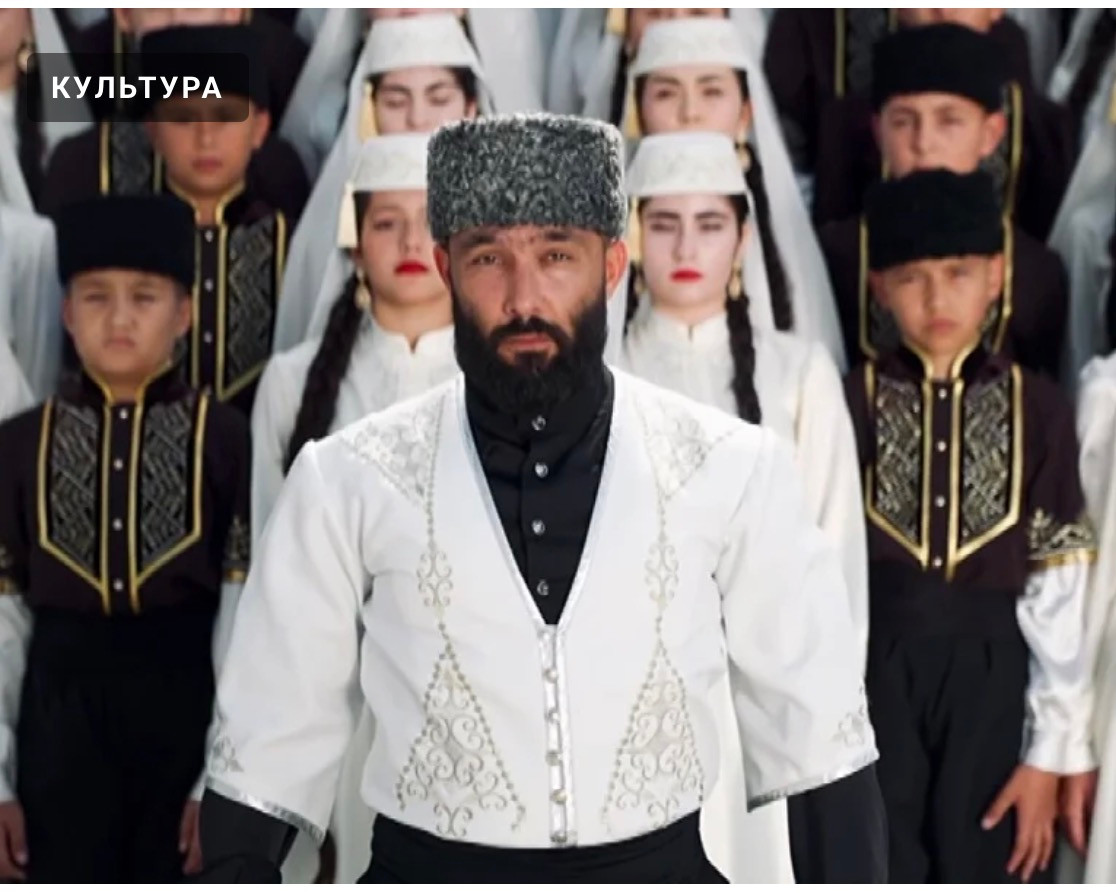
Many of you may have noticed the viral social media trend of national dance collectives performing folk dances to the beats of American rap. It started with a Georgian reel, then Uzbek and Armenian groups joined. Now it is the Crimean Tatars. The reel by our dance collective Atesh has already reached one million views.*
▶ Watch the original Atesh reel
*Atesh, a Crimean Tatar dance ensemble led by Midat Khalilov, joins the viral trend and puts traditional movement and modern sound side by side. Over a million views in under a week
At first glance, the core of the trend seems to be the unexpected combination of traditional choreography and modern music. But if we go back to the source video, we notice that the main emphasis is on being recognisable. And this is truly interesting.
This format turns out to be a good test of the state of dance traditions. If the choreography remains recognisable when the soundtrack is replaced, it has its own distinct movement language.
That is why the Georgian reel is so compelling. From the first seconds it is clear who they are: the rhythm, the quality of movement and the silhouette are clearly readable. Moreover, the dance sequences resonate with the landscape, the architecture and the traditional way of life of the Georgian people.
Their culture keeps speaking its mother tongue regardless of context, while contemporary Crimean Tatar stage dance tends to assimilate into it. This does not refer to any particular dance collective, but to the overall phenomenon.
Over the past three decades our art has literally risen from the ashes. While researchers were painstakingly piecing together lost traditions, dance collectives worked with whatever had survived and naturally filled the gaps with elements of Caucasian, Balkan, Turkish and other Turkic cultures. That was an inevitable stage of survival, but we are still stuck in it.
That is why our stage dance today uses a fairly universal "oriental" movement language instead of speaking in our own. This may be why it resonates so strongly with the mass audience: it expresses a sculpted Caucasian silhouette, a Kazan Tatar visual style, the highland expressiveness of the male parts and an easily understandable stage dramaturgy. At the same time, a performance can be very professional, visually striking and technically perfect, yet express only a few Crimean Tatar elements.
Folk dance is not only a set of beautiful movements. It mirrors the character of a people, their way of life, their historical experience and even the natural landscape as the cradle of the culture’s formation.
This is especially visible in the male dance parts, which tend to inherit warrior traditions. Caucasian dance grew out of the movement language of the highlander, which is built around close combat: sharp lunges, explosive dynamics, displays of physical strength and readiness to fight.
Our military tradition was different. At its core lies not the mountain infantryman but the cavalryman. The Crimean warrior is first of all a horseman and an archer. His main weapons are speed, manoeuvre, precision and self-control, not physical pressure. He wins through strategy rather than raw strength.
That is why the male movements of the old Crimean Tatar tradition stand out for their lightness, continuity of movement and striking economy of gesture. There is no room for demonstrative aggression, rather for caution. There are no sharp, loud lunges, no urge to dramatically draw a pychak from its sheath or to put martial bravado on display. Every male movement is calculated and demonstrates complete mastery of the body, from the signature expressive shoulders to the weightlessness of every leap. A horseman whose dismount could be heard a mile away wasn’t worth his salt.
Female dance is no less distinctive. Nowadays we are used to seeing elongated silhouettes, cold distance and nearly swan-like movements on stage, but this has nothing to do with Crimean Tatar aesthetics. Our grace is born not from a sculpted look but from weightlessness, emotionality and brightness of movement, matching the rhythms of Crimean nature and lifestyle. An important remark about the female stage costume: the basis of the traditional women’s costume is not a cone-shaped, floor-length dress, but the çabuvlı anter**, with gores that widen the hip line and fall in a rectangle to the ankle. Such a shape allows the body to move with unique plasticity, complementing the modest but open and even playful character of female choreography.
As a cultural scholar, I see precisely these qualities in the traditional choreography, and they are the exact opposite of what we have inherited today.
**çabuvlı anter: a long, gored women’s robe.
Even our pair dance, which developed only in the 20th century, is built on a subtle play of interests and caution, not on conquest. It is enough to watch the early performances of the duet of Munir Ablaev and Cemile Osmanova.
If we want to be nerdy about details: the fashionable white colour is not just unorganic but exotic to traditional Crimean Tatar clothing. Within our culture, white clothes were reserved for elders who had completed the hajj, in contrast to many Christian societies, which celebrate this colour as festive. Does it matter in the 21st century? It does, because the silent infiltration of contemporary Crimean Tatar stage aesthetics carries alien cultural semantics. And we love bright colours. We are a southern Muslim culture.
The culture of the sun, the ocean horizon and open space shaped our dance traditions. Our compositions live from the delicate dialogue of the performers, their individuality and inner dramaturgy, not from perfectionist synchronicity for the "WOW" effect. We are still on the way to relearning these skills.
Contemporary discussions of dance very often focus on analysing the authenticity of single steps. One could get the impression that once we finally identify and learn the right movements, the problem will be solved, without noticing the deeper layers of the problem itself.
If we translate this into arts and crafts, movement is an ornament, and an ornament is always subordinate to form. We could learn every single element of a national pattern precisely, yet assemble them into a composition that contradicts the nature of the tradition. Therefore it is essential to understand all its laws, contexts, history and conventions.
It is a painful question whether we will be able to address this underlying challenge as we did with trends. We are running against time.
It was one struggle to revive the culture a generation after the catastrophe***. Another is to reach new generations who have adopted "temporary" stage conventions as a "historical norm". We are no longer talking about the preservation of bonds and traditions. Now we are losing something far more valuable: our cultural language.
***The 1944 deportation of the Crimean Tatars and, in part, of other indigenous peoples of Crimea such as the Karaim.