Queer(ing) War and Peace
“The Parajanov Battalion” at Alice nelle spazio latente, Venice
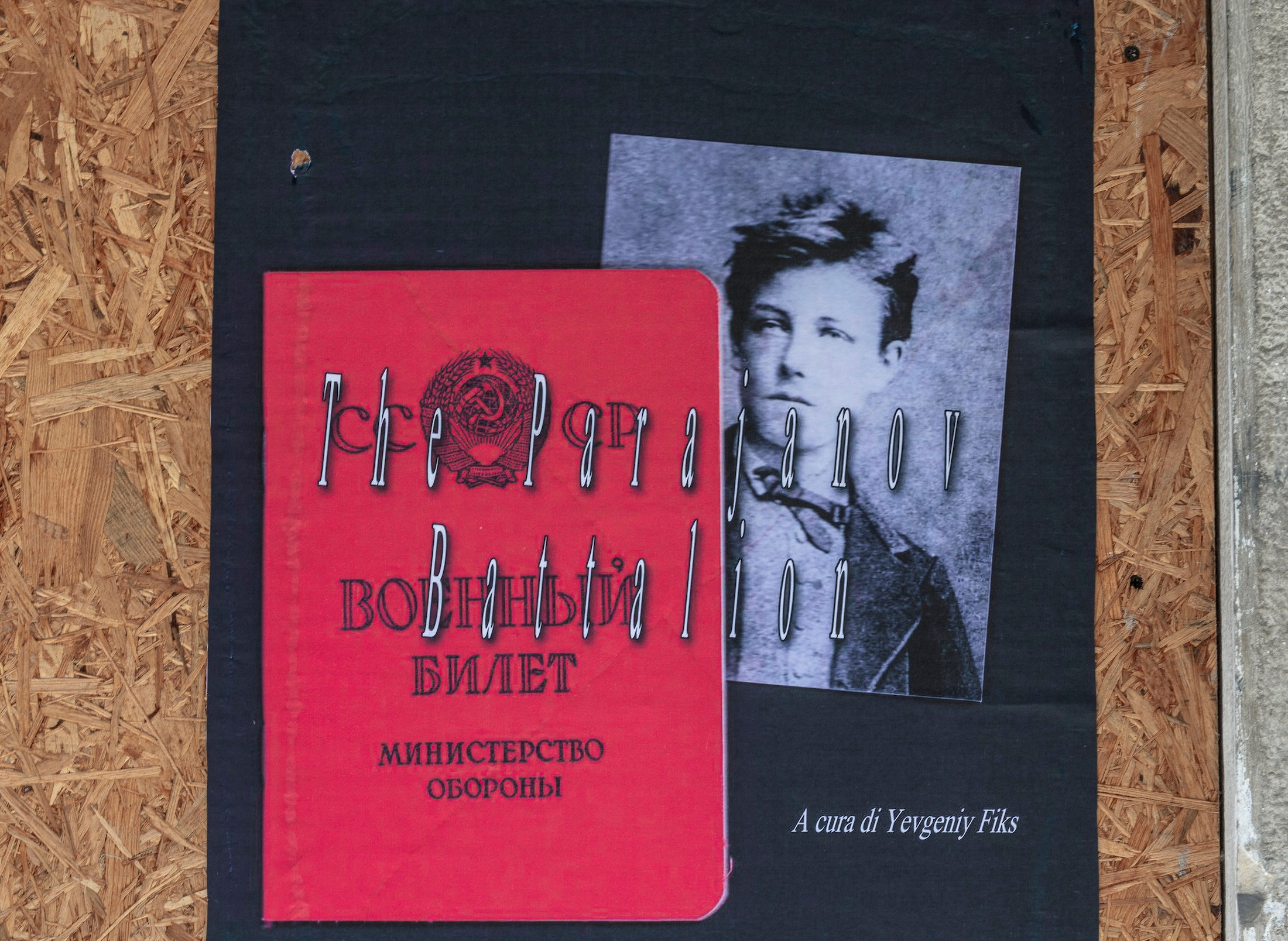
To what extent can international queer solidarity challenge the borders erected by nationalism, militarism and adjacent identitarian politics? How does the perception of the occupant soldier change if we discover that he hides his queer identity, serving in the army of a homophobic and queer-repressive country? Can such cases help us to build chains of solidarity across borders? Or do they actually undermine it, by reminding us that there have always been gay nationalists and even Nazis? Do they perhaps even play right into the dangerous dynamics of competitive victimhood and victim inversion? These and related questions are raised by “The Parajanov Battalion, ” a project organized by USSR-born, New York-based artist Yevgeniy Fiks, that was recently presented in the Venetian art space Alice nello spazio latent (Alice in latent space)1.
Co-founded by Alice Vongola, a photographer, who moved from Moscow to Venice in 2021, and Arsen Zhilyaev, a (post)conceptual artist who lived between Venice and Moscow until being labeled a “member of a foreign agent organization” by the Russian state, Alice nello spazio latent is located in the historic Castello district, in a narrow street, a ten-minute walk from Arsenale. Behind its large display window, which is framed by deep green wood paneling, a glowing bottle is suspended on a lab-style metal stand. The bottom of the vessel has been chipped off, and a video of fire is projected into it from below, causing the glass to shimmer with different colors, as if some alchemical reaction was going on inside.
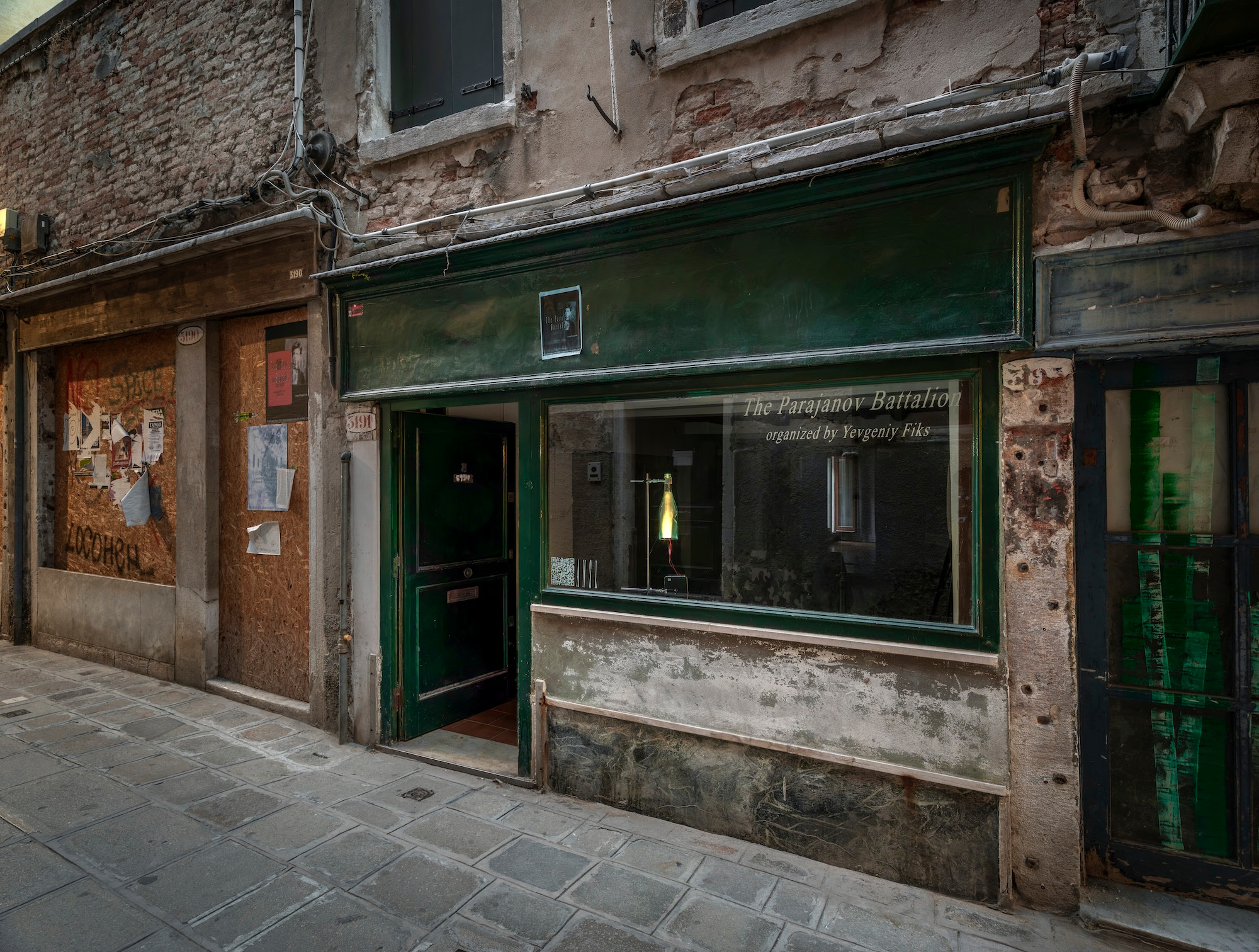
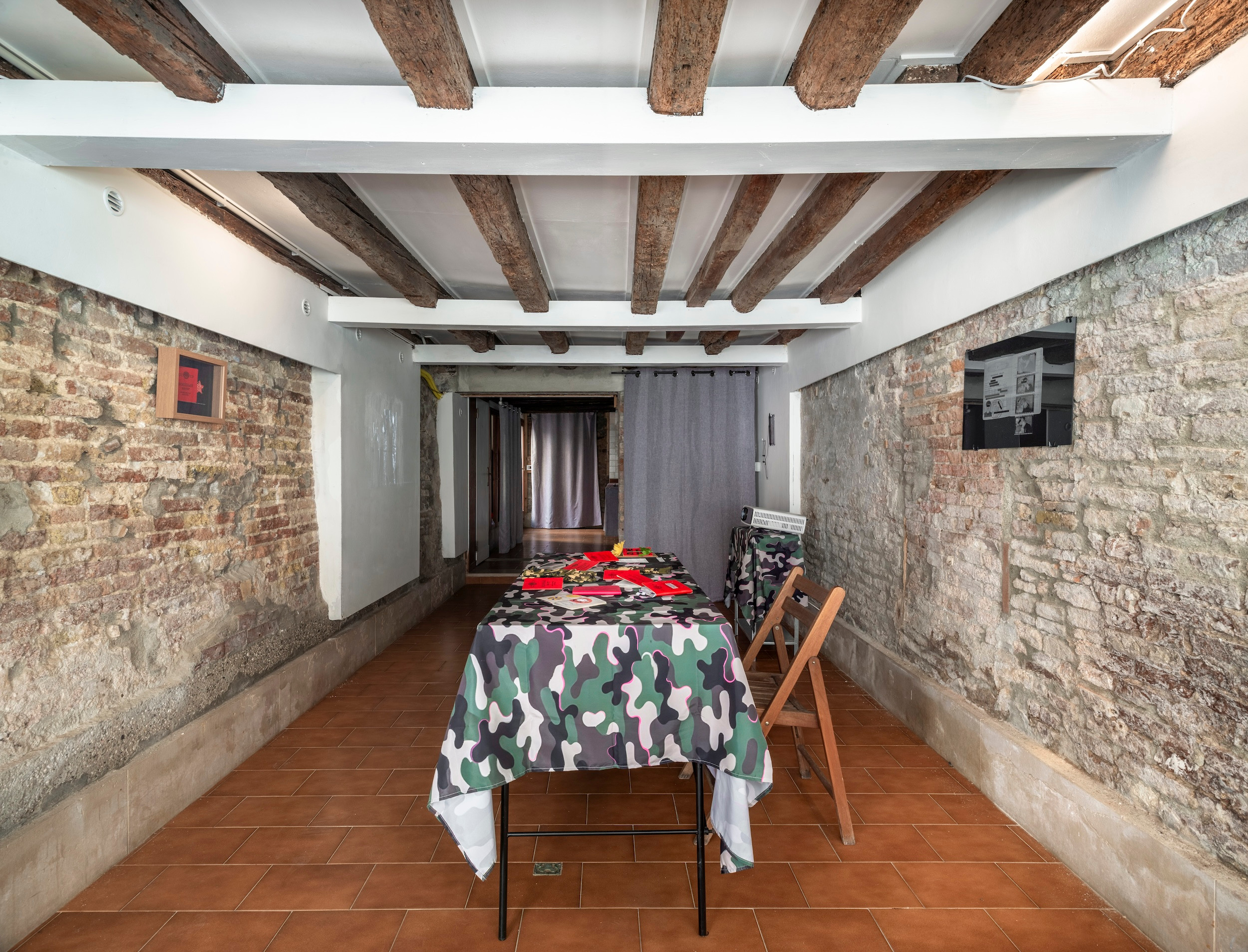
Pulled into the space by this mysterious object, visitors are greeted by a slowed-down version of the Danish national anthem, which emanates from the side of the bottle, evoking a funeral procession. Created by Lasse Lau, the work references Homoer i Aktion, the 2000 Copenhagen group that used Molotov cocktails to protest the deportation of an Iranian gay asylum seeker. The bottle holds the transcript of the trial against the group. Stepping further into the bunker-like room with its stone walls and wooden beams beneath a low ceiling, one encounters the exhibition’s center piece: a table covered in a khaki cloth that evokes an underground command post or a veterans’ feast. The thin pink lines that are tracing the camouflage pattern only become visible as one approaches the installation — and so do the details of the eleven Soviet military ID booklets that are distributed on the table, accompanied by khaki gloves that invite closer inspection. The red-covered booklets have 33 pages, each bearing a big three-color Soviet star watermark. As part of Fiks’ project, these discarded government documents became canvases for a selection of international artists.
During our zoom conversation, Fiks tells me about the incident that inspired the project: In 2022, Ukrainian soldiers discovered a military ID booklet on the body of a dead Russian paratrooper. Enclosed within it was a photo-booth strip of four images showing him kissing another man. The case was reported by several Ukrainian and Russian online media outlets and sparked an intense debate in their comments section. Some queer-sympathetic commentators expressed empathy for the soldier, others argued his personal life was irrelevant given his role as invader, while homophobic voices viewed his homosexuality as reinforcing his status as a repulsive enemy.2 Fiks saw in the incident deeper tensions among nationalism, militarism, and queerness crystallized in the image of the military ID as a site of what he described as both queer concealment and revelation.
This image developed into an art project when Zhilyaev and Vongola in 2025 invited Fiks to create an exhibition for their space. As Fiks explains, after this he purchased blank Soviet military IDs on eBay — obsolete documents issued by a state that no longer exists — and sent them to twenty queer artists worldwide, along with the triggering story, inviting them to respond. Many worked directly with the booklets, adding drawings or collages to their pages; others used the ID as a prompt and responded with objects or videos. Conceived as a participatory, open-ended conceptual protocol, the project was named after the queer Soviet filmmaker Sergei Parajanov, a Georgia-born Armenian who lived in several Soviet republics, made films in various languages, and was imprisoned in the 1970s on charges of homosexuality.
Half of the military IDs returned to Fiks by the artists are displayed on the table in the first room. In one, Andrey Shental, an artist and researcher who left Russia for Germany after 2022, wrote a four-page reflection on the militarization of sexuality and the sexualization of the military amid global escalation and media saturation. A portrait of Kate Bush from the music video for “Army Dreamers” (1980) is pasted into the ID, while a DIY Arduino-based media device inserted inside plays the song. Bush’s waltz-like performance contrasts satirically with the lyrics, which depicts a mother grieving for her son, who was killed on army service, and imagining an alternative life for him — one foreclosed by poverty and other obstacles. This contrast both echoes and is complicated by Shental’s conclusion: “War is not sexy. Pacifism is a privilege.” While people in democratic societies can still openly identify as pacifists, in Russia even the word “peace” is now effectively criminalized. Depending on the political context, pacifism can come at a high price.
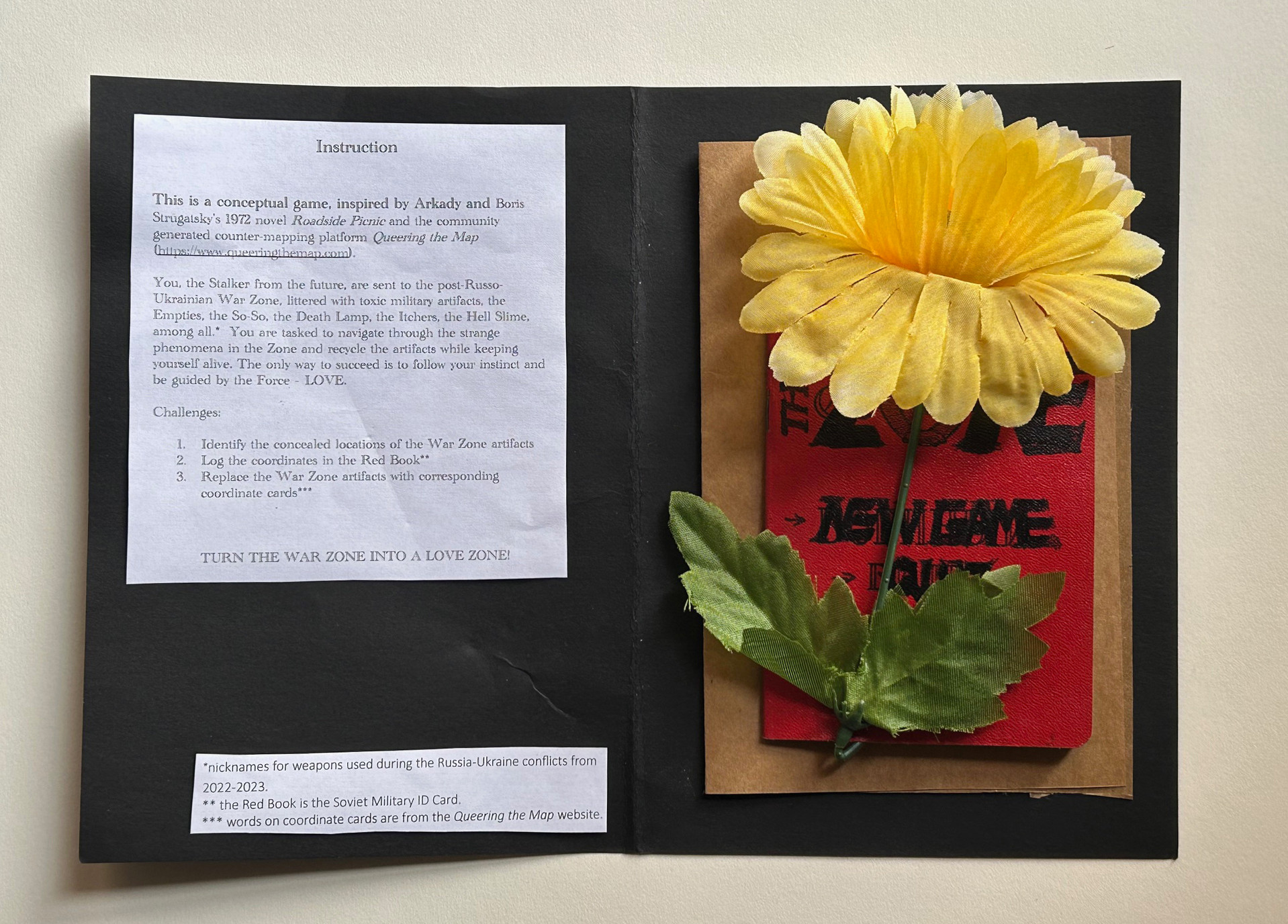
This critique of abstract pacifism contrasts with works that propose speculative pacifist projects. Juliet Jacques, a London-based writer, filmmaker, and academic, filled the ID with reflections on British militarism, personal memories related to it, and lists of antiwar cultural figures who had inspired her. She concluded with a call to join her queer peace movement conceived specifically for this project. Queer feminist theorist and artist Shana Ye turned the ID into a game: a yellow flower and instructions invite participants to transform a war-ravaged landscape along the former Russian — Ukrainian border into a “territory of love.” The work reimagines the “Zone” from Arkady and Boris Strugatsky’s Soviet science fiction novel Roadside Picnic (1972), later adapted in Andrei Tarkovsky’s film Stalker (1979) and the Ukrainian S.T.A.L.K.E.R. video game franchise (since 2007). In the novel, authorities establish the Zone as a cordoned-off, desolate area after a brief extraterrestrial visitation. Ye invites to reimagine the space’s negative weirdness — its hostility and radical loveless — as a positive queerness of openness and love.
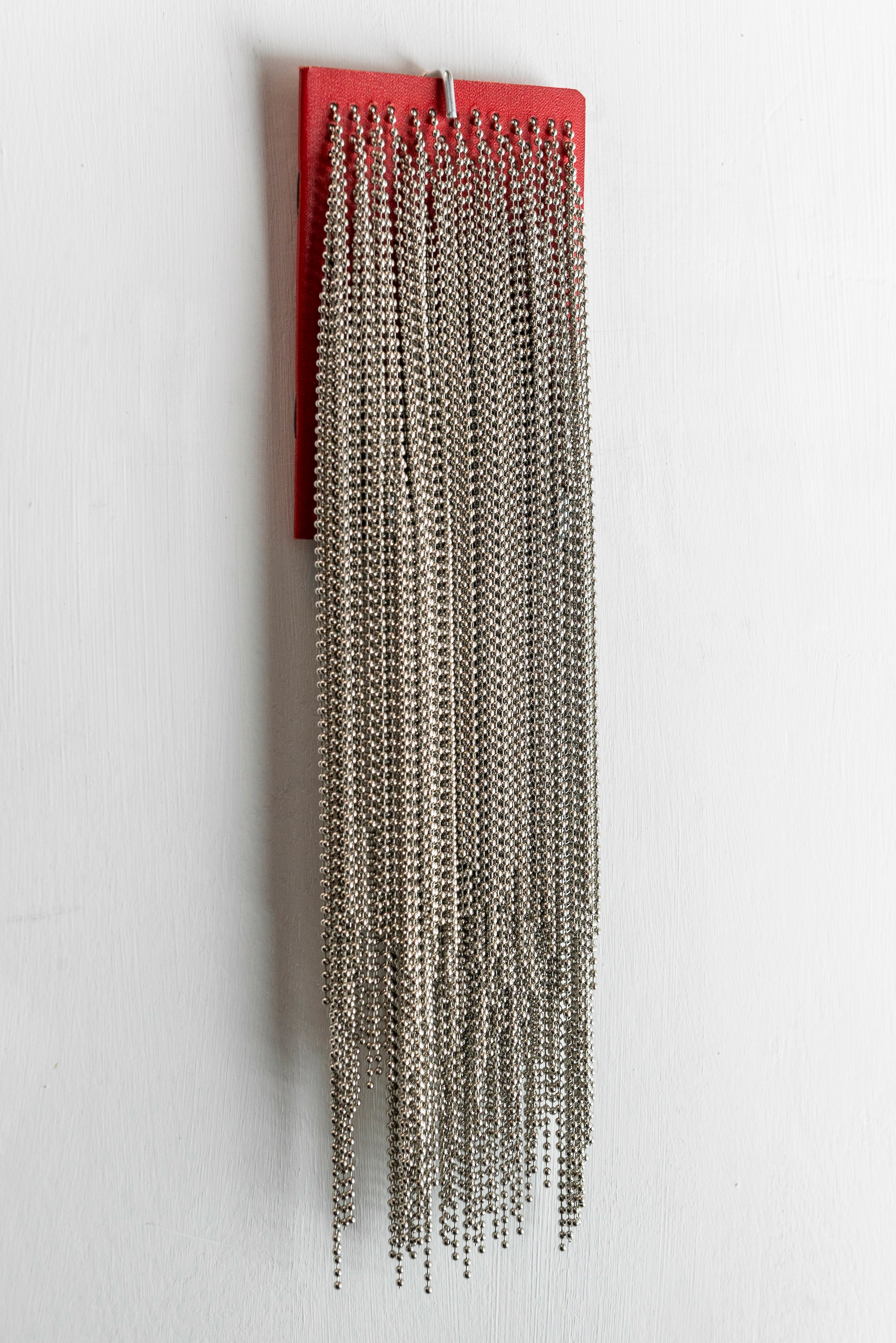
On the wall behind the table, a black plastic panel resembles a contemporary Russian gravestone. Prints on it reproduce the images that sparked the project — the Russian paratrooper’s military ID and photos of him kissing another man. This is Fiks’ own contribution, How to Hide a Photo with Your Boyfriend Inside Your Military ID. Through its gravestone-like form, its tender obscuring of the lovers’ names and identities, and its refuse to inquiry into the soldier’s role in the invasion, the work evokes a memorial both to the deceased and to the lost possibility of queer happiness. In doing so, it encapsulates the entire project’s conceptual approach: Fiks advocates for a complex, humanist sensibility, contrasting clear moral judgments with a more nuanced picture that portrays the reality of specific contexts, cases, and identities. This approach is echoed in the ambiguous sensibility of a nearby work by Brussels-based artist David Bernstein, who pierced beaded chains through the ID, creating an object that evokes contradictory associations with military dog tags, disco fringes, and Art Deco dresses.
Further into the room, a video by filmmaker Noam Gonick unfolds as a cinematic ballet on the Cold War purges, when thousands of 2SLGBTQ+ people were expelled from Canada’s military and civil service. On the opposite wall, a tablet plays Babi Badalov’s testimony: during his service in the Soviet army in 1979, homosexual relationships found space but had to remain hidden under the constant threat of humiliation and violence. The juxtaposition of these accounts highlights how, despite the differences across the Iron Curtain, queer lives were threatened by their unavoidable encounters with the military apparatus.
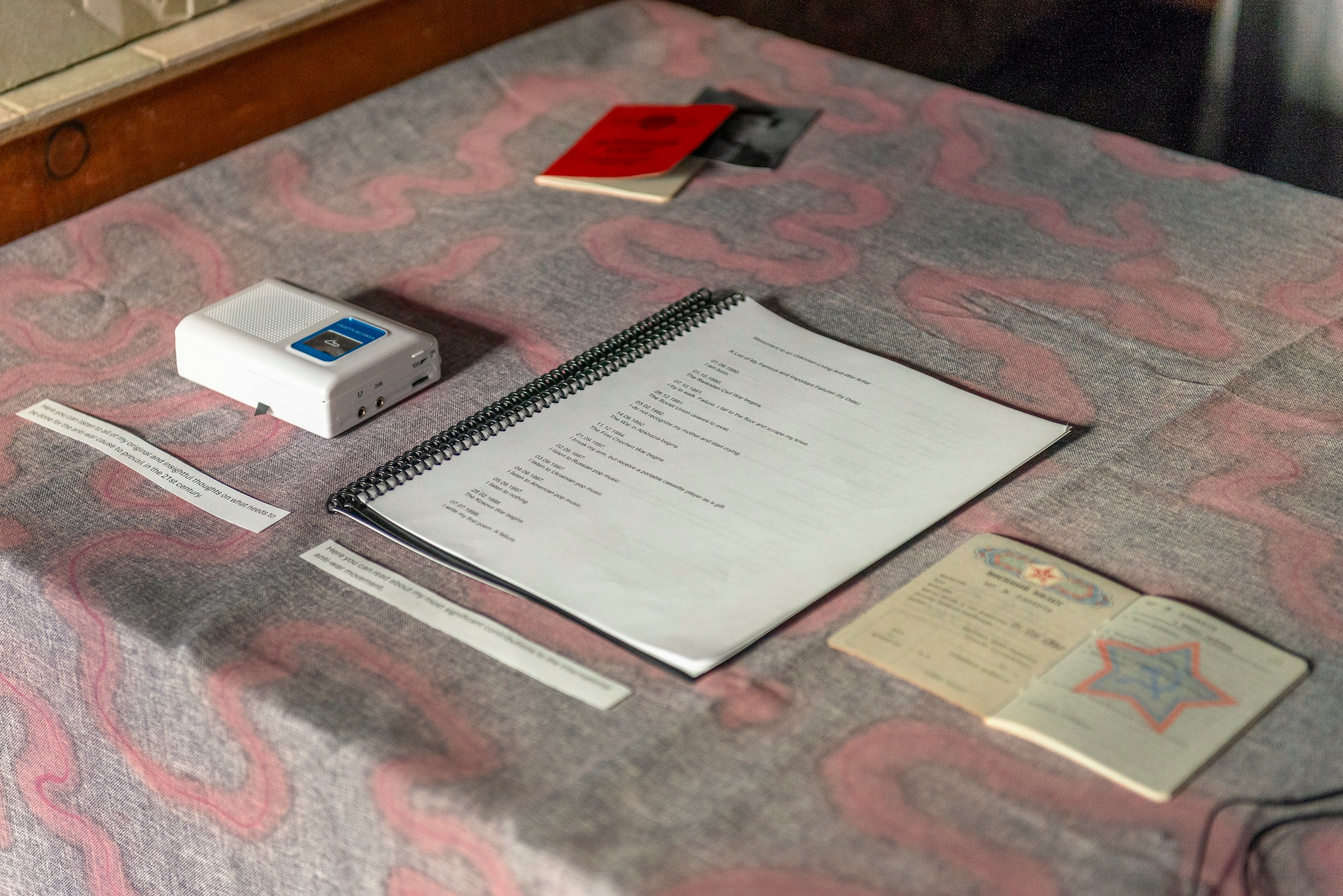
A second room, which is connected to the first by an open doorway, contains another table draped in a plain cloth, on which a khaki camouflage pattern is traced in pink lines, echoing the table in the first room. Among the four works on the table is a multipart installation by Vadym Yakovlev, a Ukrainian writer based in Germany. A military ID bearing their birth date lies beside an empty cassette player, accompanied by a strip of paper reading: “Here you can listen to all my thoughts on what needs to be done for the antiwar movement to win in the twenty-first century.” Nearby, an A4 sheet titled “Monument to an Unknown Living Anti-War Artist” lists specific dates as personal failures to act against the war. Presented in English, Ukrainian, and Russian, the installation reflects the futility of Yakovlev’s attempts to articulate a pacifist position on Russia’s war against Ukraine. Drawing on Jack Halberstam’s The Queer Art of Failure, it treats the failure of these pacifist efforts as both evidence of the dominance of capitalism and heteronormativity and a means of critiquing them.
The exhibition fosters empathy for queer stories, including those of soldiers serving in an aggressor’s army, rather than imposing ethical judgments. Realized as a DIY queer archive rooted in lived communities, it performatively constructs a collective identity at the intersection of queer, pacifist, and internationalist affiliations. By overwriting state seals in official ID documents with individual artistic interventions, the project constructs the “Parajanov Battalion” as the topos of “international antiwar queer” movement — place or common ground simultaneously imagined and spatialized through the exhibition and its ID cards. The battalion thereby becomes a utopian combat unit or peace force, rendering the project as contradictory as the very concept of peacekeeping. This contradiction may be its value, but it also exposes a difficulty the project cannot resolve: is the aspiration to such a movement necessarily illusory? As the various artistic contributions demonstrate, the costs and meanings of pacifism and international queer solidarity must be situated critically in each specific context. How prowar and nationalist was the Russian paratrooper whose ID inspired the project? The exhibition does not answer this question. Like any identity formation organized across multiple affiliations, it foregrounds certain features while backgrounding and excluding others; like any artistic speculation, it suspends some questions in favor of aesthetic ambiguity and broader utopian claims. In doing so, it may also contribute to victim reversal in particular cases. Ultimately, however, its principal merit lies in queering war and peace, thereby challenging their appropriation by patriarchal militant nationalisms.
“The Parajanov Battalion” at Alice nelle spazio latente, Venice, August 17–September 26, 2026.
The author is grateful to Anna Sinofzik for her valuable editorial suggestions during the preparation of this text.
