The Coexistence of Physical and Digital in Art Presentation (The Case of Thomas Ruff)
Many of Thomas Ruff’s works may raise the question of whether or not they are photographs in the generally accepted sense of the word. He often edits and processes photographic images made by others in order to rethink their possibilities. In his works of the early 1990s he used photographs taken by scientists at the observatory or black and white photographs found in newspapers. Later he began to use images from the Internet. He continued his series based on astronomical photographs, but this time downloaded from NASA’s website. He also created series based on pornography (Nudes, 2003), images from Japanese manga and anime cartoons (Substrat, 2002-2003), and pixelated JPEG images (jpeg, 2004-2007) all taken from the web.
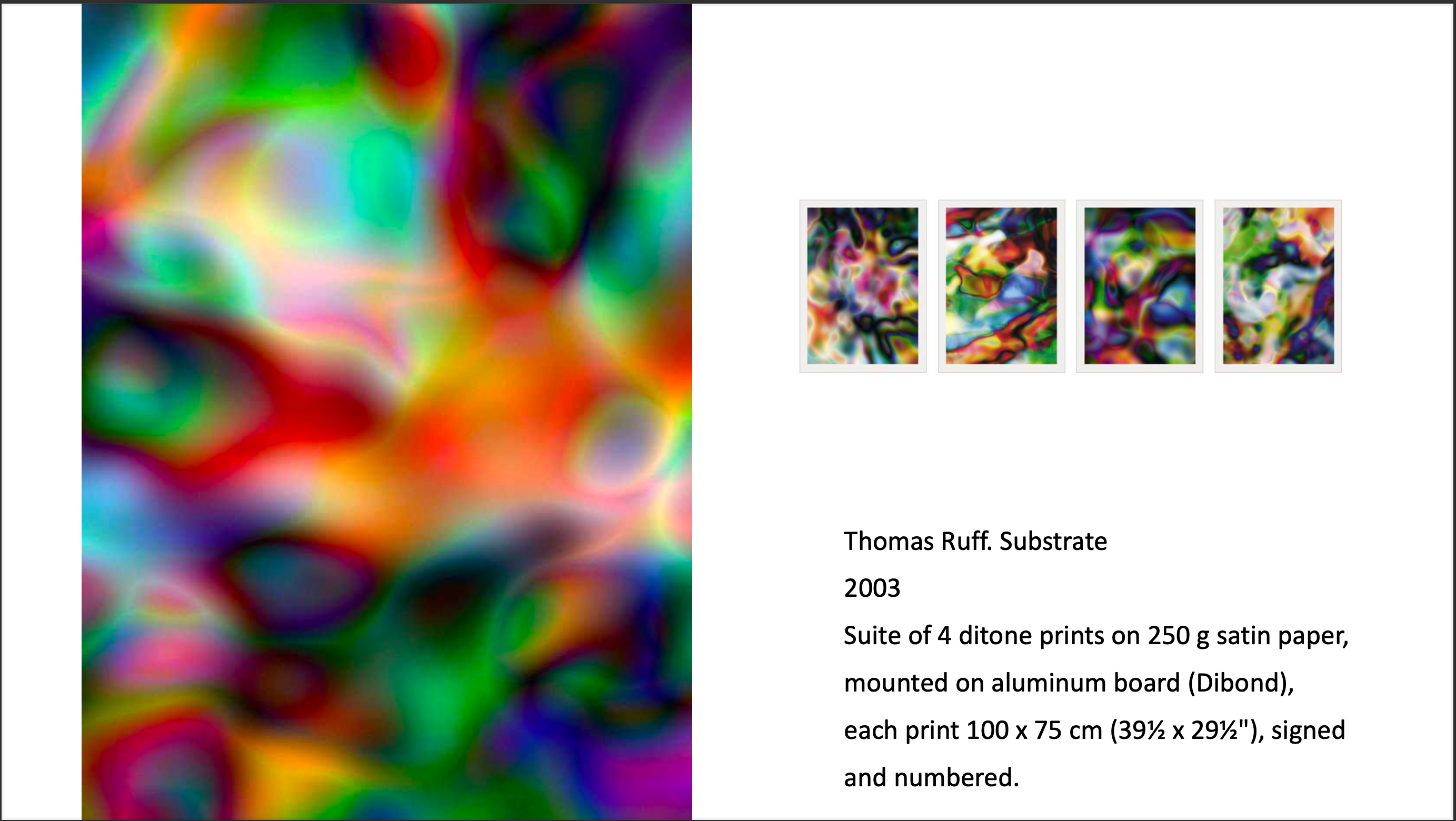
The work of Thomas Ruff challenges the processes, methods, and concepts of photography. All images in these series were digitally processed and altered without any camera or traditional photographic device. He downloaded images from the web (did not shoot them with a camera), edited them on a computer, and then printed them (did not develop them). This shows that he is not interested in the ability of photography to represent reality, but in the image itself. Ruff says that he does not strive to present himself as the author of these photos, as he believes that there is a shift in authorship and we can no longer recognize an author. It does not matter to him whether he pressed the shutter himself, whether someone else did it, or whether a machine took the picture without human intervention. What is important to him is obtaining the image itself.
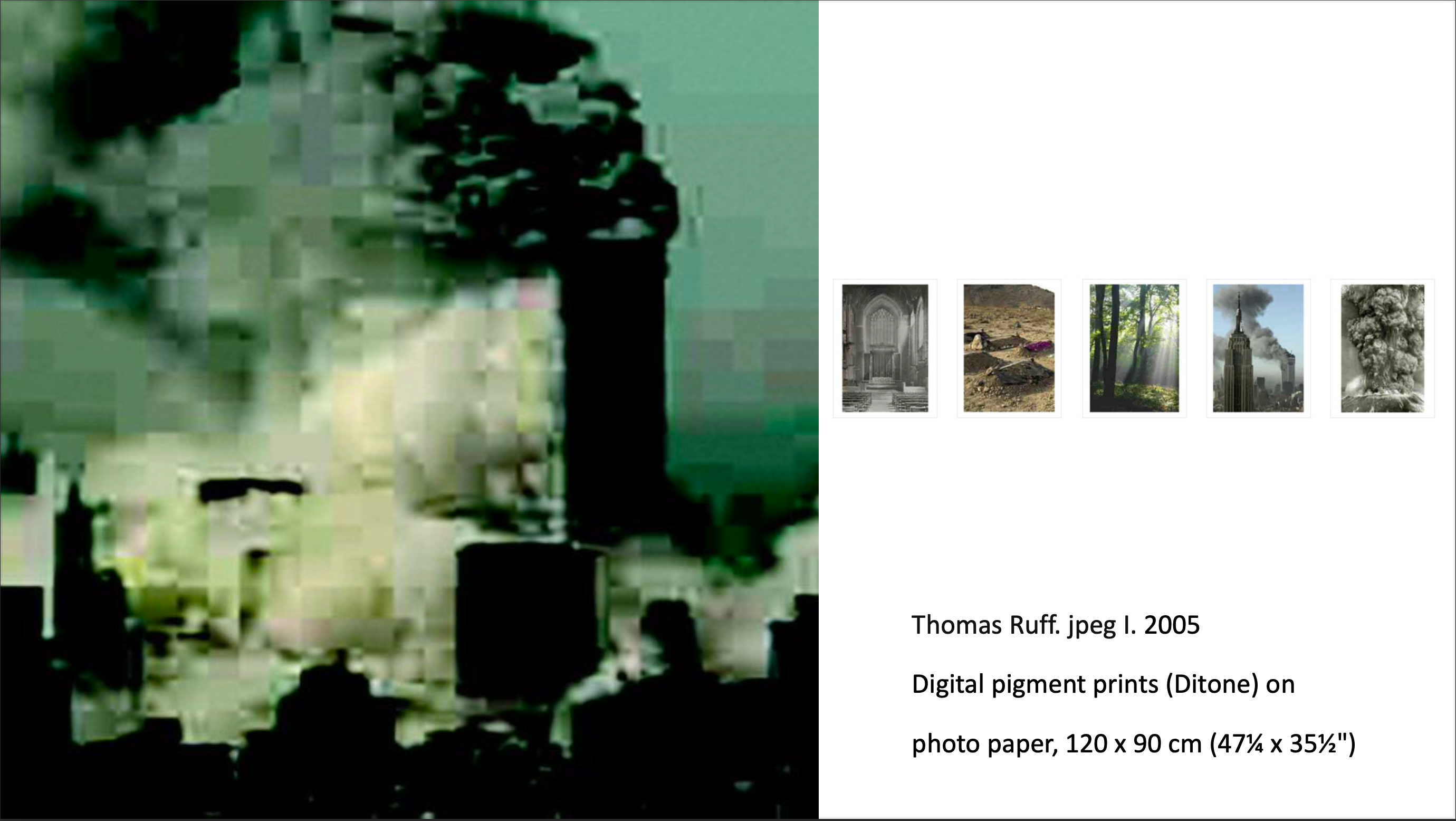
Moreover, it is worth emphasizing that his interest in the structure of an image concerns specifically digital images. This is most clearly seen in his "jpeg" series. This series researches the digital age’s influence on the perception of images. Here Ruff uses familiar images from the Internet to study the transformation and degeneration of images that have undergone electronic propagation. The series is named after one of the popular graphic formats used for storing photographs and similar images. JPEG is most widely used due to its application for storing and transmitting images on the Internet. The JPEG algorithm is most suitable for compressing photographs and pictures containing realistic scenes with smooth color transitions and brightness. But since the JPEG format compresses with loss, it can sometimes create a sharp contrast between pixels, the smallest elements of a two-dimensional raster graphics digital image, and they become noticeable. Thus the image loses its quality and becomes less realistic. Each pixel is an object characterized by a certain color, brightness and, possibly, transparency. One pixel can store information about only one color, which is associated with it. A pixel is also an indivisible object that has a certain shape. We usually encounter rectangular-shaped pixels, although they may be round. If the image is zoomed in, the pixels turn into large grains of this shape. It was on this feature that Ruff founded this work, turning more or less clear digital images from the Internet, via some manipulations, into a pixel grid.
Ruff started the series in 2004 when early social networks appeared, which greatly contributed to the distribution of content thanks to the possibility of faster exchange of messages and posts. This has influenced the way information functions and spreads. Due to the increased mobility of sharing and receiving information, the content does not need to be searched for; it flows into your feed thanks to the work of others, if you, of course, exist in the social network discourse. It seems to me that the fact that the opportunity to share information became easier (posts are available to the entire community of the network, which is much larger than the number of users that could reach someone’s personal home page) accelerated the emergence and spreading of images familiar to many people. For example, speaking of the present moment, the fact that memes are spread mainly through social networks can prove it. Also, this rise of social media basically revived the focus on user-generated content, as it was during the rise of homepages in the 1990s. The role of the artist has been combined with the role of the regular user; he uses the same tools as users do, such as search agents. Thus, the work of Internet artists has become devoted to the experience of working in the network as a part of daily experience, a common thing.
Ruff searched for images and downloaded them online, re-scaled them to a very small size, compressed them to the worst possible JPEG quality, then printed them on a large scale. Mostly, he is satisfied with the picture that is obtained through the work of technology, but if he does not like something, he corrects it with the help of Photoshop. As a result, we have a large image broken into many pixels content of those we can only recognize from a distance. That is, each work in this series has a dual mode of perception. First, you can look at it as an abstract canvas when viewed from close range. These photos of Ruff show that a breakdown of an image that occurs unintentionally has a certain aesthetic. Squares of pixels are broken into smaller squares, smoothly flowing from one color to another, changing shade, and as a result, looking like a Pantone palette. The perception of the viewer, in this case, is directed to the play of color; one enjoys this sensual mode of viewing the work. Secondly, these photos can be viewed as a specific image. However, the entire image is visible only from a distance, so that it can only be identified by stepping back a few steps. The perception of the viewer shifts from a sensual to an intellectual mode aimed at image recognition.
This series is printed on a large scale and presented as physical media in the space of the gallery while being clearly an electronic phenomenon by its nature. JPEG is an authoritarian system that controls the representation of images on the web and Ruff shows this with the help of this work. Pixels become a sign of the network and the artist turns to people who are able to recognize it and are able to consider this contradiction between the physical medium in which he reproduces the image and its virtual nature.
The usage of low-resolution images also has some economic aspects. This is the kind of visual material that most network users have access to. It is the most widespread type of images. Of course, now as I see high-quality photos taken on the latest model iPhone while scrolling through Instagram, it is hard for me to comprehend this; but if I go beyond the limits of my subscriptions, which form the content I see, and instead of accounts of bloggers and designers (for whom a good picture is their work), I scroll through the pages of most people who have nothing to do with it, I will see the prevalence of poor-quality images. Needless to say, it’s also hard to find a high-quality image on Google. This is especially true for 2004-2007 when Ruff was collecting materials for this series, since most of the images were (and are) uploaded by ordinary users, and they had limited technical capabilities, not to mention the fact that at that time devices had lower quality.
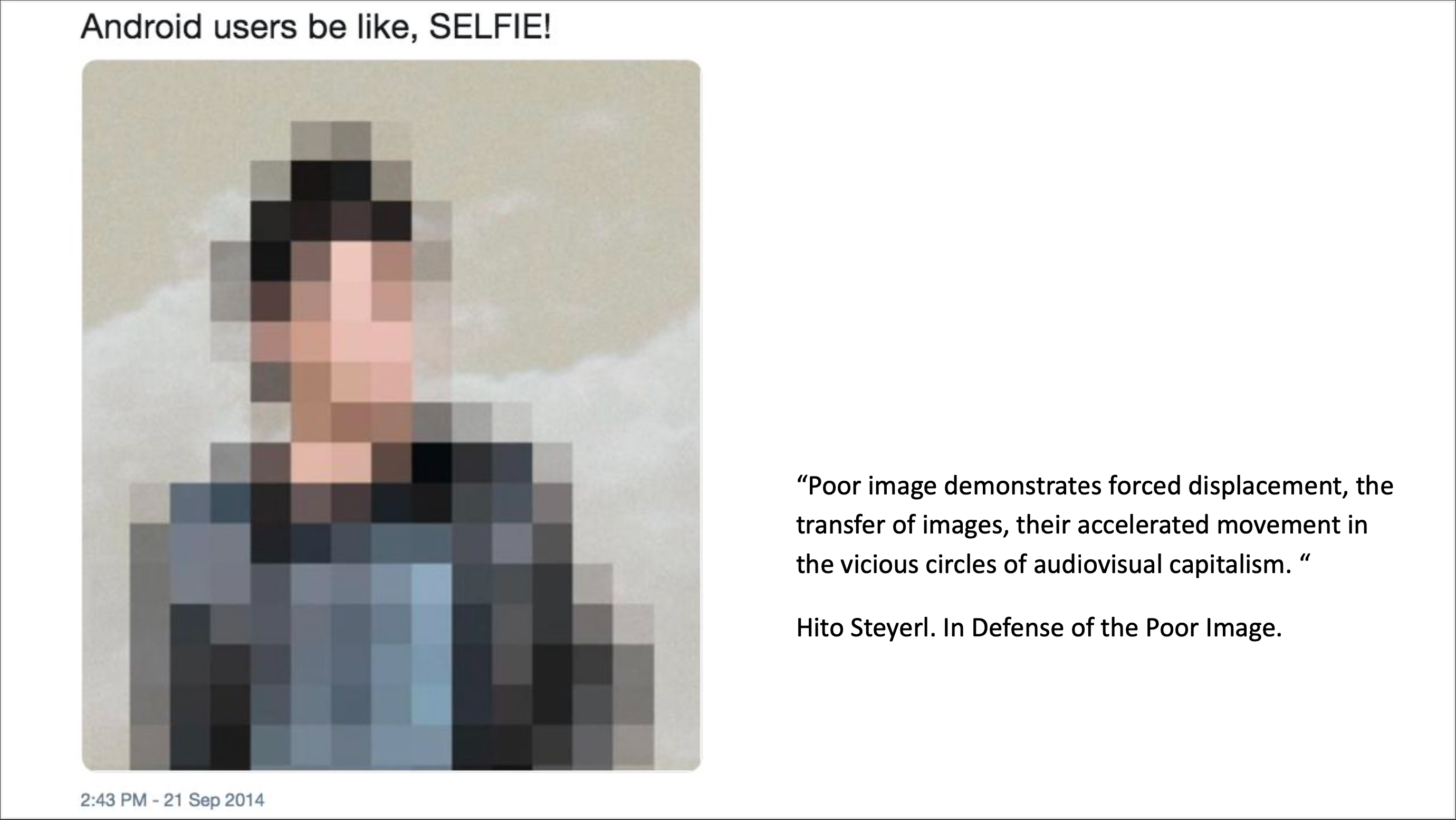
Despite the fact that many articles about Ruff’s "jpeg" series describe it as a study of image deformation via the Internet, it is actually aimed at revealing the visual information we are mostly surrounded with and showing through what kind of images we perceive the world outside our direct vision and experience. In order to show this more clearly, let us compare Ruff’s photographs with other visual objects that reveal exactly the work of the Internet in the degeneration of images. I’m talking about the public page in the Russian social network VKontakte called "Putin for every day" (https://vk.com/putineveryday). Although it is not proclaimed as art, this project has creative potential. The administrator of this page has posted the same photo of the President of Russia every day since 2012. He/she saves this image on the computer and posts it on the Internet again, so it gradually loses quality. This happens not only due to the properties of its format but also due to the work of social network algorithms that optimize images to reproduce them. This media operates with the same digital structure that the photograph represents, but also makes its own changes to it. That is, it leaves its mark on the original picture, distorting it.
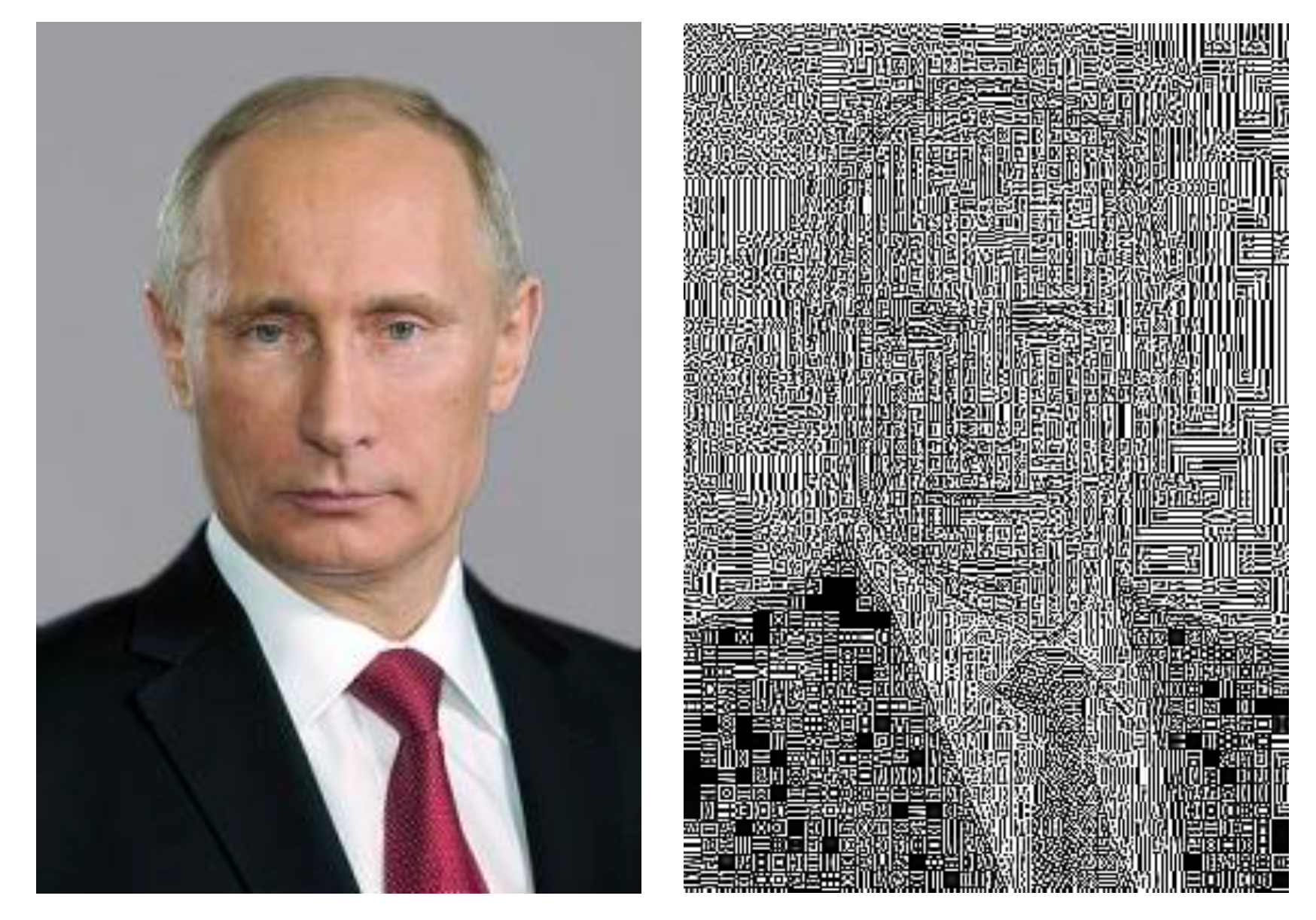
But in Ruff’s project, he artificially grows this effect in a Petri dish; he does not produce it with the help of the Internet. If he were interested in the way the Internet operates, he would take advantage of its work, not the work of the JPEG format. That is, he bases his series on content that the mass of Internet users consumes. At the same time, the mass produces this content (the main part of it), posting and sharing it. It forms a visual environment which one is surrounded by on the web, and by doing so brings it to its collective memory.
The theme of collective memory is directly related to "jpeg". This series has two sub-themes that I would define as "disaster" and "pastoral". He chose pictures of natural disasters (volcanic eruptions, floods), the war in the Middle East, ruins, and 9/11. For the other theme, he chose pictures with the opposite effect to the catastrophic images: jungle, forest, fields, and uncrowded city landscapes. A conversation about collective memory will relate mainly to the first theme because collective memory is mostly a memory of events. The most striking example that Ruff uses is, of course, the photos of the events of 9/11, which in many cases is the turning point for Western civilization. The memory of a large number of people (who have access to the benefits of the information age) contains the image of this tragedy, but it is blurred as a result of the horror of watching the catastrophe live. The fragmentation of Ruff’s pictures works the same way. It gives an idea of the general structure of the image but hides the details of the traumatic experience associated with it. Ruff’s manipulation of the image limits our access to the scenes depicted and thus reduces their aggressive nature. To some extent, this works as censorship.
It is clear that the overall picture of this event was formed by television, but it showed these shots during a certain period of time when it was relevant. The 9/11 photographs would not have been available if they were not on the Internet. Due to the fact that they are on the web, people have the opportunity to make them part of their personal archive, and the collective memory can be stored as something personal. Thus, all have a common similar picture of what happened through the personal perception of it. Ruff, in a conversation about what prompted him to use these photos in his series, said that he personally witnessed the event, and was even able to take photographs of it, but because of the damage to the film, he turned to the Internet to have these photos in his archive. Then he used these images for his series.
In this act, we see that since the Internet had already managed to be filled with visual content by this time, it began to be perceived as an archive. So from a huge pile of information existing in one place, artists, including Ruff, choose something specific, based on personal preferences or conceived concepts, and form their own archive with it. The point is that the Internet archive is chaotic; it cannot be compared with the orderly storage of information such as in a library file. It works according to its mutable laws, and the only possibility to operate it is with the help of search agents. They make surfing the Internet a more or less structured process via search word filters, but still leave a gap for a throw-in of thematically unrelated images because of the imperfections of the internet algorithms. Thus in order to create a selection of online content you need to go on a fairly long journey, going from one link to another, choosing sometimes the most unexpected paths. Moreover, the trajectory of reaching content on the Internet is mediated by many steps that shift it: the search system, browser, and WWW. The archive that the artist collects and the archive to which he refers for this exist in different forms. The "jpeg" series is a small thematic archive of content, that is, just a compilation of images, explicated from the complex structure of a large and multi-level archive of the Internet.
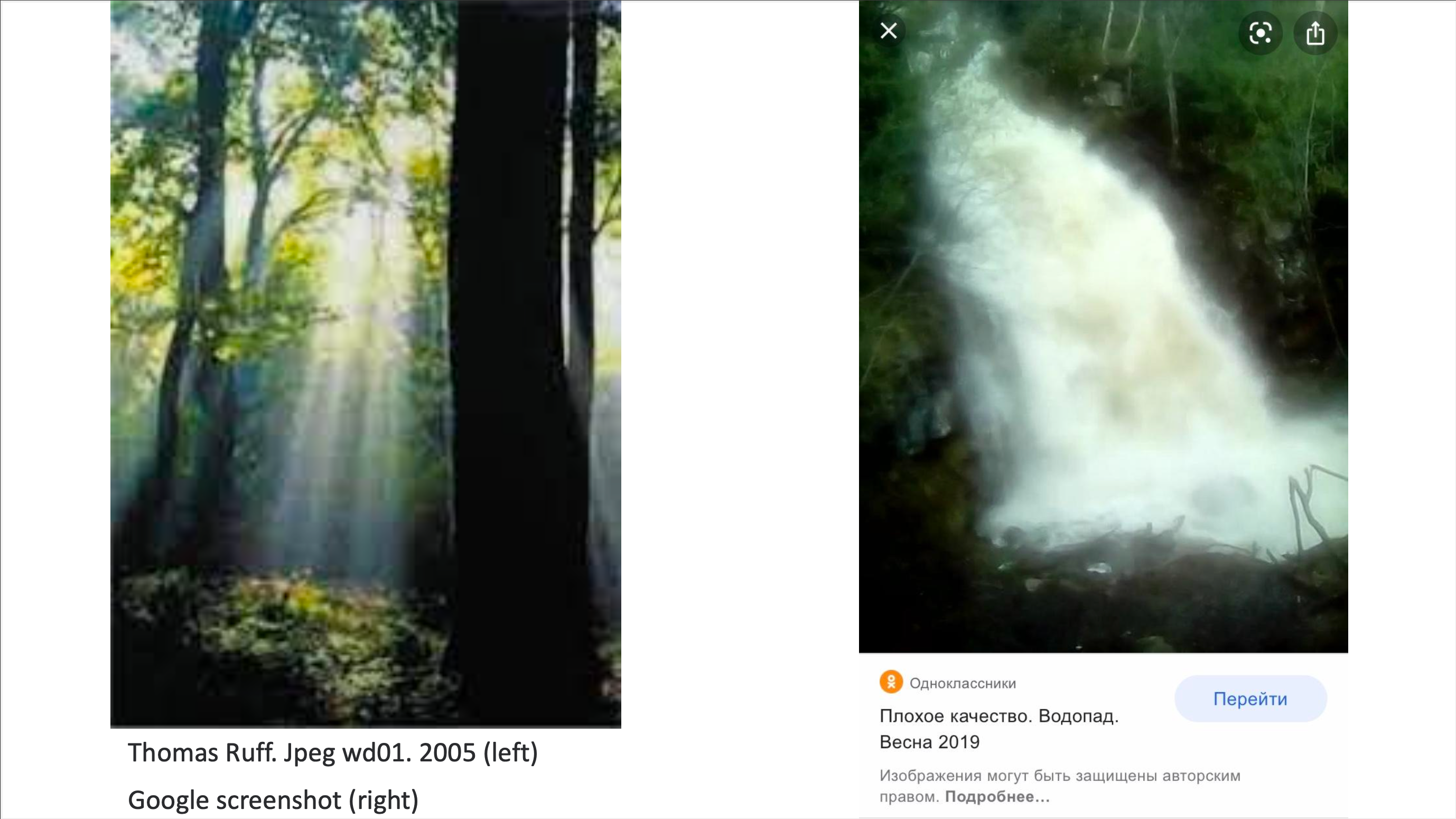
If we come back to the sub-themes of the series, we can say that unlike catastrophes, which are specific events and are covered in the media, and therefore have a more or less specific image, the pastoral is something more archaic. It shares a common culture-shaped image. That is, when you talk about a pastoral landscape, one imagines an abstraction rather than a specific place. The image is blurred in the collective mind as are the images that Ruff’s works represent. In any case, he form of the image is split into pixels to achieve the effect of alienation. Ruff said: "I always want to take the medium of photography into the picture, so that you are always aware that you are looking at an image—a photograph—so, in the picture I hope you can see two things: the image itself, plus the reflection—or the thinking—about photography… It is as if I am investigating the grammar of photography." And alienation allows you to achieve this kind of vision. It exposes the structure of the image, bringing it to the surface. Thus the viewer can both recognize the whole image and examine its elements. Moreover, these are elements of a digital image.
Ruff is interested in the shift in media because right now we’re surrounded mostly by digital images, whether they’re in the virtual world, online, or in the real world: printed on paper in books, magazines, newspapers, packaging, or advertising banners. Ruff is surprised at how few artists explore the fact that most of the images that surround us have a homogeneous structure as they are spread in the form of pixels. Even if these images originally existed as analog images, in order to be distributed they must now be reproduced in binary form. This fact addresses us to the classic Walter Benjamin essay "The Work of Art in the Age of Mechanical Reproduction" (1936). In this work, Benjamin analyzes the transformation of works of art as physical objects in the context of technological development. In the essay, he pays special attention to the term "aura" which Benjamin associates with the authenticity of things. The development of reproduction mechanisms, like the appearance of photography and cinema, entails the disappearance of aura. On mechanical reproduction, he says, "By making many reproductions it substitutes a plurality of copies for a unique existence. And in permitting the reproduction to meet the beholder or listener in his own particular situation, it reactivates the object reproduced. These two processes lead to a tremendous shattering of tradition which is the obverse of the contemporary crisis and renewal of mankind." Although reproduction allows us to perceive a work of art beyond the situation available to the original, it is not able to convey the unique experience and presence in every moment which is inherent to the original.
However, this is not the only reason for the gradual dissolution of the aura. Art has turned from sacred to profane. This profanation, or in other words, the availability for anyone to refer to the image of the object of art countless times, detracts from the value of the original. For Benjamin, the history and the changes in the physical structure of the original over time, which a copy may not exhibit, are important. Thus, the presence of aura requires the physicality of the work.
It is important to understand that the conflict between an art object and its representativeness, described by Benjamin, is relevant only in relation to classical forms of art and representation tools operating on the physical level (redrawing, engraving, film). New artistic forms, based on digital production, have a different type of existence, based on which representativeness and reproduction awareness are already inherent features. The digital way of distribution also has its own specifics. The line between the original and reproduction is erased. In fact, when we take a picture with a digital device, we do not care where the original is: on the flash drive of the camera, in our phone, in the cloud, on Facebook, or if it is hung in printed form on the wall. In this case, the relation of the original and the copy is not the same as in the case of the reproduction of a picture made by hand. Because now the copy is not just an imitation that mimics the original, leaving it in its uniqueness untouched; it operates on the "original" itself. Thus the questions regarding the perception of this copy as art arise.
If someone takes an image from the Internet, it is difficult to perceive it as art, even as a ready-made. Perhaps it is so because there is no re-contextualization which is necessary for the ready-made (as a part of the institutional perception of art). Even if this image is placed in the space of the gallery, it will sooner or later get onto the Internet in modern realities and most people will perceive it through the web (because the gallery cannot achieve such a mass audience as the Internet can). That is, the image will make a loop, returning to the same place in the same form in which it was taken. Therefore, in order to be perceived in the field of creative activity, the Internet image used by an artist needs artistic or conceptual processing._
At this point, there is a dual situation with the "jpeg" series, as the photos were taken from the Internet, were processed, and were presented by the artist in another, physical medium. On the other hand, they are not really re-contextualized, because the processing consists in exposing the already present effect, pixelation, which, in fact, in the same exaggerated degree can be simply found on the Internet. Despite the fact that Ruff highlights the work of the Internet and digitalization in this work of 2004-2007, it does not (yet?) entertain the thought that these images will exist in two modes, and that what produces a sensual and intellectual effect, which was mentioned earlier, in the gallery space, is absolutely lost when it returns to the bosom of the Internet. It mixes with the same images among which it was taken and causes confusion among the public observing his works on the Internet. Even now I am writing this work based on images of Ruff’s works on the Internet, not perceiving them as they should be perceived. For example, I did not see the gradient transitions and could not appreciate the abstract structure until I opened a book with a physical reproduction of his works.
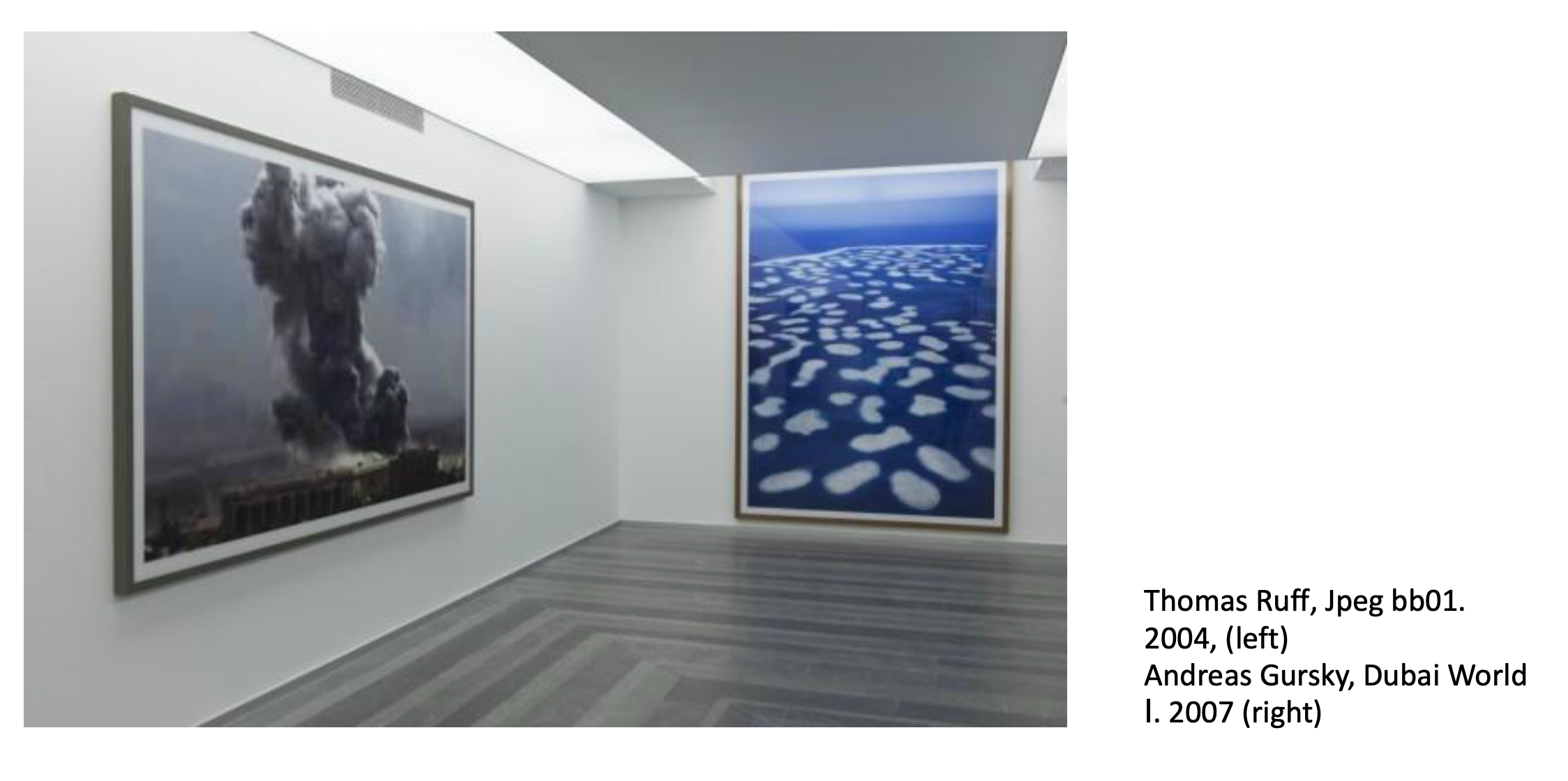
It seems to me that the fact that art is now mostly viewed through the Internet, in a form and context different from the intended (not the space of the "white cube", but a more uncertain environment: you can see it on a site about art or you can come across it accidentally on a meme page) is one of the most important points. It changes the way art is perceived and also the way it is rep_resented, which, in theory, should now take into account its future distribution via the Internet.
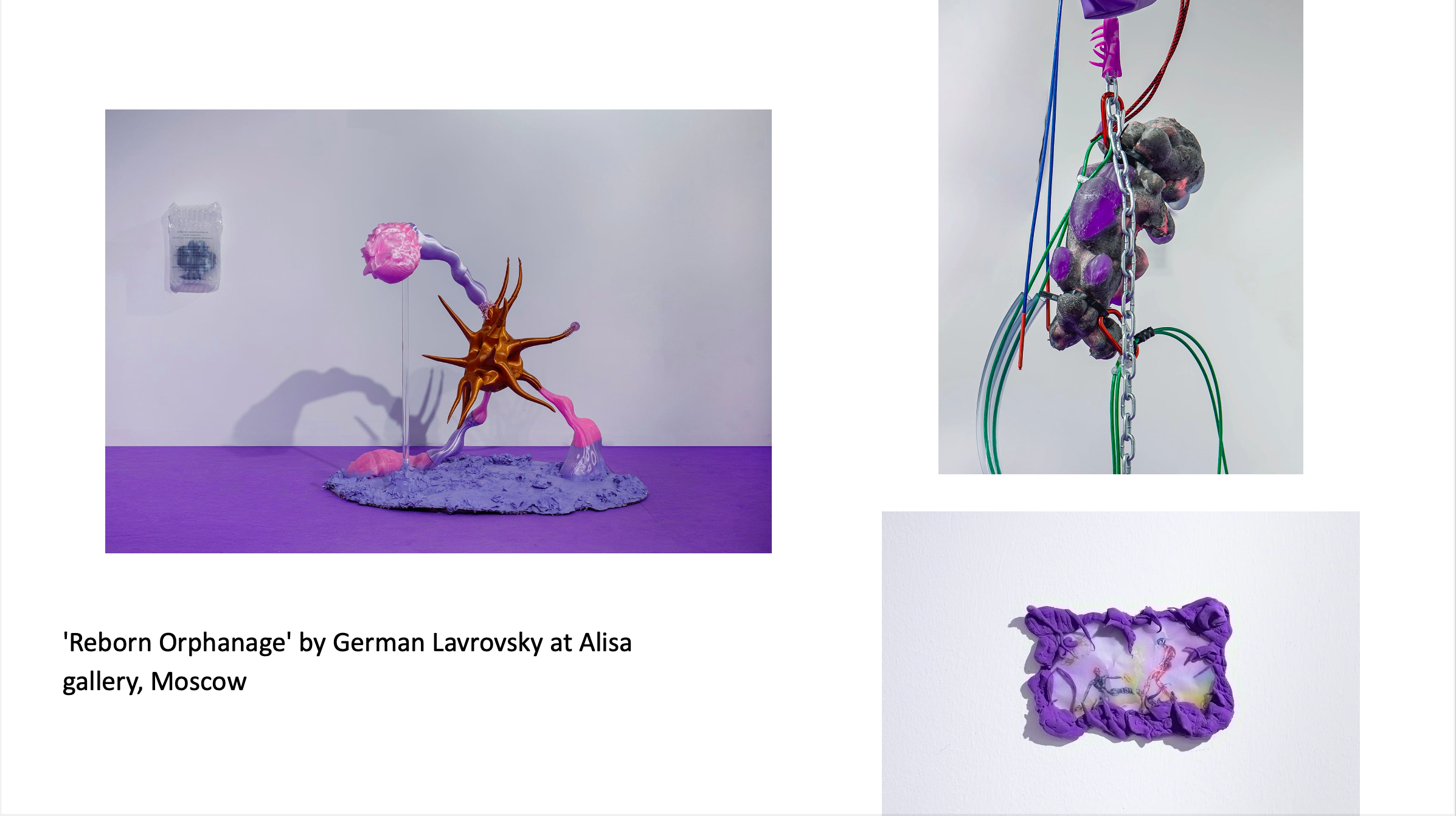
Internet art went through the stage of researching the Internet, while existing in it (net-art), then went beyond it, into the real world, starting to use rather than explore Internet tools (we can see this in the usage of the Internet as an archive). The next step, in theory, should be the combination of two modes, real and virtual, of the presence of artwork in the modern world. Since even if it is created in reality and is exhibited in reality, it still gets into the virtual space and this fact cannot be ignored because both viewers and artists expand their online presence. And it seems to me that art is entering this stage now. At least I get that feeling when I look at mainstream art in commercial galleries. Art that takes into account the rapidly evolving situation. Even being produced physically, it begins to gravitate to the digital presence. Art which is produced today can be completely unpresentable and plain in reality, but at the same time, in photographs, it will look extremely expressive. Such a new property is not about neglecting the hundreds of viewers who see this object live, in favor of the hundreds of thousands who will see only its digital image; rather it is about a change in the very logic of production, representation, and distribution of art. It cannot hold on to the previous forms of its display and remain insensitive to the changes that have come.
When placed on the Internet, this art attracts attention with its unusual brightness, and complex structure reproduced in 2-D on the screen. It is embedded in interface design even if in reality it is a 3-D object. Examples of what I am talking about are often the exhibition documentation selected by so-called aggregators — tzvetnik, ofluxo, kubaparis.
If for the perception of installations of the 20th century their direct experience is necessary, for installations of the beginning of the 21st century just a look is enough. I believe that these works do not make a really strong impression when observed in the gallery, but deliver aesthetic pleasure and admiration as a beautiful picture on the screen.
Let us return to the point that in the process of digital reproduction the meaning of the concepts "original" and "copy" is lost. But what then to do with the aura, which according to Benjamin can only belong to the original? Does this mean that works of art have lost their aura? If we follow the logic of Benjamin, the answer to this question is "Yes", since their mass character, and therefore the exhibition value, which contrasts with aura according to his essay, has reached enormous proportions. Moreover, the works, represented in the form that the artist conceived, take into account new forms of distribution and strive to correspond to them.
However, I share the point of view that Douglas Davis, an early net artist who created one of the earliest art pieces on the world wide web, "The World’s First Collaborative Sentence" (1994), wrote in his 1995 article-homage to Benjamin, entitled "The Work of Art in the Age of Digital Reproduction". He stated: "Even now, in the age when copying is high art, when the simple physical availability of vintage masterpieces is dwindling, when postmodern theories of assemblage and collage inform our sensibility, the concept of aura (if not of its material realisation) persists. Surely it must be further transformed, simply to survive the technical assault brought on by the digital age. But transformed into what?.. Here is where the aura resides — not in the thing itself but in the originality of the moment when we see, hear, read, repeat, revise"
In this case, Benjamin’s understanding that authenticity appears in the perception of a thing is still preserved. But here it is perception not necessarily of something physical, but of an image. The desire to combine the physical and digital presence of the work and the desensitization of the concept of "original" thanks to widespread digitalization allows the viewer to be satisfied with the perception of only the image. I see Ruff’s work on the border of two modes of representation, as it can be tricky to perceive it on the Internet, but at the same time, we do not need to see "brushstrokes" right in front of the "canvas" in order to perceive his work fully. And now physical and virtual modes of representation are gradually striving for balance, so I assume that in the future the situation will develop in this direction.
2019